| | In this edition, why the Class of 2026 faces a tough job market, and China still isn’t buying Nvidia͏ ͏ ͏ ͏ ͏ ͏ |
| |  | Technology |  |
| |
|
 - Tech jobs slide
- China chip logjam
- Musk v. Altman ends
- Newsom’s new tech tax
- Codex from anywhere
 The Class of 2026 is facing a tough job market, and AI killed the radio star. |
|
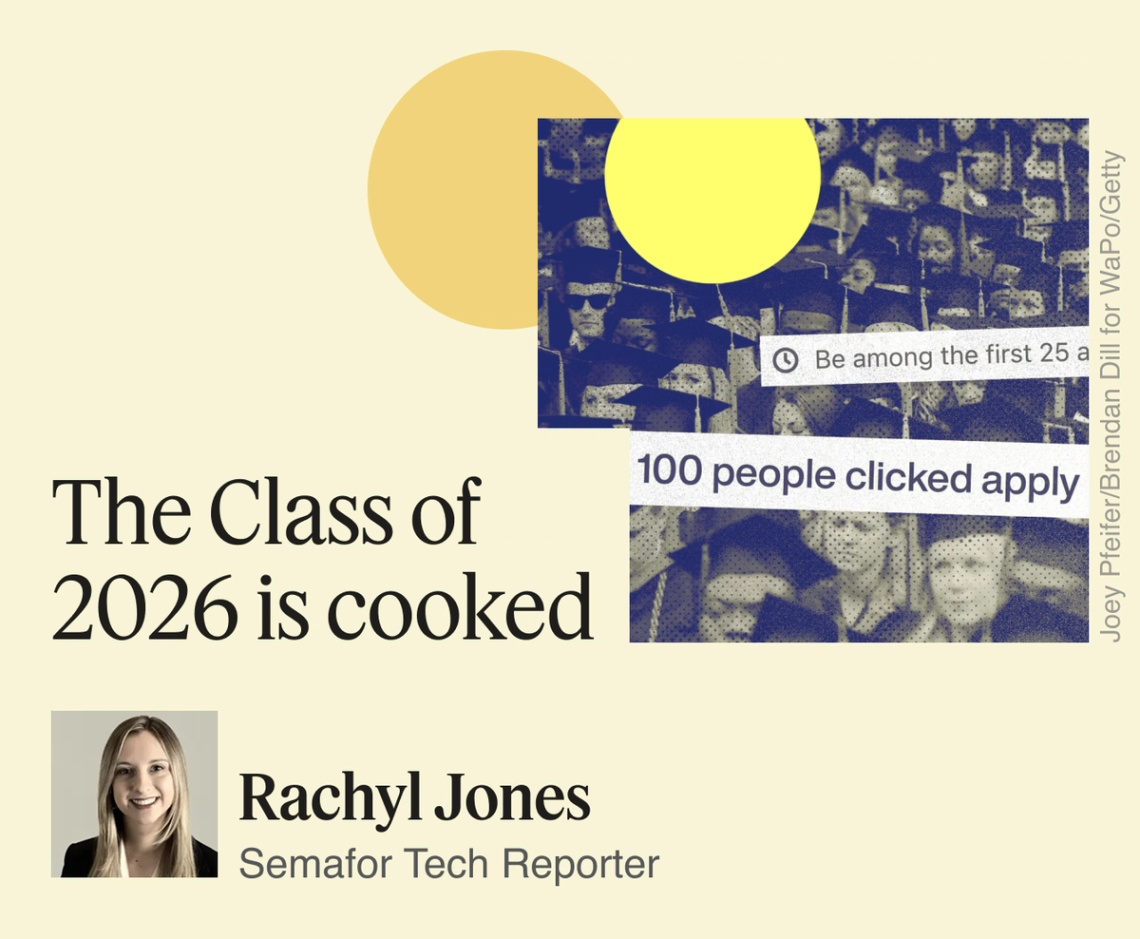 When the Class of 2026 arrived on campus four years ago, ChatGPT hadn’t been released. Computer science was among the fastest-growing majors and words like vibe coding and tokenmaxxing hadn’t even entered the lexicon. Times have changed. Kids leaving college this May face a radically different world (See what they’re saying here). AI has contorted hiring, especially at tech companies, which have slashed 100,000 jobs this year. Cloudflare axed a fifth of its staff after realizing that thousands of AI agents can handle the humans’ old tasks. Graduates looking for jobs in computer science, business, and data analytics are facing the worst of it, Laura Ullrich, Indeed’s Director of Economic Research, told me, but the market for nurses, therapists, and civil engineers is still open. Nursing might not be for everyone, but if there’s one thing job dislocation does well, it’s forcing people to be creative. It couldn’t come at a better time: Entrepreneurship, once a beacon of American progress, has been on the decline since the 1970s. Generations of young professionals were taught to go to college, get a 9-5 job, and climb the corporate ladder. The latest generation was inculcated to learn how to code, following the rote path of 1s and 0s that would land them a six-figure job at Google or Amazon, where they could scarf down free sushi and play table tennis in between work. If AI renders those jobs obsolete, or at least more difficult to come by, the upper hand goes to people who can still come up with big ideas and think abstractly. The VC money is there. We’ve already seen the number of LinkedIn users who have added “founder” to their profile triple since 2022, as vibe coding and agents lower the cost and technical barriers of creating something great. The best thing companies can do now is stop the cycle of overhiring and mass layoffs. The best thing policymakers can do is advance regulation that eases the burden of starting a new business. And the best thing new graduates can do is open up their laptops and build something. |
|
Degrees without guarantees |
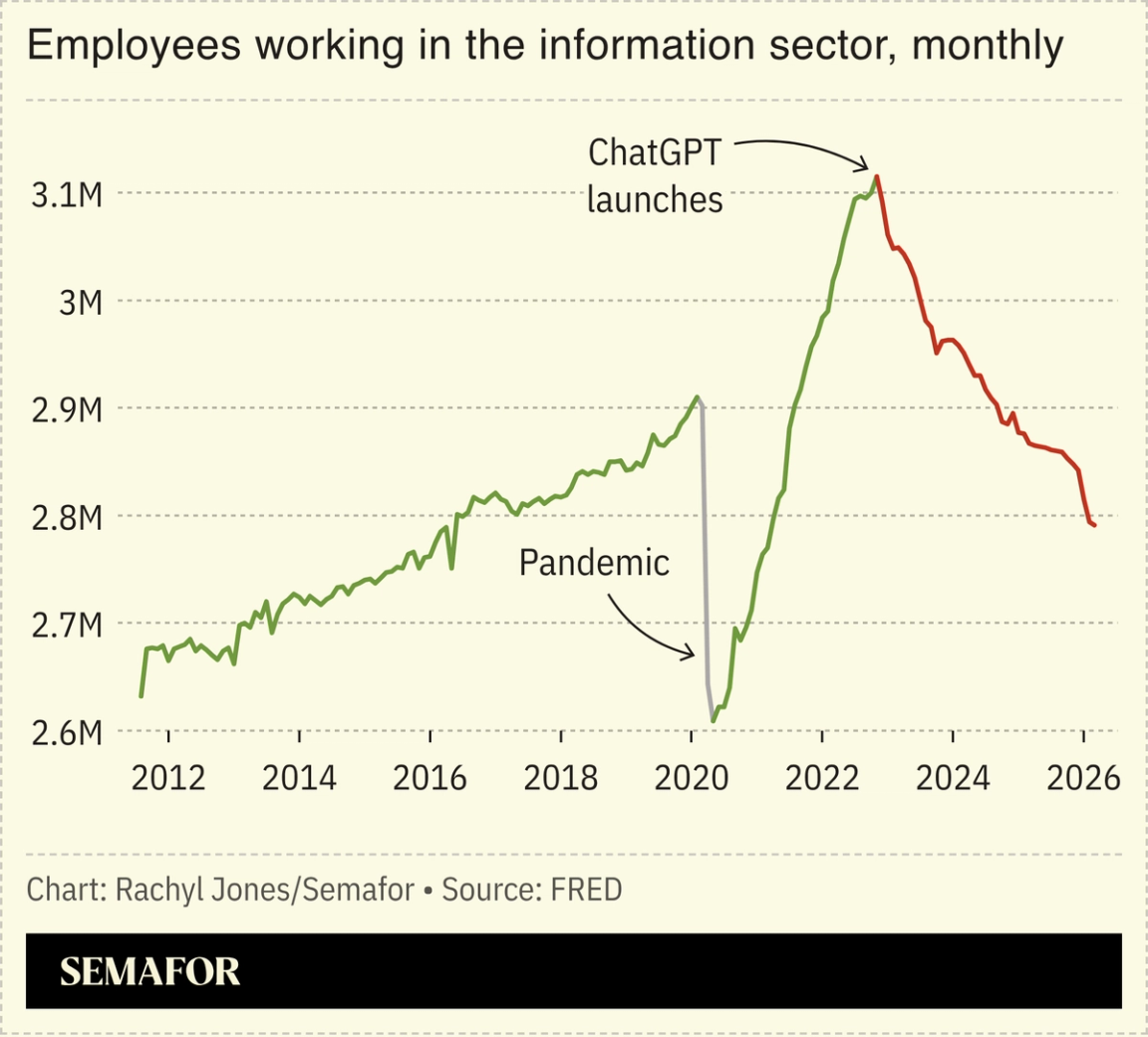 The AI future is here, but it’s unevenly distributed, my colleague Liz Hoffman wrote this week. Doomsday predictions about AI’s jobs wipeout are overly influenced by tech companies and don’t reflect the reality that most companies barely understand how to use it, Blair Effron, CEO of boutique investment bank Centerview, told Liz yesterday. But when you look at the stark drop-off of tech jobs, it’s easy to see why people are concerned — especially entry-level workers just coming out of college who grew up during a decade of growth in the business and tech labor market. Jobs in those sectors have been sliding since 2022 — when Covid-era overhiring became unsustainable, interest rates surged, and, of course, the AI boom began. Economists cite the former two causes for the sluggishness more than the latter, but many students who spoke with Semafor place their blame on the technology. In any case, jobs look different than they did four years ago. “Every other day, a new AI agent is being released in the market,” said Vaishali Hireraddi, 23, a University of California, Davis graduate student who’s applied to 500 jobs so far with little luck. “What am I doing with my life?” — Rachyl Jones |
|
China still isn’t buying Nvidia’s H200s |
 Maxim Shemetov/Pool/Reuters Maxim Shemetov/Pool/ReutersFor all the attention on Nvidia CEO Jensen Huang’s last-minute presence on Air Force One, Trump ended his Beijing trip without breaking the logjam over the company’s stalled sales to China. The US has greenlit the sale of Nvidia’s H200 chips to Chinese firms, but Beijing still isn’t buying them. “They want to try to develop their own,” Trump told reporters on Air Force One, though he added that the issue came up and “something could happen on that.” US Trade Representative Jamieson Greer told Bloomberg that the decision about buying the H200s “is going to be a sovereign decision for China.” For its part, the Chinese government is pouring money into Huawei with hopes of revving its own domestic chip industry to challenge US AI dominance. The lack of a deal on the H200s will actually play better at home for Trump, who has caught flak from lawmakers in Washington who don’t like the idea of selling American chips to the Chinese — or any US tech, for that matter. — Morgan Chalfant |
|
Everyone lost in Musk v. Altman |
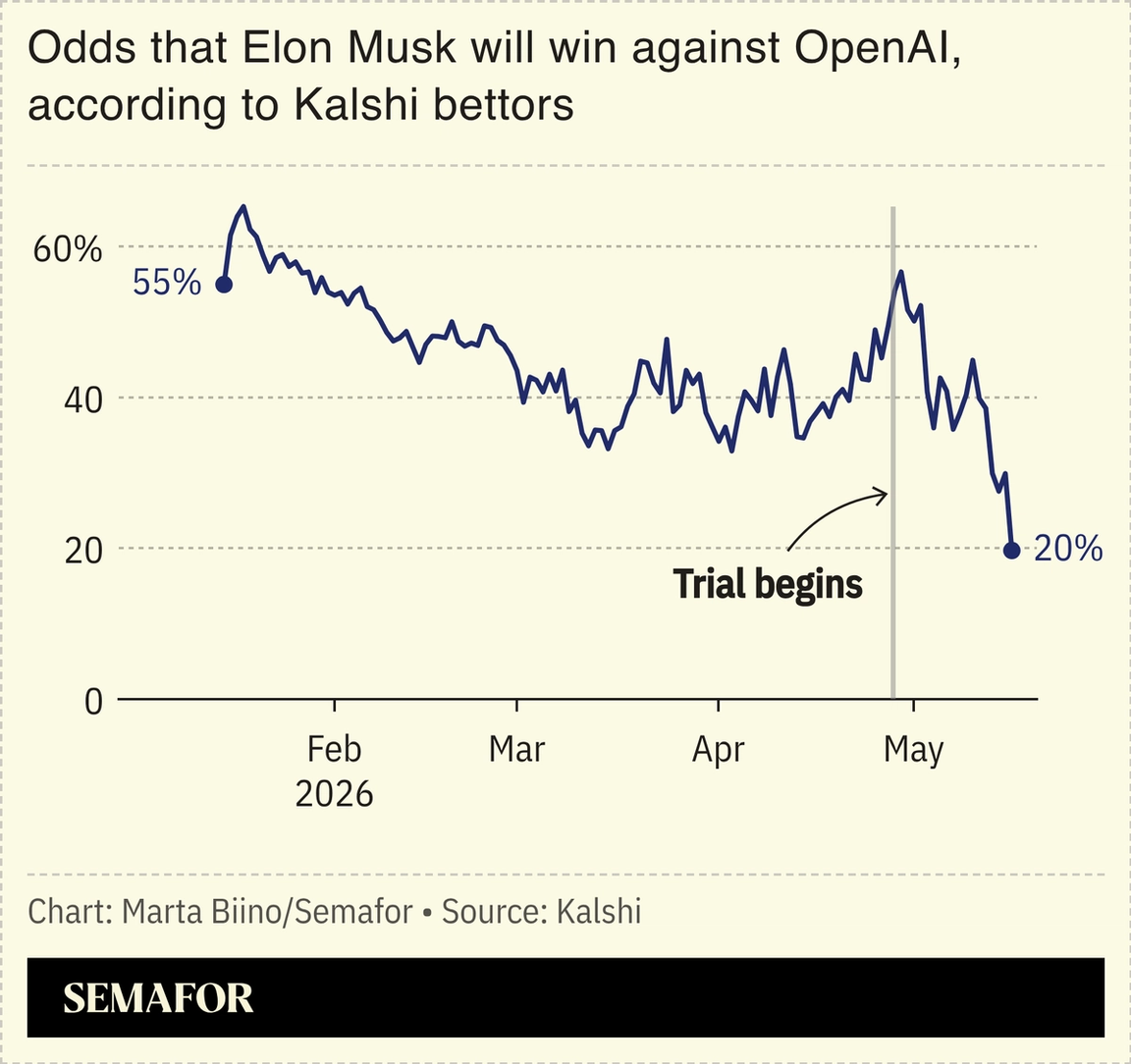 The jury in the Oakland trial between Elon Musk and Sam Altman will begin deliberating Monday, following closing arguments Thursday. According to bettors on Kalshi (which hopefully don’t include any jurors, but it’s hard to know these days), Altman and OpenAI will be the undisputed winners. Musk’s odds of winning dropped to nearly 20% Friday, from 58% at the outset of the trial. Musk alleged that OpenAI, founded as a charity, was stolen from him. But that charity now has exponentially more resources than it did when the billionaire left. And that’s only because OpenAI opted to launch a for-profit company with shares worth tens of billions of dollars. In a kind of “split the baby” scenario, Musk would like for the company and the charity to go down in flames, rather than see them both continue. Regardless of the outcome, the reality is that everybody lost. The trial unearthed embarrassing emails, texts, and diary entries of some of the most powerful people in Silicon Valley. It revealed the worst side of the leaders running some of our most important tech companies. As we said from the outset, what this case is really about is feeding the angry, anti-AI masses. |
|
  Brendan Smialowski/Reuters. Banner credit: Andrew Caballero-Reynolds/AFP via Getty Images Brendan Smialowski/Reuters. Banner credit: Andrew Caballero-Reynolds/AFP via Getty ImagesOur coverage brought together reporting and analysis on how the summit will shape energy markets, business, policy, and the broader US-China relationship. With Donald Trump and Xi Jinping having met at this week’s summit, Semafor’s newsroom broke down what was at stake — from the durability of Trump’s China deals, to Washington’s rare earths Achilles’ heel, to Beijing’s wider geopolitical calculus. |
|
Newsom’s counterintuitive tax proposal |
 Manuel Orbegozo/Reuters Manuel Orbegozo/ReutersIn Silicon Valley, the software industry is being disrupted, as people with zero experience now vibe code from the comfort of their own homes. California Gov. Gavin Newsom doesn’t appear to be partaking in this revolution. He’s still “at Best Buy often,” he said at a press conference Thursday about a new digital software tax. “I’m paying sales tax on a lot of this prewritten software. And then I find out that all my friends that aren’t near a Best Buy, they’re downloading and they are not paying sales tax. How is that fair?” Yes, this is a big problem. All those lucky software downloaders who don’t have Best Buys nearby, tempting them to hop in their cars and burn $7/gallon in gas so they can get their software on a CD-ROM. Why can’t politicians just say what they actually think? To me, it seems that California’s government has become so inefficient that its main function these days is incinerating cash, and there’s nobody who can pay for it except tech companies and the billionaires who found them. I’m told by someone at a frontier AI lab that the proposed 7.25% sales tax on software sold over this newfangled thing called “the internet” does not apply to AI tokens. But it could add some difficulty to the tech companies that sell software out of the state. The good news is that AI tokens might just replace a lot of the software Newsom wants to start taxing. Now we just have to get Best Buy to sell AI tokens at its retail stores. — Reed Albergotti |
|
Codex untethers AI from the laptop |
 Courtesy of OpenAI Courtesy of OpenAIOnce you start using AI harnesses like OpenAI’s Codex, it’s hard to leave your computer: You’ve got perhaps a dozen different projects running simultaneously and you need to check in with your agents building your software and apps, steering them as they work toward an objective. The problem is these programs work on desktop computers, which leads to AI coders “carrying half-open laptops through airports, offices, and ice rinks,” Business Insider details in an entertaining jaunt into this very real symptom of this AI era. “I think people think I’m whatever the equivalent of an iPad kid is for a middle-aged woman,” one AI user said. A new Codex feature launched this week may solve this problem. Users can now send messages to Codex via the ChatGPT app. It’s a feature I’ve asked OpenAI about and figured was coming, eventually. Just like I expect we’ll all be connected around the clock to teams of AI agents the way we’re reachable via mobile phones today. But until then, it’s also a good reminder of how early we are into the product road maps of all of these technologies. — Reed Albergotti |
|
 He was first labeled a teenage chef prodigy. Fast forward to today, Flynn McGarry is trying to answer the question: what actually gets people to show up to a restaurant? On this week’s episode of Mixed Signals, Max and Ben ask the Chef and Cove owner how early media attention shaped his identity and what he’s learned about the social media content that actually drives traffic to his restaurants. Plus, how he missed years of TV development deals — including one with White Lotus creator Mike White. |
|
|


