
|
 |
Donald Trump vs. America’s Moms
He says America should be the best country for having and raising kids—but he’s cutting the safety net that protects millions of mothers.
|

| ||||||||||||


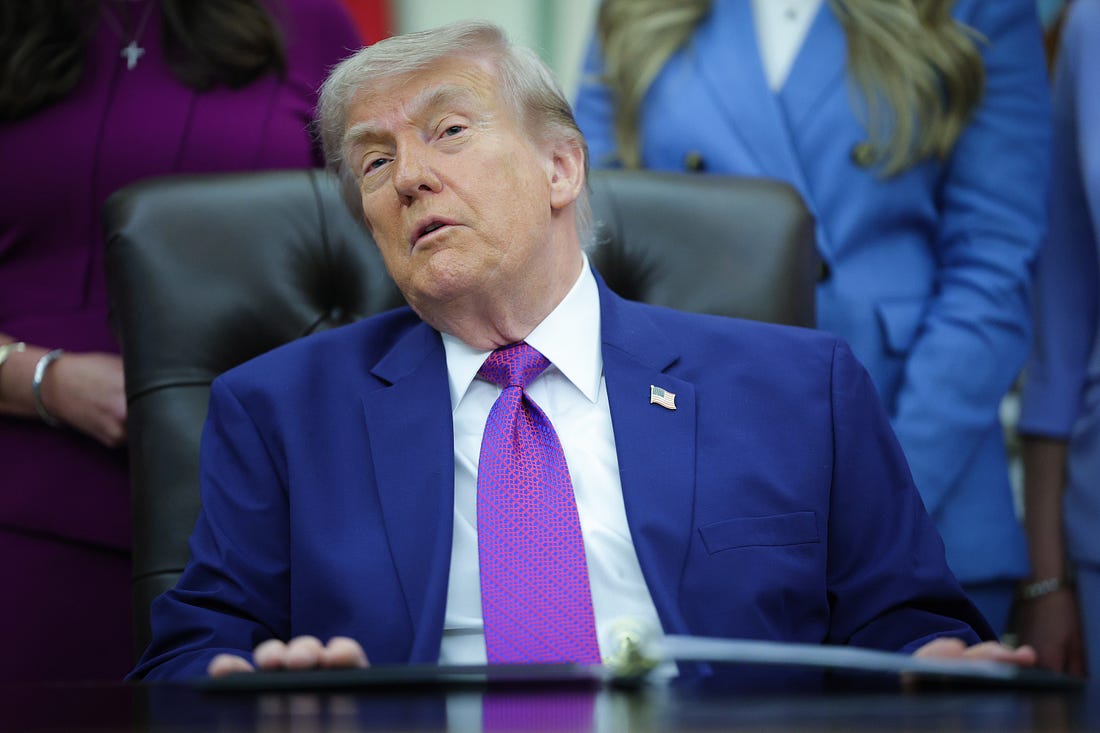 |
DONALD TRUMP ON MONDAY hosted a forty-minute Oval Office event focusing on maternal health, and mostly it got attention because he seemed to nod off in the middle of it.
But the president and his invited guests also got some news coverage for the intended message, which was about a series of initiatives like reducing the cost of some fertility drugs, and launching an informational website called Moms.gov. These are supposed to demonstrate, as one attendee put it, that “President Trump wants to make America the best place to have a baby.”
That’s a laudable goal, though it would require an awful lot of policy work.
Both the maternal and infant mortality rates in the United States are the highest among economically advanced countries, according to analyses by the Commonwealth Fund. And when UNICEF last year rated several dozen nations for child well-being, the scores for the United States were terrible, way behind the world leaders: the Netherlands, Denmark, and France.
Those facts may come as a shock to anyone used to hearing about those other countries as socialist hellholes. But spend time in the countries of Northern and Western Europe and you’ll see all the ways people living there benefit from universal health care, cash support for newborns, guaranteed paid leave for new parents, and heavily subsidized childcare.
Several U.S. presidents have tried to replicate versions of those supports here, piece by piece. And some have made real headway.
Today, millions of young children and their mothers have health insurance because of Barack Obama and the Affordable Care Act. Child poverty fell dramatically—if, alas, temporarily—thanks to Joe Biden and the income support measures that he signed into law as part of his pandemic-relief efforts. Lyndon Johnson’s Great Society is the reason so many millions of low-income families can enroll in Medicaid and Head Start. Richard Nixon got behind a substantial increase in food assistance for young families.
Trump is well on his way to creating his own legacy when it comes to maternal and child well-being. But it’s not the kind his predecessors left. Whatever the modest contributions of the initiatives he was touting in the Oval Office last week—and “modest” is a generous description—they aren’t the real story about what the president has done for young families with children.
No, the real story is about what Trump has done to young families with children, by downsizing or undermining some of the most important programs on which many of them rely. And because it’s a big, sprawling tale that involves several programs—not to mention wonky policy details—it may be easiest to follow the way it would affect a typical family as it grows.
So you’re having a baby. . .
If you care about improving maternal and child health, the place to start is with prenatal care.
Research makes a strong case that women who get proper care in pregnancy are less likely to develop gestational diabetes, high blood pressure, and other health problems. They are also less likely to give birth to low-birthweight babies, which is a big risk factor for all kinds of poor child health outcomes—up to and including death in infancy.
Exactly how big an impact prenatal care has is the subject of ongoing debate, because the subject is tough to study. The same goes for how much health outcomes for pregnant women and newborns truly depend on insurance status per se. But there’s plenty of evidence that people with insurance are better off in other ways, including financially. People who have coverage are less likely to fall behind on rent, or to run up debt.
For most of the last decade, the United States has been making steady progress at getting people insurance thanks to the Affordable Care Act’s creation (under Obama) and then its expansion (under Biden). The one interruption was during Trump’s first term, when progress stalled for a few years. But that was just a preview of what’s happening now, thanks primarily to the $1 trillion taken out of Medicaid over the next decade as part of Trump’s “One Big, Beautiful Bill.”
Trump and the Republicans have defended their cuts by saying (among other things) that they are merely targeting waste—and that the whole point is to preserve the program for people like pregnant women who really need it. They have also noted that pregnant women are, by definition, not subject to the law’s controversial work requirements.
But there’s good reason to think that the cuts will end up affecting pregnant women anyway, partly because the financial pressure the cuts place on states will force them to scale back outreach or special services that target the most at-risk parents. That’s in addition to the fact that, historically, work requirements have reduced enrollment by ensnaring people in paperwork, so that even people who qualify for exemptions end up without insurance anyway.
“With the punishing amount of administrative burden that’s on state Medicaid agencies, it could take three, four months to sort that out,” Sarah Gordon, co-director of the Boston University Medicaid Policy Lab, told the New York Times after the cuts became law last year. And three or four months out of a nine-month pregnancy can make a big difference.¹
< |