|
|
|
Newsletter continues after sponsor message
|
|
|
Brent Stirton/Getty Images |
|
Police officers sue over “weaponization” fund: Two police officers who defended the U.S. Capitol on Jan. 6 have filed a lawsuit in federal court against the Trump administration, arguing that the almost $1.8 billion "Anti-Weaponization Fund" is both illegal and dangerous. The lawsuit comes as former Jan. 6 defendants are already preparing their applications to the fund and anticipating major payouts.
Democrats wanted answers for what went wrong in 2024: Now, there are more questions. NPR political reporter Stephen Fowler breaks down the DNC’s unfinished zombie autopsy.
The “DACA kids” aren’t kids anymore: The Obama administration created the Deferred Action for Childhood Arrivals, or DACA, program in 2012 to create protections for immigrants, who were brought to the U.S. illegally as children. Now, the average DACA recipient is 31 years old. Many of them have advanced degrees, businesses and children, who are U.S. citizens. And, as immigration correspondent Ximena Bustillo reports, they’re facing increasing uncertainty and legal limbo in Trump’s second term.
North Carolina swing voters are frustrated with Trump’s economy: But that doesn’t mean they’re ready to back Democrats. Political correspondent Ashley Lopez brings us takeaways from two online focus groups.
What does abortion messaging look like in the age of affordability? After the Supreme Court overturned Roe v. Wade, Democrats made abortion rights a central part of their campaign platform: Democratic congressional candidates in 2022 and 2024 spent more on campaign ads mentioning abortion than on any other issue, according to data from the ad-tracking firm and NPR partner AdImpact. But this year, candidates have spent almost four times less on campaign ads about abortion compared to the same period in 2024. As NPR’s Elena Moore reports, it underscores a broader shift in attention within the party ahead of the midterm elections this fall, as voters consistently rank cost-of-living concerns as their top issue, raising questions about what an evolving Democratic message on reproductive rights looks like in 2026.
Collins highlights “bringing home the bacon”: Maine Democratic Senate hopeful Graham Platner is calling for a political revolution to upend a system he says is working against working-class Americans. Republican incumbent Sen. Susan Collins, meanwhile, is using old-school pork barrel politics to try and win over voters who may be ambivalent about reelecting her. Maine Public’s Steve Mistler reports on whether her clout in the chamber and ability to secure federal dollars will be enough to win a sixth term. |
|
Going Deeper: Two Swing Voters Divided On Trump's Second Term |
Illustrations by Tara Anand |
|
Gerald and Wally are Black men who live in the suburbs of Atlanta. Both grew up voting for Democrats and voted for Joe Biden in 2020. Then in 2024, they switched to voting for Trump.
That’s where the similarities end: Gerald couldn’t be happier with Trump’s performance in his second term. Wally gives the president an F.
The two are among a dozen swing voters in swing states who have agreed to regularly speak with NPR over the next three years as part of a project we are calling, “Swing Shift.” Senior political correspondent Tamara Keith spoke to them at their homes for the first installment.
|
|
The Shot: Colbert’s Final Bow |
Scott Kowalchyk/CBS Entertainment |
|
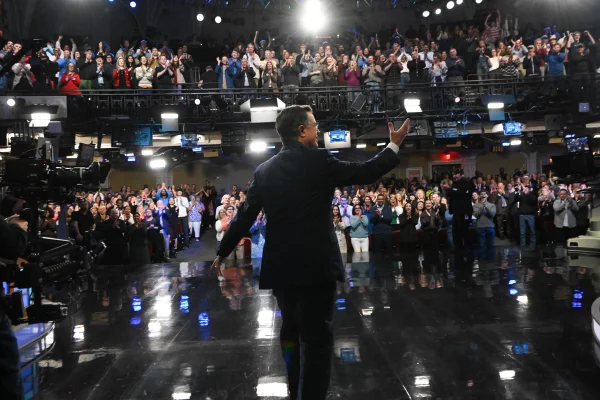
Stephen Colbert hosted his last episode of The Late Show Thursday night, ending his nearly 11-year run on a whimsical and joyful note. During the finale, Colbert invited his audience, his crew and famous friends to dance with him onstage as he sang, “Hello, Goodbye” with former Beatle Paul McCartney.
In the end, Colbert and McCartney together switched off the lights at New York's Ed Sullivan Theater, where the Beatles made their American debut in 1964 and where The Late Show franchise was taped in front of audiences for close to 33 years.
CBS canceled Colbert’s top-rated, late-night show last July, saying it was "purely a financial decision against a challenging backdrop in late night." But his fans and friends believe it was retribution for his continuous criticism of President Trump and his administration.
The network gave Colbert months to wind down his show, and he never stopped roasting Trump during his monologues…. except for his last one, where he didn't mention politics.
Read more from NPR’s Mandalit del Barco. |
|
|
Listen to your local NPR station. |
|
Visit NPR.org to find your local station stream. |
|
|
| |
|
|
|
|
|
|
|
|
You received this message because you're subscribed to Politics emails. This email was sent by National Public Radio, Inc., 1111 North Capitol Street NE, Washington, DC 20002
Unsubscribe | Privacy Policy |
 |
|
|
|
|
|
|
|