Hi! NASA wears Prada: The Italian fashion house is working with Axiom Space on a high-tech cooling garment that the administration’s astronauts will wear underneath their spacesuits on Artemis IV mission moonwalks. Today we’re exploring:
|
- Still charging: EVs make up over half of China’s new car sales, but BYD sees room for more.
- Heir-drop: Could the iPhone be to blame for America’s plunging birth rate?
- News flash: The BBC became the world’s top news website last month.
|
BYD says EVs may soon take 80% of China’s new car market |
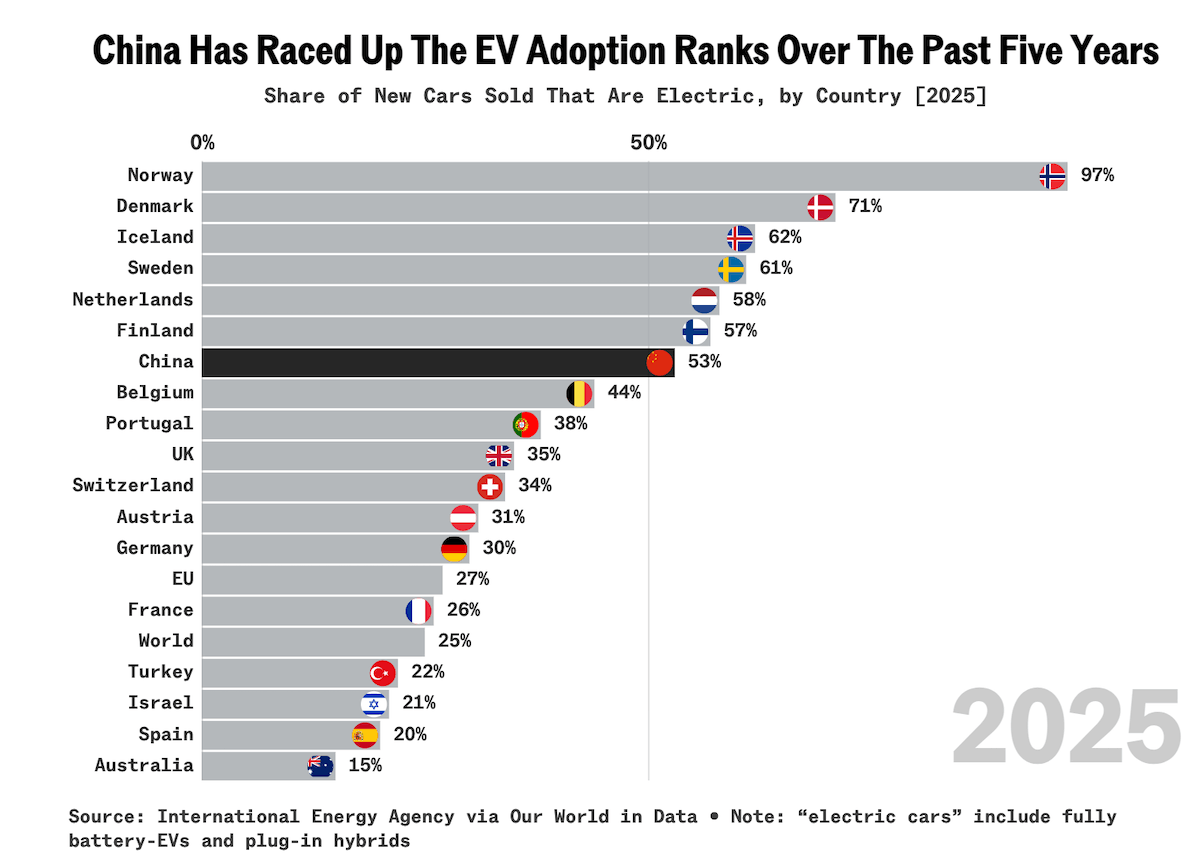
China’s largest EV maker thinks the country’s shift to electric still has room to run, even though EVs have already roared in recent years to account for more than half of the country’s new car sales in 2025.
On Monday, BYD Executive VP Stella Li told CNBC that China’s market could “very quickly” push close to 80% EV penetration, helped by new technology in the space and a growing wave of electric options. That would be another significant leap for a nation that the International Energy Agency says has already grown at an “extremely rapid” pace in the last five years.
|
In 2020, China barely registered among the world’s EV leaders by sales share, with electric cars taking just 6% of new car sales that year, according to IEA data. Five years later, that share has surged to 53%, putting China behind only a handful of early adopters, where years of tax breaks and purchase incentives have helped push adoption higher.
|
China hasn’t just been climbing the adoption ranks either — it’s also supercharged the global market, accounting for six out of every 10 EVs sold worldwide last year and more than half of the global increase in EV sales. That’s even more striking given that domestic growth slowed slightly at one point last year, after a trade-in subsidy (paying consumers to swap old cars for new EVs) was temporarily halted.
The nation’s been sending more of its electric vehicles abroad, too, with China’s EV exports in Q1 surging 78% from the same quarter last year, per official data cited by CNN. At the same time, BYD’s new-car registrations in Europe jumped 115% in April from a year earlier, outpacing Tesla’s 47% growth.
|
Could the iPhone be to blame for America’s plunging birth rate? |
There have been several theories proposed as to why birth rates are falling so rapidly around the world, from the cost of living, to female education, to anxieties about the future. But, per a recent study, there might be an even simpler explanation: it’s because you’re always on that damn phone.
This week, at the same time that Apple announced plans to bring new life to its smartphone models with, you guessed it, AI, a working paper has been published that links the launch of the tech giant’s most valuable product to lower fertility rates in the US.
|
In the study, researchers presented data from the introduction of the iPhone back in 2007, when it was made exclusively available on AT&T’s network, until 2011. By comparing birth-rate changes between those years in US counties with AT&T broadband access versus those with little or no coverage, the paper postulates that the iPhone’s diffusion may have caused as much as half of the fertility decline in covered areas in that time frame.
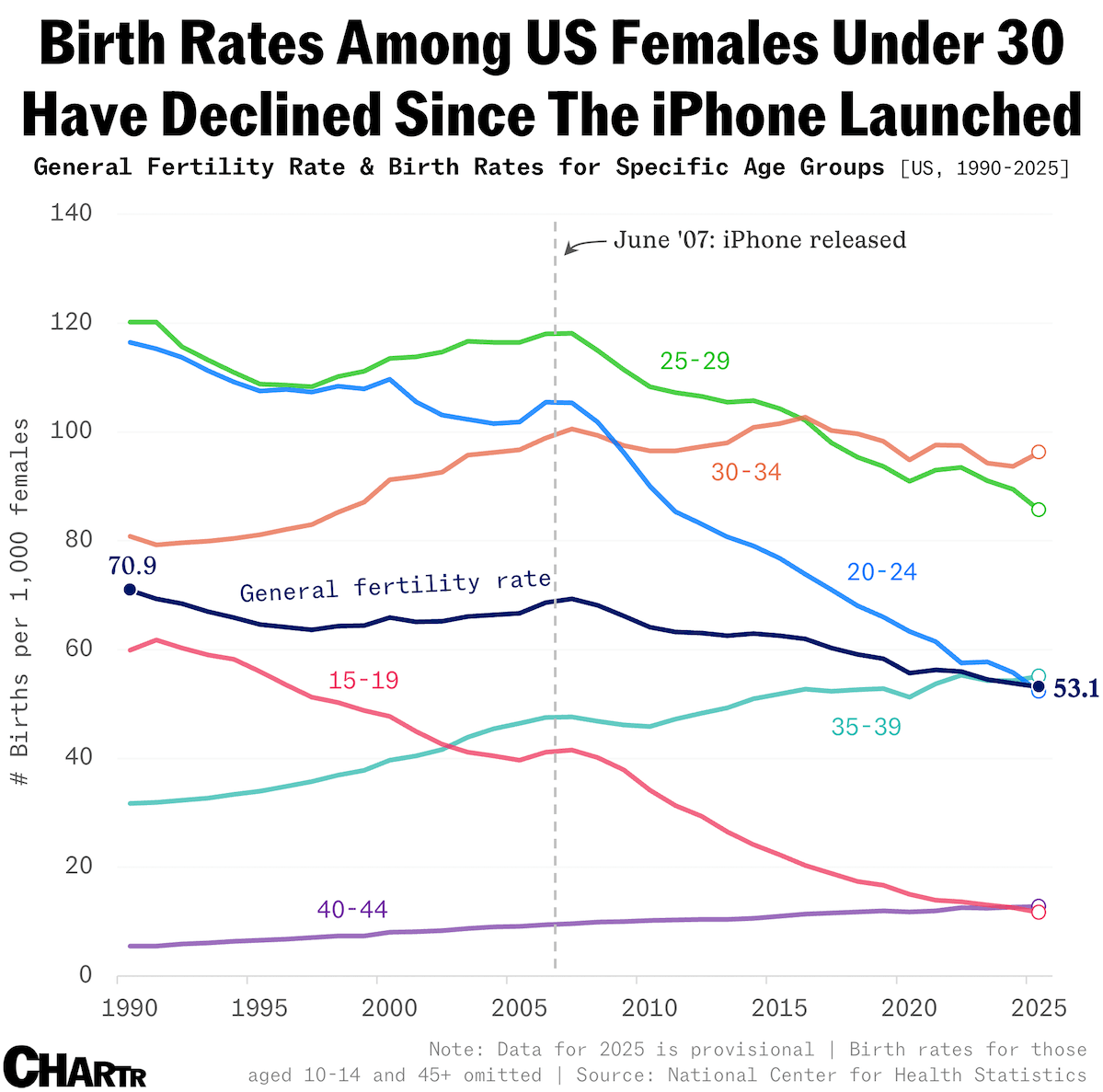
The declines were especially pronounced across younger age groups, with implied reductions in births of up to 8% for the cohort aged 15-19 and 6.6% for ages 20-29. Zooming out a little, evidence for the iPhone’s impact also broadly tracks with historical US birth data from the National Center for Health Statistics across age groups. |
Overall, the US general fertility rate has fallen some 23% since 2007 to just 53.1 births per 1,000 females aged 15-44 in 2025, per provisional figures in the latest NCHS release. In parallel, birth rates have declined significantly since the first iPhone rollout for American females aged 15-19 (-72%), 20-24 (-50%), and 25-29 (-28%). Birth rates among those aged 30 to 34, meanwhile, stayed relatively level, and rates for cohorts aged 35+ have all ticked up.
|
|
|
|
As US large cap equity markets have evolved over the past 15 years, the Nasdaq-100 Index® (NDX®) now stands as the premier benchmark for the 21st-century economy. |
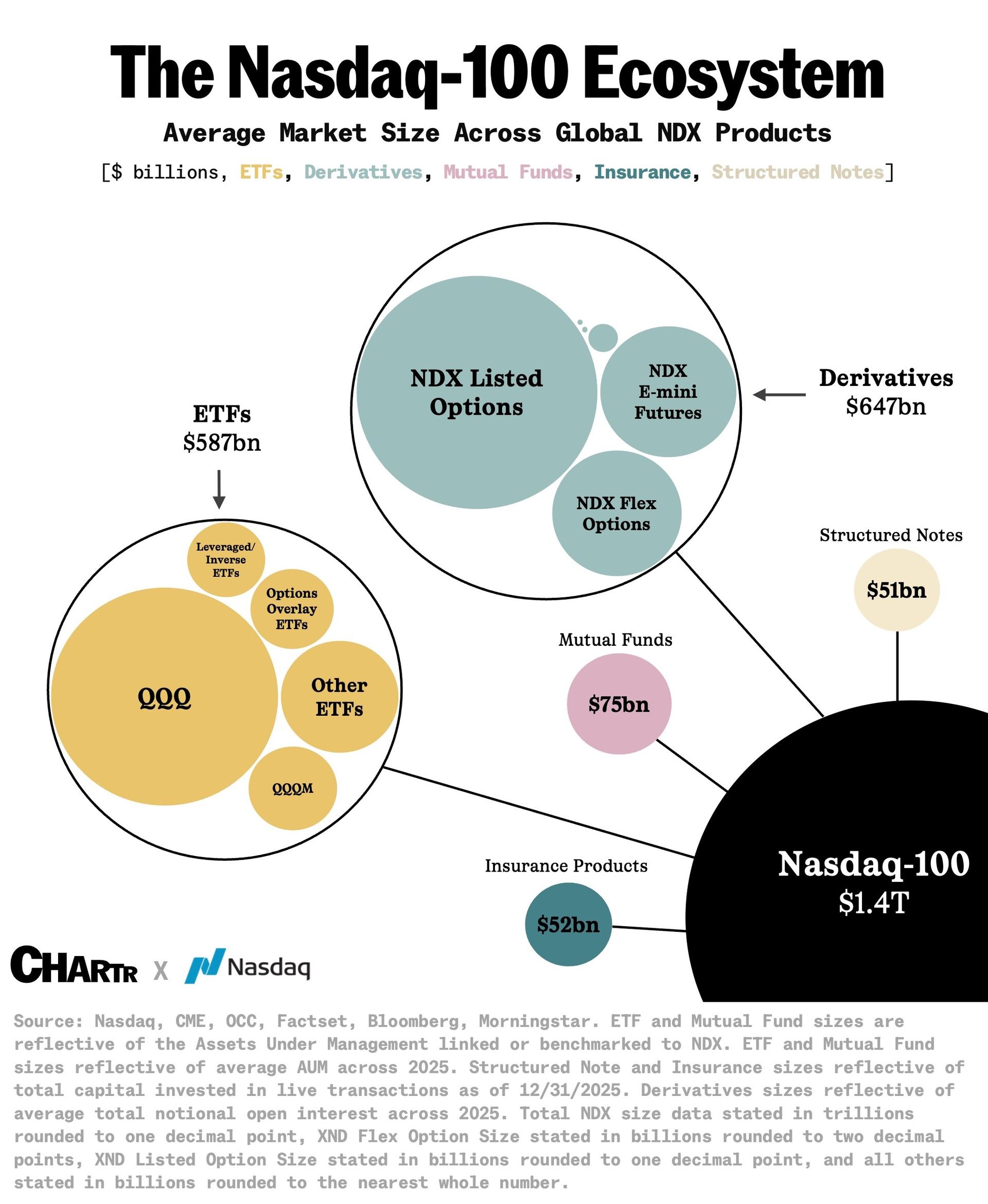
Today, the Nasdaq-100 global ecosystem represents over $1.4 trillion in exposure to the world’s largest, most liquid, and most innovative companies.
With a vast range of investment vehicles, including ETFs, options, futures, and more, the Nasdaq-100 Index® provides retail investors with scalable solutions, offering different products and strategies for every type of investor. |
|
|
|
The BBC has become the world’s top news website... by collapsing a little less than its competitors |
Press Gazette just published its annual look at the biggest news sites in the world across all languages; for the most part, it doesn’t make for particularly pretty reading.
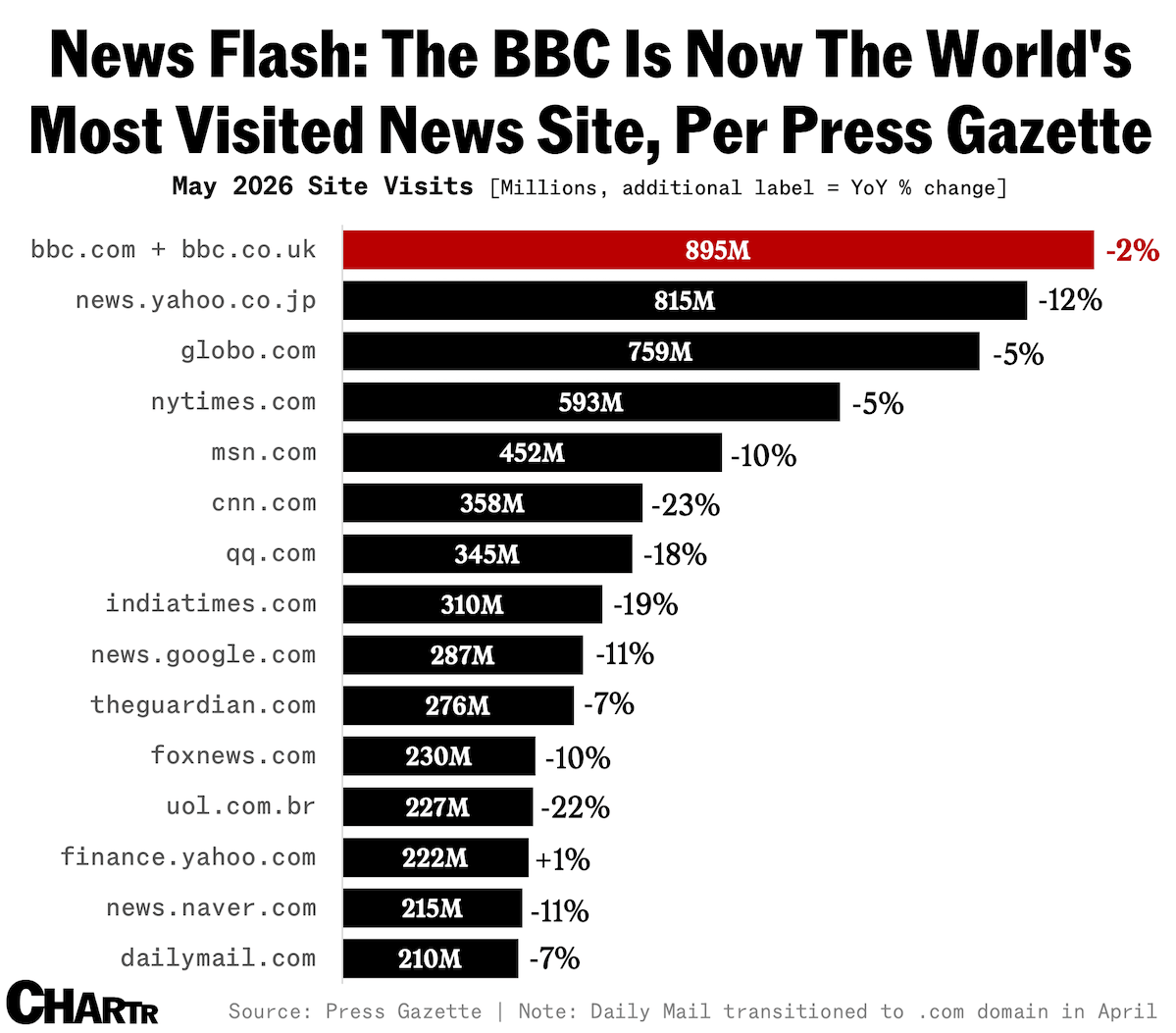
The journalism industry publication’s latest update, which is based on estimates provided by Similarweb for May, found that 37 of the world’s 50 most visited news sites saw their reach shrink. Press Gazette highlighted that American outlets have been hit particularly hard by declining Google traffic compared to European counterparts, owing to the platform’s AI features rolling out earlier in the US.
Even the BBC, having climbed the rankings from last year to top the 2026 chart — reportedly in part thanks to Similarweb’s decision to combine the “.co.uk” and “.com” versions of the URL, given that the sites redirect to each other depending on the user’s location — still showed a 1.9% decline from last year. |
It’s now become quite plain that, in the world of online news publishing, you don’t really even have to gain new web visitors to shimmy your way up the standings: it’s now simply enough to shed slightly fewer readers than everyone else. The New York Times saw a 5% decline and Fox dropped 10%, but neither came close to CNN, which saw visits plummet 23% year on year.
One bright patch on the landscape? Substack.com, which broke into Press Gazette’s top 50 for the first time after rising 49.1% to clock nearly 165 million site visits this May, having already leapfrogged some of the industry’s more established names a while back. |
|
|
|
-
Google is reportedly backstopping lease payments at five Anthropic data centers, helping the Claude maker secure $35 billion worth of AI chip financing.
-
Deeper learning: In 2021, just five US colleges offered AI majors; now there are at least 74 majors on the subject, per Northeastern University’s Center for Inclusive Computing.
-
Amazon just opened its less-than-truckload shipping service to outside businesses, putting legacy freight carriers up against the retail giant’s 80,000 trailers and 24,000 containers.
-
Tesla now has authorization for 69 unsupervised Robotaxis in Texas — that’s up from 42 last month, but still far below the ~500 vehicles Elon Musk had promised.
- 1B-Up: After the weekend’s ticket sales, “The Super Mario Galaxy Movie” became the first film to gross over $1 billion at the box office in 2026.
|
|
|
|
Access the cornerstone of the 21st-century economy: The Nasdaq-100 Index® (NDX®) has evolved into a $1.4 trillion global ecosystem featuring the world’s largest, most liquid, and most innovative companies. |
|
|
|
-
Reuters takes a layer-by-layer look beneath the 2026 World Cup’s football pitches.
- Love lockdown: An interactive analysis from The Pudding on how the pandemic tested relationships.
|
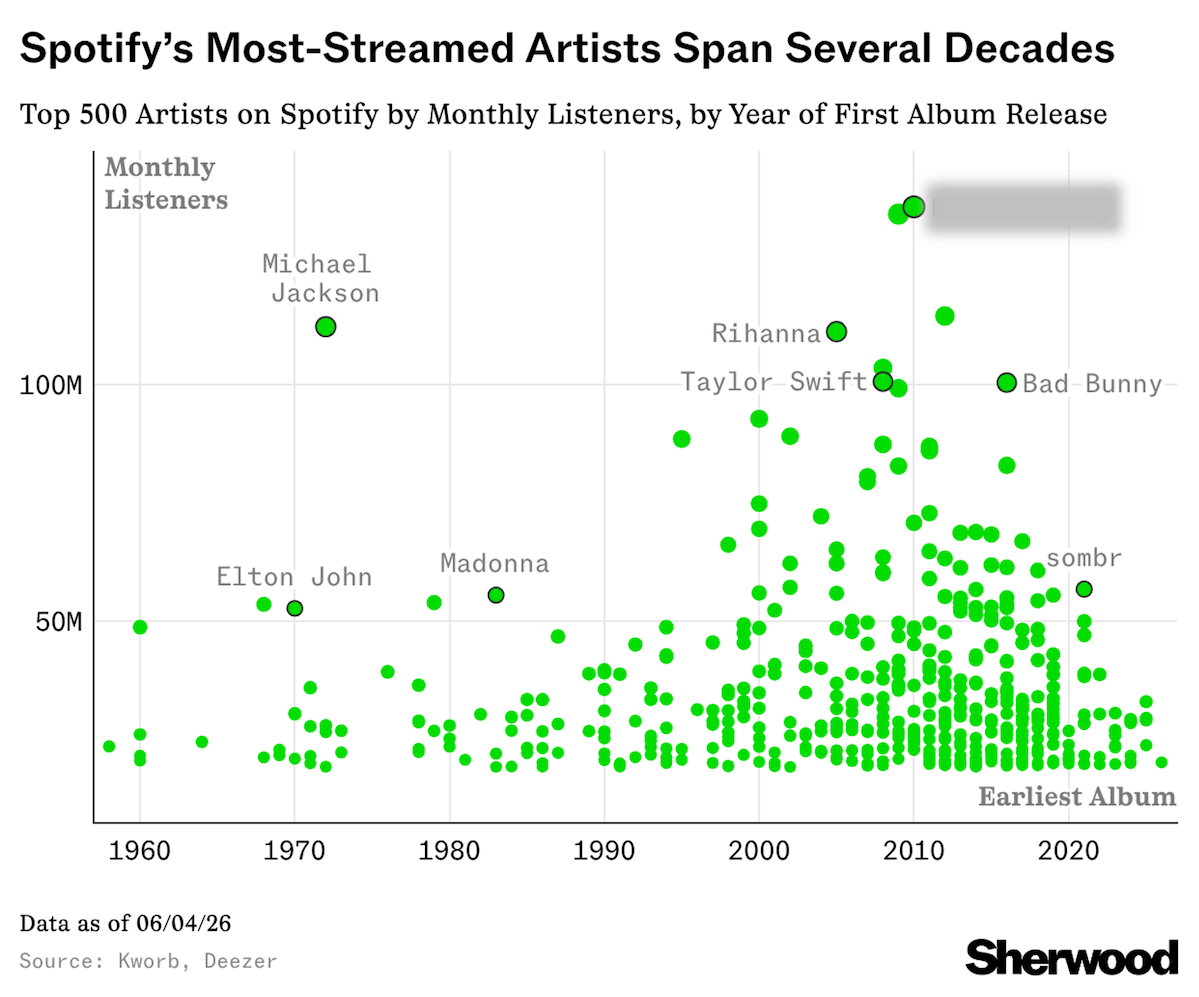
Off the charts: Who is the most-streamed artist on Spotify by monthly listeners? Hint: The male singer is still locked out of the top 10 artists by all-time streams. [Answer below]. |
Not a subscriber? Sign up for free below. |
|
|
|
|