Hi! No cap: The people of Switzerland voted against a proposed 10-million-person upper limit on the nation’s population, notching a 55% majority in yesterday’s referendum. Today we’re exploring:
|
- Accrual intentions: Cash used to be king for stocks — now spending cash is.
- GO already: Lionsgate still wants to make a Monopoly movie.
- Taking accounts: The UK announces a social media ban for under-16s.
|
It’s still the “you gotta spend money to make money” stock market |
A major theme of this year is that American companies are once again becoming major sellers of stocks.
For years, companies did the exact opposite: buying back trillions of dollars’ worth of shares, a practice that juiced earnings and was seen as a safe option for management teams that had run out of other ideas. Just look at Google, which is wiping out more than two years’ worth of buybacks with an $85 billion offering, while Meta reportedly mulls an equity raise of its own.
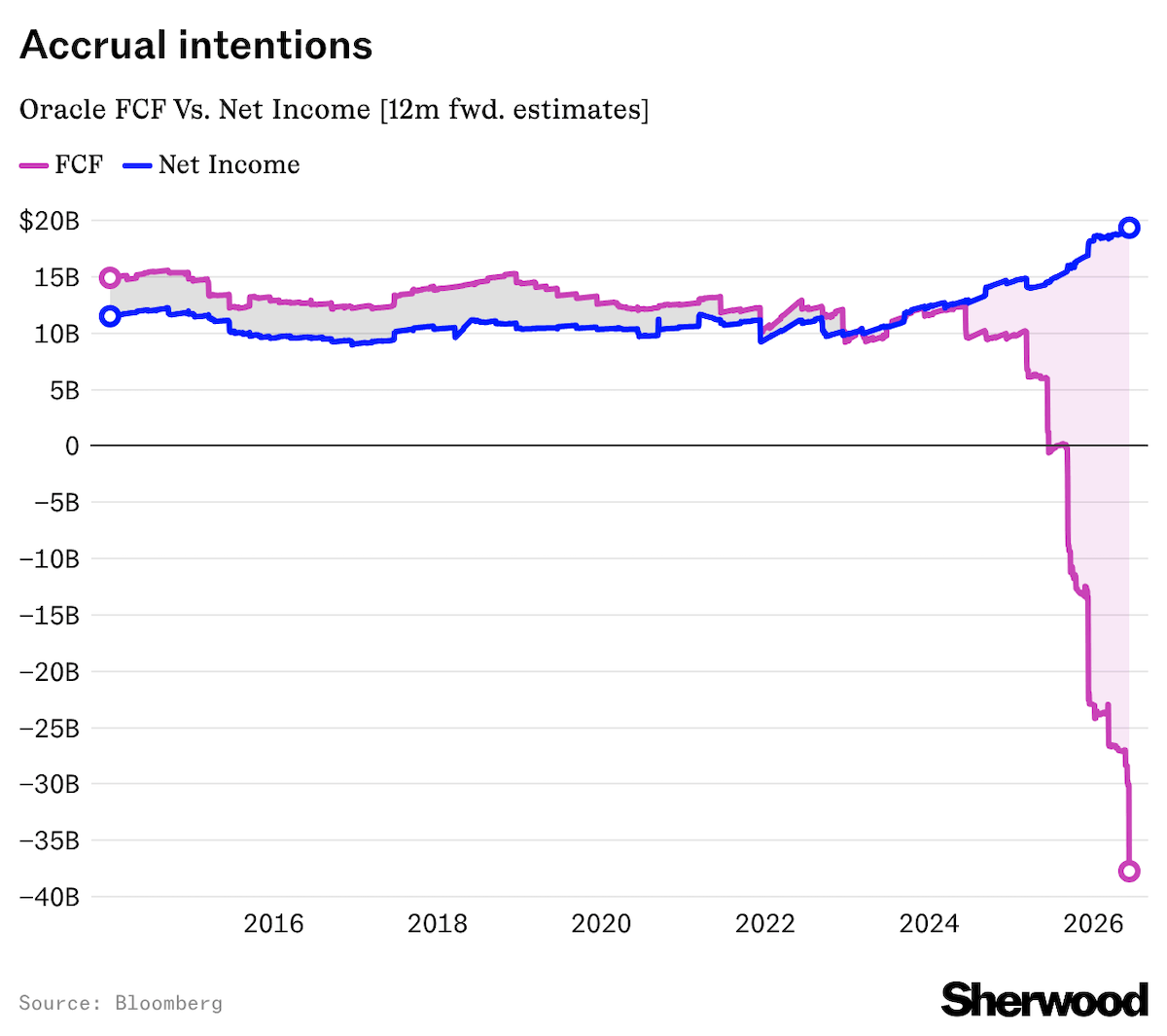
Now, the mantra is that investing in AI — particularly as suppliers to the arms race — is a source of future returns that’s also key to sustaining growth. In short, capex is king, and buybacks are admitting that you don’t have enough investment opportunities allowing you to benefit from the AI boom. Indeed, a Goldman Sachs basket of companies with elevated capex relative to peers is besting stocks with the strongest buyback yields by some 30% — the most ever. This spending is leading to some insane divergences in profit measures, like net income and free cash flow (which takes capex into account), for companies like Oracle. |
Of course, the rest of the AI complex doesn’t care whether the cash spent on the next data center was raised via debt or equity: more funding for the AI build-out is more funding for the AI build-out. If we took capex to a bazillion dollars, that spending would still be accretive for aggregate earnings in the first year (assuming all the recipients of the capex binge were public stocks). Yes, eventually the depreciation on those assets starts to be felt and we’d normalize lower, but in the short term, it’s a boon to the stock market’s bottom line.
This is why Oracle’s chart is just a more extreme version of the wider market: free cash flow used to be about 90% of aggregate net income, and now it’s hovering around 75%, per estimates compiled by Bloomberg. |
Packed with market data (like the story above about free cash flow), macro themes mapped to micro ideas, technical signals, screens, and charts, EntryPoint has insights about what Robinhood* traders are actually doing, unavailable anywhere else. Subscribe to EntryPoint. |
*Robinhood Markets, Inc. is the parent company of Sherwood Media, an independently operated media company subject to certain legal and regulatory restrictions. |
Lionsgate persists with decade-long effort to make a Monopoly movie |
Lionsgate — no doubt buoyed by the success of “Michael,” the biggest film in the studio’s history and now the highest-grossing music biopic of all time — is pressing on with its mission to get a Monopoly movie off the ground, reportedly enlisting two different writing teams to work on separate versions of the film.
|
GO directly to movie jail
|
The latest move to bring on two writing partnerships, one of which penned “Dumb Money,” while the other wrote “A Minecraft Movie,” shows that Lionsgate thinks that the idea of a Monopoly movie still has legs, even over 10 years after the studio first started the project with the screenwriter behind “The Truman Show” in 2015.
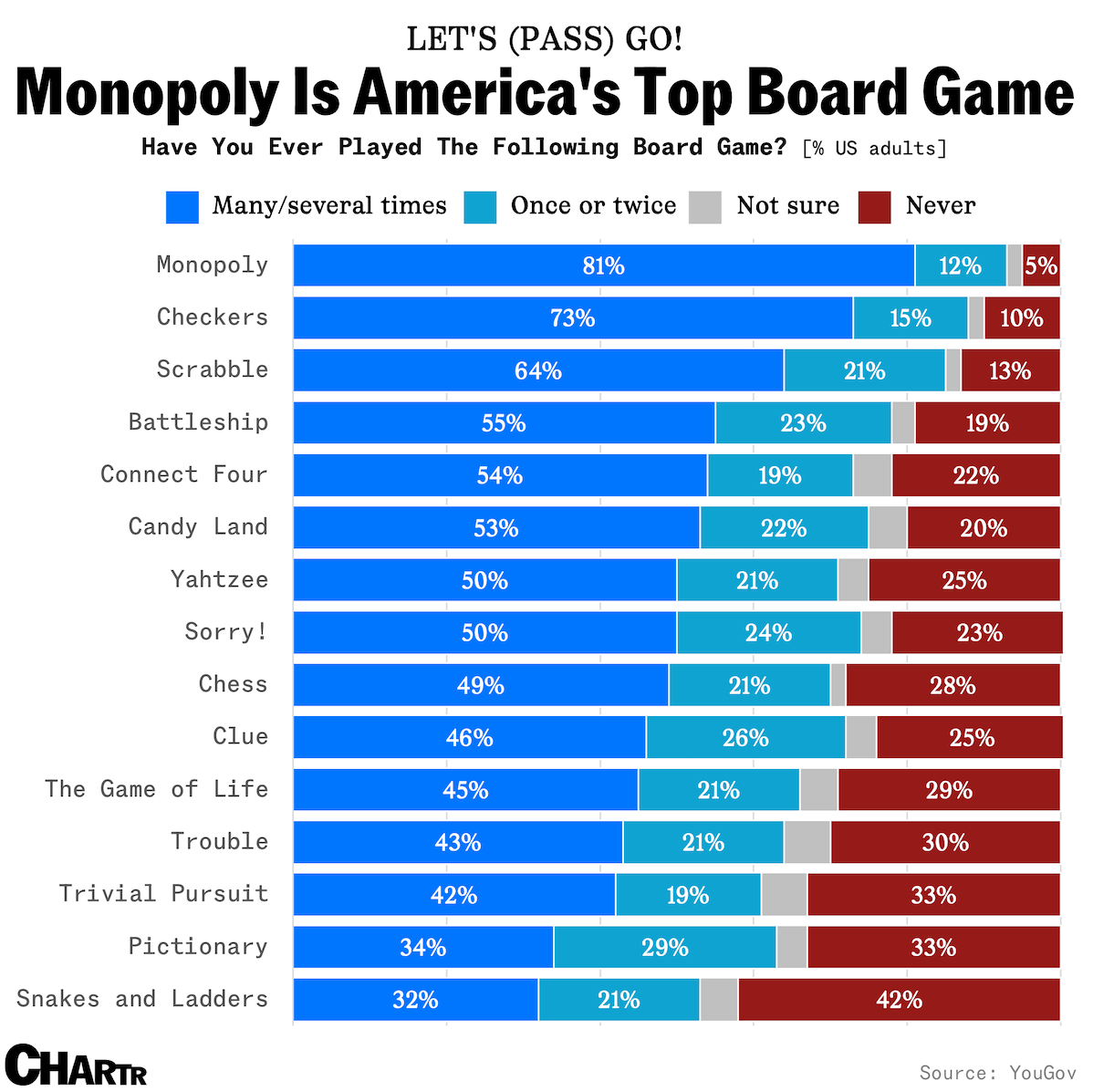
On paper, a movie based on America's most played board game, despite being a century on from its initial inception, could be a 2026 cinematic slam dunk — likely kid-friendly and based on beloved IP. |
Indeed, a YouGov survey published last week revealed America to be a nation of dealmakers, with just 5% of US adults reporting that they’ve never played Monopoly, compared to the 81% who’ve played it “many” or “several” times.
Still, Lionsgate might be right to take their time around translating the board game to the big screen, at least if the 2012 movie “Battleship,” based loosely on the fourth top game in the YouGov ranking, is anything to go by. Universal Pictures sunk an estimated $300 million into the feature all told, only for the film to fetch just $25 million on its very disappointing domestic debut.
Perhaps an indie horror take on the game, helmed by a star of social media, could be a safer bet for Lionsgate in the current cinematic landscape... |
|
|
|
Britain announces social media ban for under-16s starting early 2027 |
Commiserations (or cry reacts?) to chronically online British teens: the UK will officially enact a social media ban for children under the age of 16, Prime Minister Keir Starmer announced Monday.
The landmark ban is set for a formal nationwide launch in spring 2027 once legislation is finalized, restricting under-16s from using platforms such as Alphabet’s YouTube, Meta’s Instagram and Facebook, as well as X, TikTok, and Snapchat. However, per a government press release, messaging services like Meta’s WhatsApp won’t be covered by the ban.
|
News of the bill comes after months of speculation that the UK would take a cue from Australia’s ban. The Oceanic nation passed the then first-of-its-kind full social media ban in November 2024, which was enacted over a year later in December 2025. Since then, countries like Spain and Greece, among others, have moved to curb adolescents’ social media use.
Unsurprisingly, social media companies have reacted with similar disdain to the UK ban as they did to Australia’s restrictions. But now, more than six months later, just how successful has the social media ban Down Under actually been in keeping kids offline?
|
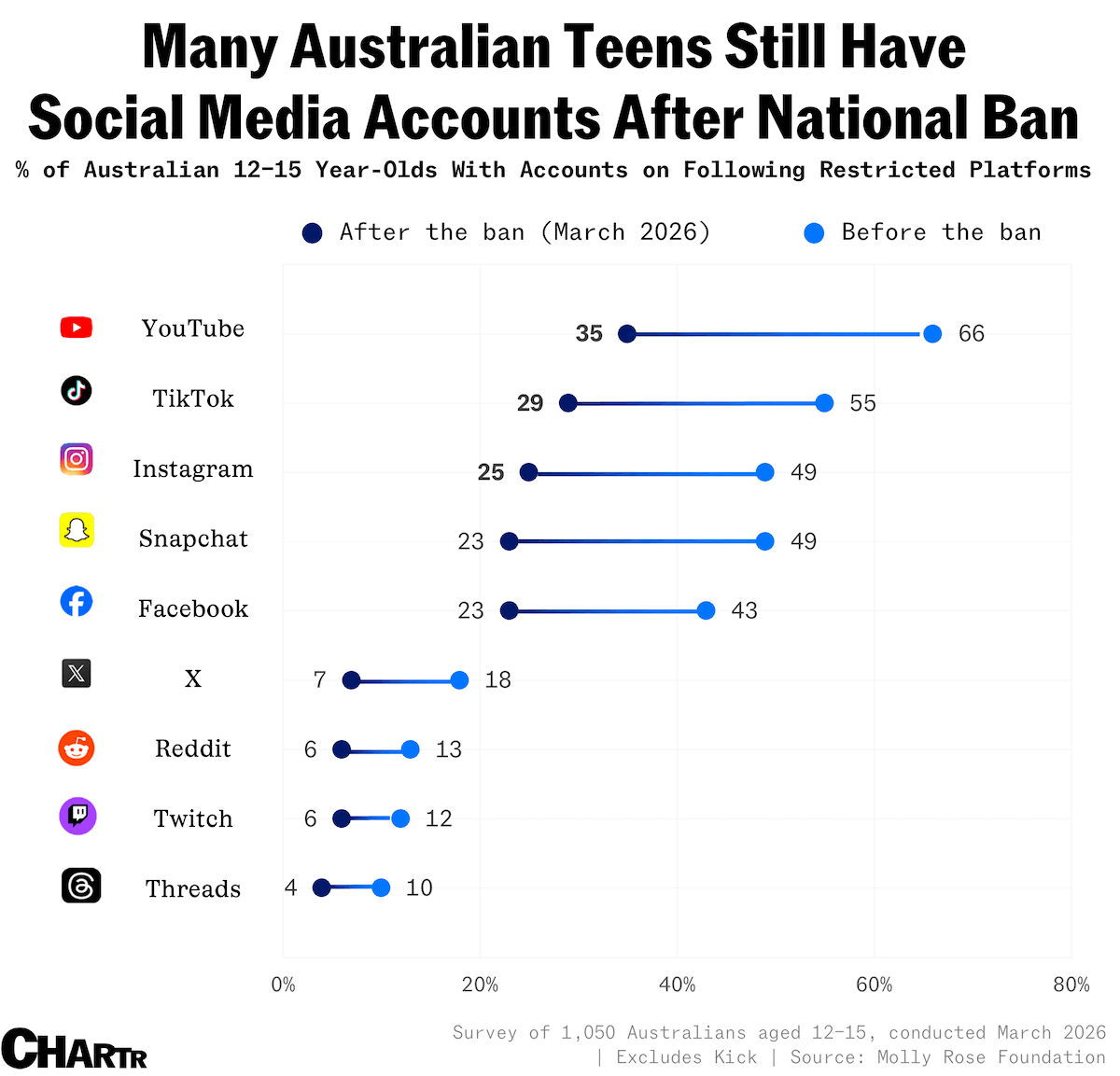
A large-scale poll of Australians aged 12 to 15 conducted by the Molly Rose Foundation and research agency YouthInsight found that ~61% of respondents who previously held accounts on restricted platforms still had access to active accounts as of March 2026.
Proportionately, over half of teens who previously used YouTube, TikTok, and Instagram were still able to use these platforms, with more than a fifth of the cohort overall still having accounts on each of the top five platforms in the survey. Even so, the legislation remains relatively popular with Australian parents... and, according to a Fox News poll from last December, almost two-thirds of Americans are eager to thumbs-up a similar ban.
|
|
|
|
-
Oil fell as much as 5%, the Nasdaq climbed 3%, and the S&P 500 rose 2% after the US and Iran announced that they reached a deal to reopen the Strait of Hormuz and end the war.
-
What’s in the box… A look at the contents of the America 250 time capsule, including coins, cards, chips, and a whale bone, which will be reopened in 2276.
-
Tesla’s claim that its Full Self-Driving tech is over 7x safer than human drivers might be built on skewed data, per Reuters reporting.
-
We will Roku: Fox has agreed to buy Roku in a $22 billion cash-and-stock deal, giving the broadcaster access to the 100 million+ households that use its streaming platform.
-
Stephen Spielberg’s “Disclosure Day” netted the director his best opening weekend ever for an original movie (not adjusting for inflation), hauling almost $93 million around the world.
|
|
|
|
-
Doomsday scenario: Kyle McDonald tracks unusual private jet movements that could one day sound the alarm on a potential apocalypse.
-
This circular sankey maps out the ~25% of players at this year’s World Cup who are playing for nations where they weren’t born.
|
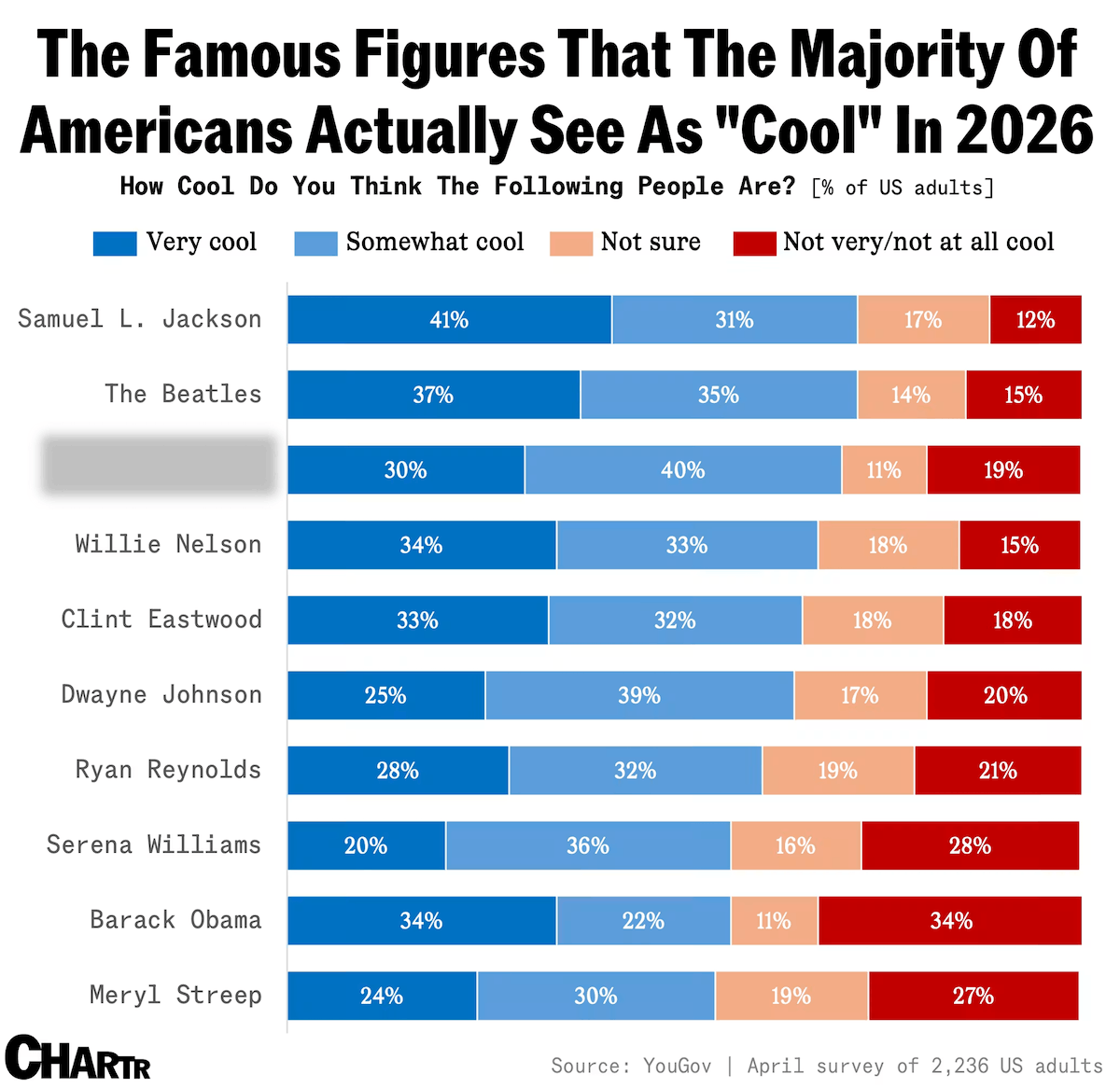
Off the charts: Congratulations to the Knicks, who won the NBA championship for the first time since 1973 at the weekend — but which basketball player do Americans think is the coolest sportsman ever? [Answer below]. |
Not a subscriber? Sign up for free below. |
Sherwood Media, LLC produces fresh and unique perspectives on topical financial news and is a fully owned subsidiary of Robinhood Markets, Inc., and any views expressed here do not necessarily reflect the views of any other Robinhood affiliate... See more |
|
|
|
SHERWOOD MEDIA, LLC, 85 Willow Road, Menlo Park, CA 94025 |
|
|
|
|