
|
 |
Can You Be Alabama's Governor If You Don't Actually Live There?
A lawsuit questions whether Tuberville’s Florida beach house is his permanent residence, not the rundown 3 bedroom/1 bath “game day house” in Auburn, Al the gubernatorial candidate says he lives in.
|

| |||||||||||||||


Former Auburn football coach-turned-Senator Tommy Tuberville, apparently bored with participating in one of the branches of government he couldn’t name when asked during his campaign, has set his sights on becoming the state’s governor. The complaint, filed—full disclosure—by one of my close friends and my oldest son starts like this: “Plaintiffs contend that Tuberville has ‘usurp[ed], intrude[d] into or unlawfully holds or exercises a public office’ and seek relief pursuant to the Alabama quo warranto statutes.” That’s the language in the statute that forms the basis for the challenge to his qualifications to run for office. Quo warranto is a legal proceeding designed to challenge a person’s right to hold a public office.
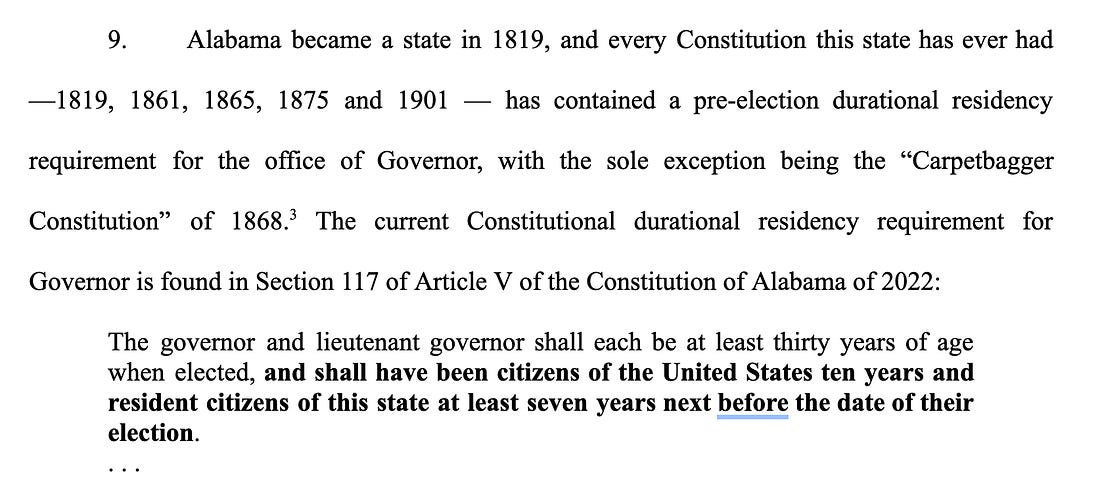
Alabama’s Constitution requires a “7-year durational residency” before a candidate can be certified as a party’s nominee or serve as the state’s governor. According to the complaint, Tuberville does not meet that requirement. The plaintiffs are two Alabama citizens, one an Air Force veteran and the other an Army veteran. The case was filed in state court in Montgomery County, Alabama.
A little Alabama history: There are many different versions of our state Constitution. But with the exception of the post-Civil War version, they’ve all included the seven-year requirement, most recently ratified by voters in 2022. The complaint points out that the law makes it clear that “The Constitution’s control is absolute.”
 |
The complaint goes on to make the consequence of that plain: “The sworn oaths administered to the next Alabama Governor, every judge and justice that will hear this case, and every attorney who will appear in this case all require that they ‘solemnly swear’ to “support the Constitution of the State of Alabama, . . . So help me God.” ‘An oath is a solemn adjuration to God to punish the affiant if he swears falsely.’”
In this action, the burden will be on Tuberville to satisfy the court that he has been a “resident citizen[ ] of this state at least seven years next before the date of the [general] election” on November 3, 2026. He must have become a resident no later than November 3, 2019.
That means we need to consider a little football history: “In early December of 2016, Tuberville abruptly resigned as the head football coach at the University of Cincinnati when his imminent firing was widely rumored following a disappointing 4-8 record, including five straight losses to end the season. As many new retirees do, Tuberville promptly moved to Florida.”
The residency and voting timeline follows:
In July 2012, Tuberville and his wife bought a 5,000-square-foot beachfront home in a gated community on Old Beach Road in Santa Rosa Beach, Florida, for $750,000. They purchased it from a Georgia LLC that appears to be owned by them. The LLC paid $3 million for the property in October 2004 or earlier. It looks nice. (There are pictures in the complaint.)
In February 2017, Ms. Tuberville registered to vote in Florida.
In March 2017, Tuberville filed papers in Alabama to register a gubernatorial campaign, using a P.O. box in Auburn as his address. Two days later, he listed a Dadeville, Alabama, address on papers documenting a loan to his campaign. That same day, Tuberville’s wife and son purchased a three-bedroom house in Auburn. Dadeville is home to a popular recreational lake in Alabama, and it is in a different county than Auburn.
But by the end of April, Tuberville abandoned his gubernatorial aspirations, telling the press, “'I think I could’ve gone through the legal channels to get the residency issue solved, but my family wasn’t wild about the idea either.” He also told the press he decided to live in Florida rather than run for Alabama Governor: “My wife and I said, let’s go to the beach.” Tuberville followed up by registering to vote in Florida in May 2017. Florida law required him to swear an oath that Florida was his legal residence at the time.
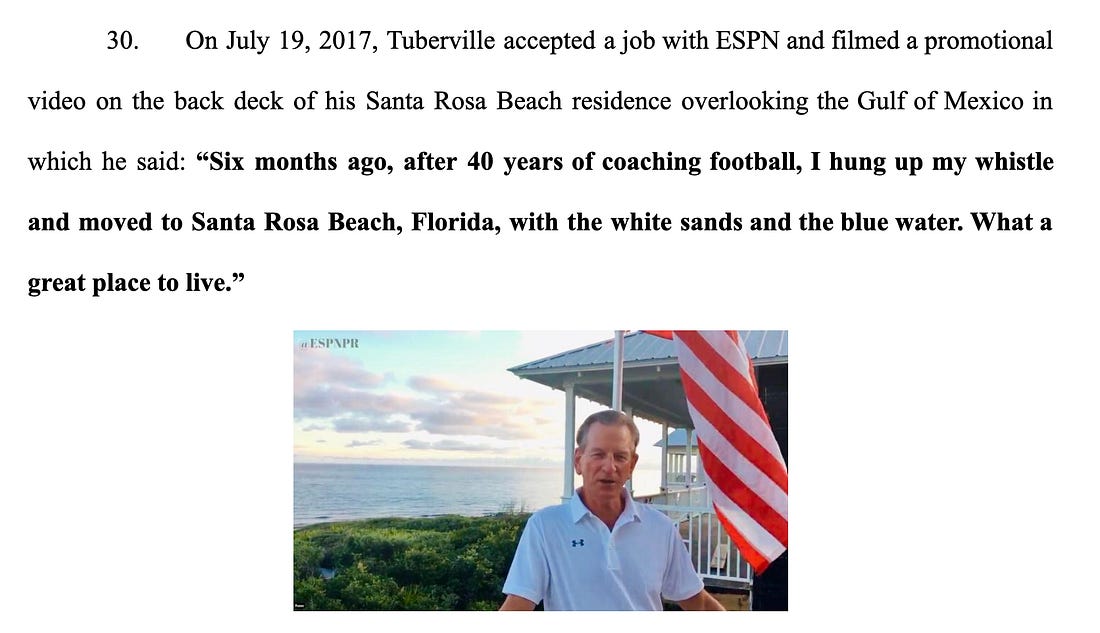 |
Over the next few years, Tuberville acted like a Florida resident in multiple ways. He voted there in November 2018. He claimed the house as his primary residence for tax purposes. He and his wife sold their Alabama lakehouse.
The complaint alleges that although “Tuberville has publicly claimed that he changed his legal residence to Alabama in 2018 or early 2019, the overwhelming evidence suggests that he remained a Florida resident well beyond the November 6, 2019 deadline imposed by the Alabama Constitution.” They refer to his early 2019 decision to run against Doug Jones for the Senate (history now repeats, Jones will be his opponent to be governor if he remains on the ballot). The complaint alleges—and reminder, Tuberville will have an opportunity to respond and identify any inaccuracies he believes exist—he engaged in ”a series of acts calculated to give the false appearance that the Tubervilles had moved their legal residence from Florida to the house in Auburn” that his wife and son bought. It concludes: “Much of the documentation that Tuberville now relies on to support his claim of Alabama residency was manufactured and fabricated pursuant to this scheme.”
The details the complaint offers in support of those conclusions include Tuberville telling a radio host he had moved back to the state in August, only to have her point out that he’d voted in Florida in November, a fact he didn’t dispute. He registered to vote in Alabama in March 2019, but did not advise the Florida supervisor of elections, as he was required by law to do, that he had changed his residence until March 2020. He was registered to vote in both states during that period. Nonetheless, Tuberville announced his run for the Senate in April 2019, using the house his wife and son owned in Auburn as his address, according to the complaint.
How did Tuberville view himself during that time period? The complaint recites that: “At a meeting of the Shoals Republican Club on August 3, 2019, Tuberville candidly conceded that he ‘has property’ in Alabama but is not an ‘everyday resident of Alabama,’ describing himself as a ‘carpetbagger.’”
Then three years later, the Tubervilles listed their Florida home as their primary residence on legal documents associated with the purchase of a piece of property. (Where is the Trump Justice Department when you need them?)
And, in April of 2026, per the complaint, “Tuberville admitted to an interviewer at the Alabama Sports Hall of Fame that ‘I go back to Auburn for 3 or 4 ballgames a year.’ When he realized his admission, Tuberville quickly tried to cover it up by adding, ‘Actually, I live in Auburn.’”
Against this backdrop, it looks like this case comes down to whether a modest three-bedroom, one-bath house in Auburn, Alabama, is Tuberville’s primary residence, or whether it is his luxurious McMansion on a Florida beach. Unlike his wife and son, Tuberville didn’t claim a homestead exemption for the Auburn house when it was purchased, yet another indication that it was not his primary residence. When she signed the form, Ms. Tuberville crossed out “spouse” and wrote in “mom.”
The complaint notes Tuberville played loose and fast with that exemption. For instance, it alleges that “In 2025, Tuberville and his political allies fed false information to a favorable online blog claiming that Tuberville had maintained a homestead exemption on the Auburn house since 2018. That was a lie, as the records show that it was Tucker [the son], not Tuberville, who claimed that homestead exemption.” Tuberville wasn’t added to the deed for the house until mid-2024 when he removed his son’s name from the deed and replaced it with his own. It was 2025 before he took a homestead exemption.
But maybe Tuberville is the kind of guy who enjoys the beach but would rather live his day-to-day life in a more modest home? The complaint rejects any explanation like that. “Tuberville and his family members routinely referred to the Auburn House as ‘the Game Day House’ to friends and family because it was primarily used and occupied during Auburn University home football games. The Auburn House and yard are in a state of disrepair and neglect indicative of only occasional occupancy. It is facially implausible that Tuberville and his wife actually live