| | Analysts condemn the Iran war, Iranians are left leaving the brunt, Apple to raise prices, and anti-͏ ͏ ͏ ͏ ͏ ͏ |
| |  | Flagship |  |
| |
|
The World Today |  - Iran deal faces criticism
- War’s economic fallout
- What’s next for Iran
- What’s next for Israel
- A crucial UK special election
- AI drives Apple prices up
- Amazon bets on world AI
- Shein backlash broadens
- Xenophobia in S. Africa
- Growing literary vacations
 A new horror film evokes ‘solitude and unspeakable unease.’ |
|
Analysts condemn ‘disastrous’ Iran war |
|
The long tail of the Iran war |
|
Iranians bear the brunt of war |
 Iran’s Foreign Minister Abbas Araghchi. Pierre Albouy/Reuters Iran’s Foreign Minister Abbas Araghchi. Pierre Albouy/Reuters
Iran’s government may have emerged triumphant in its standoff with the US, but its people will take years, if not decades, to recover from the conflict, according to experts. For Iranians, the war not only imposed huge economic costs — food-price inflation was 131% last month, millions have lost jobs, and repairs to infrastructure will cost tens of billions of dollars — but sharpened repression, and distracted focus from Tehran’s crackdown on dissent in January that left thousands dead. As a result, the war was “almost like a gift to the regime,” a leading human rights activist told The Atlantic, empowering authorities to imprison and kill dissidents, seize their property, and block funerals for the dead. |
|
Israel seethes over US-Iran truce |
|
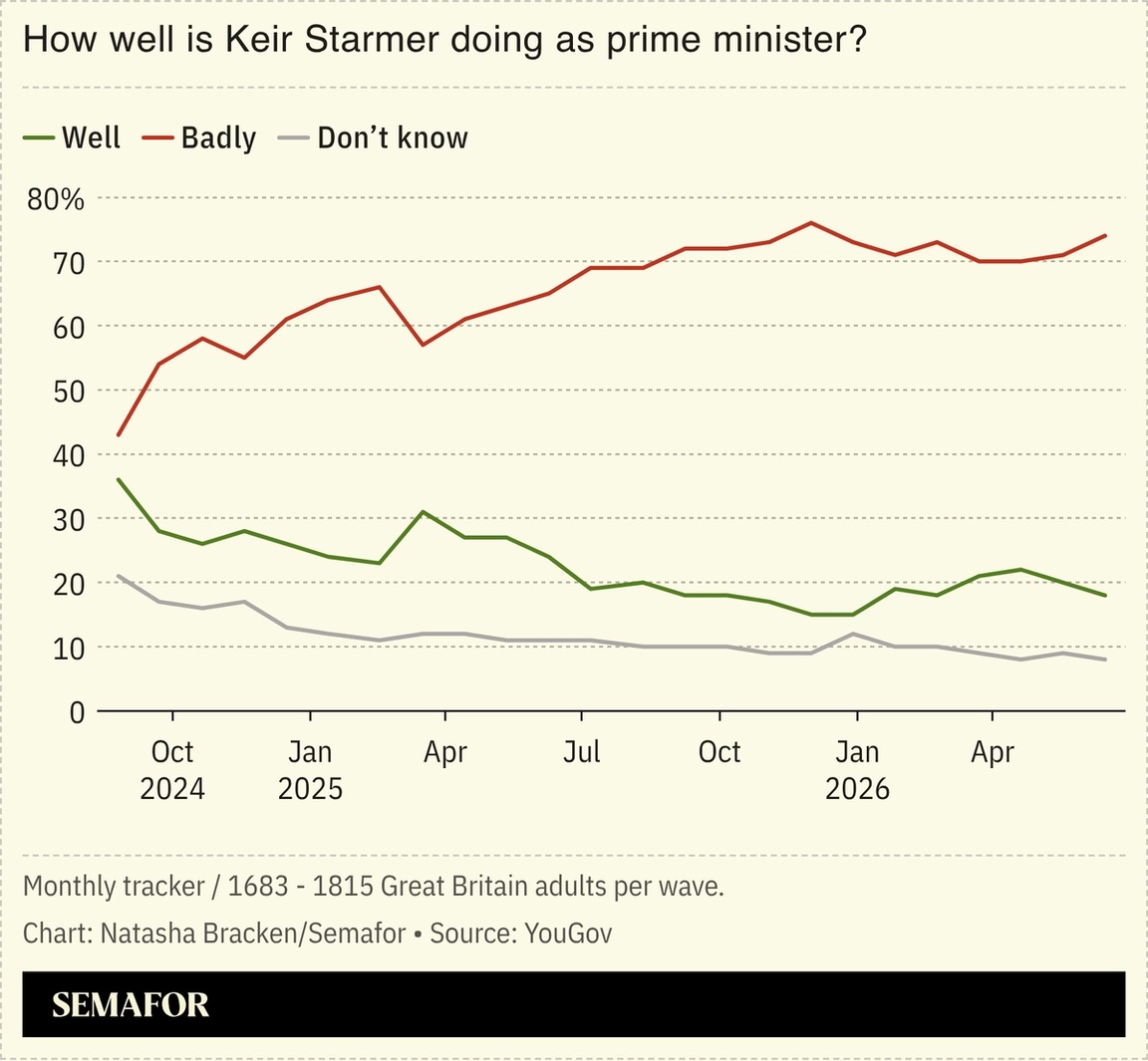 Roughly 70,000 voters in a mostly suburban part of northwest England will today determine the fate of the UK government. Andy Burnham, the Manchester mayor, is aiming to win a special election by appealing for grand national renewal — and promising to address frustrations over local traffic congestion. Burnham leads local polls and, if he succeeds, he will seek to oust Prime Minister Keir Starmer, who has suffered seemingly unrelenting controversies. Whoever emerges victorious from the battle within the Labour party will face enormous challenges: Economic growth is pallid, debt is mounting, and the far right is leading national polls. “Rage [is] in the air and no by-election is going to change that,” the deputy editor of the New Statesman wrote. |
|
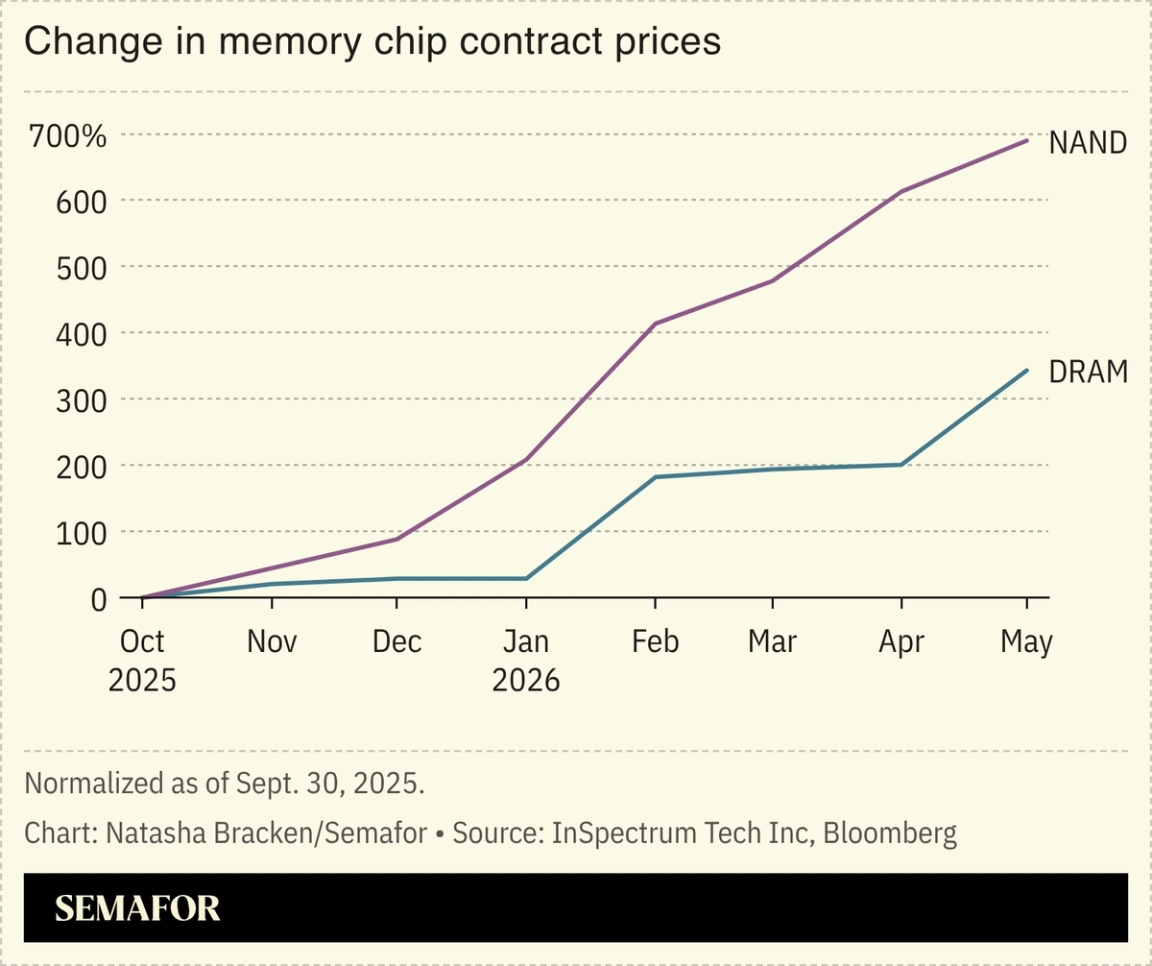 Apple said it would increase prices on some of its products in response to the surging cost of memory chips, which analysts predict could rise even further in coming months. The rapid rollout of AI infrastructure has sent demand for semiconductors soaring, with the cost of memory rising around 90% between the last quarter of 2025 and the first of this year, dealing a “double whammy” to firms as consumer purchasing power cools, an analyst at Counterpoint Research said. Though global manufacturers have vowed increases in production, experts say the shortfall will continue, with Goldman Sachs predicting undersupply will extend through 2028. “Obviously, more capacity is needed,” Apple CEO Tim Cook told The Wall Street Journal. |
|
Amazon bets on 3D-modeling AI |
 Amazon chair Jeff Bezos. Abdul Saboor/Reuters Amazon chair Jeff Bezos. Abdul Saboor/Reuters
Amazon bought a stake in a world-model AI company, a bet that the technology will rapidly move beyond text. Odyssey creates physics-based 3D simulations in which AI can train, that the company says is a route to general-purpose robotics. In-simulation training has obvious advantages — it is faster than real-world training, easing a data-gathering bottleneck for robotics, and failures don’t dent your expensive robot. But it also has drawbacks: The roboticist Rodney Brooks warned that simulation is “doomed to succeed,” because AIs optimize for exploiting the specific model and then fail in the real world. Odyssey hopes that ever-more realistic simulations will alleviate that problem, but research suggests it will never go away entirely. |
|
Shein’s first store to close |
 Jorge Silva/Reuters Jorge Silva/ReutersA top French department store called for Shein to leave its premises by Christmas after other brands housed there protested, underscoring a widening global backlash against the Chinese ultrafast-fashion retailer. The owner of the BHV Marais, which lies near Notre Dame and Paris City Hall, characterized the decision to allow Shein to open a storefront — its first physical site — as a “strategic error.” France last year began scrutinizing the environmental impact of fast fashion companies, while Argentina, Chile, Ecuador, and Mexico have imposed new regulations or duties on the sector, and Indonesia and South Africa have lowered the threshold for taxing cheap imports, many of them textiles. |
|
 On Thursday, June 25 at Google Beach in Cannes, Semafor Editor-in-Chief Ben Smith and Media Editor Max Tani will sit down with Alex Cooper, host of Call Her Daddy and founder of Unwell, for a special live taping of Mixed Signals. The conversation will examine the radical changes in the media landscape through the lens of one of the industry’s most influential creators and entrepreneurs. June 25 | Cannes | Request Invite |
|
Anti-migrant unrest rocks South Africa |
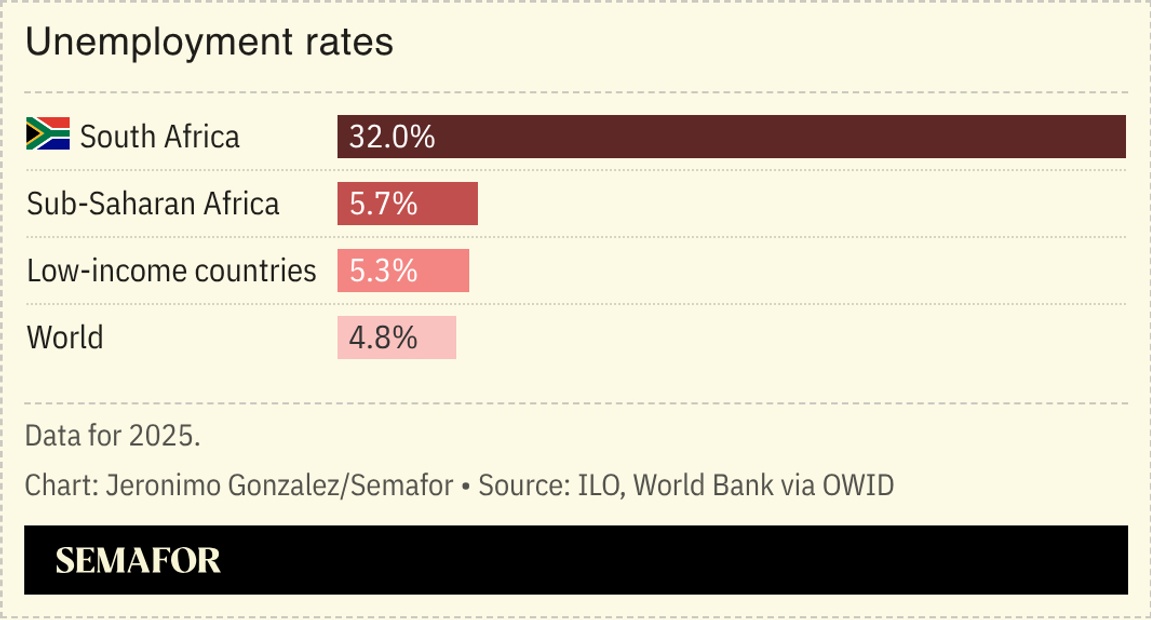 South Africa braced for growing violence stemming from widespread xenophobic attacks. Though unions and senior government figures have condemned the scapegoating of migrant workers, cooling growth and some of the world’s highest unemployment rates have turned Africa’s biggest economy into a tinderbox. Clashes recently broke out between displaced Malawians and police in Durban, while anti-immigrant demonstrators threatening violence have set a June 30 deadline for all undocumented migrants to leave the country, and fringe political parties have leapt on the issue to curry favor with disaffected voters. Governments from across Africa have as a result raced to repatriate citizens. “I am very scared and traumatized,” a Malawian mother of triplets told the BBC. |
|
|


