
| Forwarded this email? Subscribe for more |



 |
| By The Free Press |
It’s Thursday, June 18. This is The Front Page, your daily window into the world of The Free Press—and our take on the world at large. Today: Is the Iran deal worth the paper it’s written on? Batya Ungar-Sargon on the state of liberal American Jewry, Richard Reeves on embracing masculinity, and former Israeli defense minister Yoav Gallant on why military aid to Israel isn’t charity. And much more.
But first: Hard-selling the Iran deal.
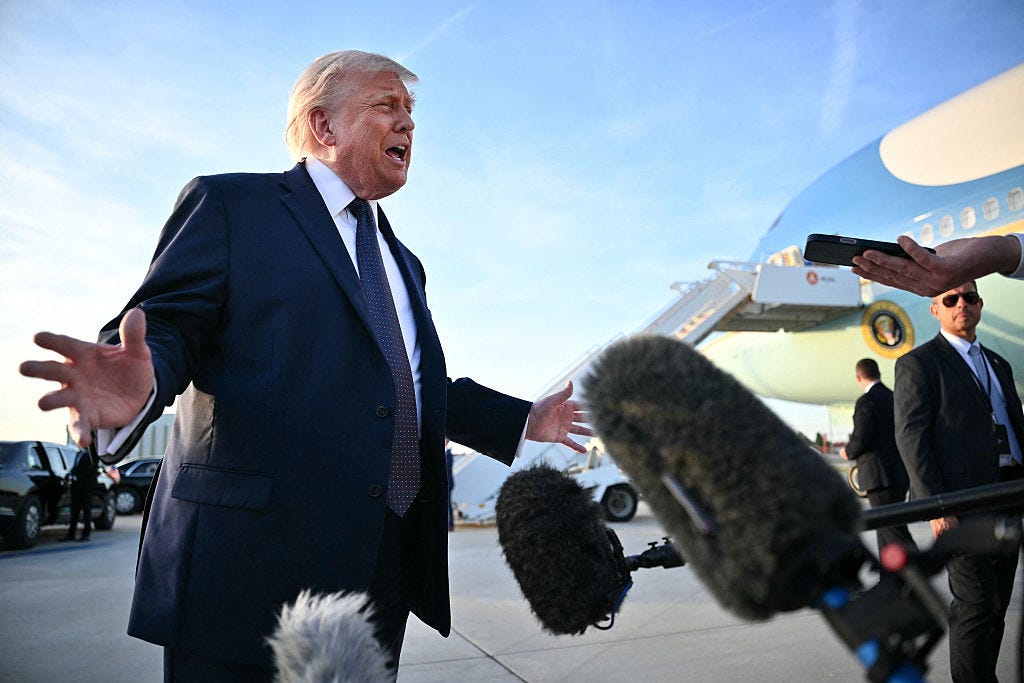
President Donald Trump signed perhaps the biggest deal of his life yesterday, and so far, he’s struggling to sell Americans on its merits. It isn’t hard to see why. The first proposed benefit to the U.S. is Iran’s promise to open the Strait of Hormuz—a pledge it has repeatedly made and betrayed. Meanwhile, once the deal is negotiated in its first 60 days, Iran would gain access to up to $300 billion in foreign investment. That would help rebuild Iran’s arsenal, which the U.S. spent months attempting to destroy.
By Wednesday afternoon, Trump seemed to admit that he struck the deal under pressure. “I didn’t want to see an economic catastrophe,” he said, suggesting that the stock market would have tumbled if he’d failed to reach an agreement.
Trump condemned any comparison between his agreement and former president Barack Obama’s 2015 deal, saying Iran’s leaders “laughed at Obama” after that deal and “said he’s a stupid son of a bitch.” Trump also defended allowing funds into Iran: “What do you expect me to say: No one is allowed to invest?”
He’s now relying on Vice President J.D. Vance to help sell the deal, and Eli Lake suggests that Vance isn’t faring much better. As a leader among right-wing skeptics of war, but also loyal to the president, Vance is at pains to portray the outcome in Iran as a win for America. Read Eli’s take on Vance’s tightrope walk between the hawks and the doves.
Our columnists also decipher the deal, sorting fact from fiction and exposing its potentially fatal flaws. Niall Ferguson is cautiously optimistic, arguing that a cascade of misfortunes among America’s enemies could yield a new status quo in the Middle East. Douglas Murray takes a contrary view, suggesting that Iran’s record of aggression means there’s little chance of good faith today.
Trump’s deal not only withdraws America from the conflict; it also requires Israel to halt its war on Hezbollah in Lebanon. Israeli prime minister Benjamin Netanyahu rebuffed Trump this week, saying “the struggle has not ended,” yet Trump says he shouldn’t worry because Syrian forces may head into the breach. Tanner Nau games out the scenario with Ahmad Shawari, a researcher on the region and Hezbollah.
And finally, Mark Dubowitz considers how we got to the deal, and the details Trump and Iran will hash out in the coming two months. Watch Mark on the latest episode of School of War.


—The Editors
 |
Are Jews still welcome in today’s Democratic Party? That’s a question that an increasing number of Jewish Americans have asked themselves as the political left abandons its support for Israel, while inviting antisemites into the party under the guise of progressivism. But it hasn’t always been this way. Jewish Americans are pivotal to the formation of today’s left, according to Batya Ungar-Sargon in her new book, The Jews and the Left. Batya, a Free Press contributor and host of Batya! on NewsNation, sits down with Rafaela Siewert to discuss the state of American Jewry on the left—and how it got this way.
Supporters of Israel—both left and right—vary in their stances on how best the United States should support its ally in the Middle East. Some stand with Benjamin Netanyahu, who has advised it’s best to gradually wean Israel off military aid, both for the sake of Israel and the United States. Former Israeli defense minister Yoav Gallant says this is a mistake, as U.S. “aid” to Israel is not charity, but a key to technology and investments in security. He lays out his case calling for a shift in perspective when evaluating whether the U.S. should provide aid to Israel.