| | US Vice President JD Vance defends the Iran deal, Amazon investigates employees who called for data ͏ ͏ ͏ ͏ ͏ ͏ |
| |  | Flagship |  |
| |
|
The World Today |  - Vance defends Iran deal…
- …and warns Israel
- Pakistan’s diplomatic victory
- Jet fuel prices drop
- Ukraine strikes Moscow
- Europe regulation complaints
- Banks in HK restrict Anthropic
- Amazon investigates staff
- AI aids satellite observation
- Augustine sermons found
 A comprehensive history on a war ‘nobody planned and nobody wanted.’ |
|
Vance becomes face of Iran deal |
 Eric Lee/Reuters Eric Lee/ReutersUS Vice President JD Vance took to the White House podium Thursday to defend the US-Iran deal, a move analysts say will likely hurt his political future given mounting criticism from conservatives over the agreement. Vance, who insisted the pact was a “win-win” for the US, went from having reservations over the war to becoming the face of a deal that is getting blowback in some Republican quarters, including influential military hawks and prominent commentators. President Donald Trump joked that he would blame Vance if the deal didn’t work out, warning him to “be careful.” But it’s “too late,” a Bloomberg columnist argued, given that Vance has largely wagered his career on the defense of Trump and his policies. |
|
US warns Israel against disrupting deal |
 Ronen Zvulun/Reuters Ronen Zvulun/ReutersVice President JD Vance warned Israel against disrupting the US-Iran peace deal Thursday, rebuking the US ally’s “freakout,” as it telegraphed further military action in Lebanon. President Donald Trump is the “only head of state in the entire world who is sympathetic” to Israel, Vance said, calling for the Israelis “to respect this peace process.” Israeli Prime Minister Benjamin Netanyahu is reportedly furious over the agreement and has suggested Israel isn’t bound by it. Despite the pact requiring Israel’s withdrawal from Lebanon, Netanyahu has doubled down on military operations there, publishing a map showing expanded Israeli troop operations. Trump has repeatedly criticized Netanyahu’s actions in Lebanon, and on Wednesday, referred to Israel as the “very small partner” in their relationship. |
|
Pakistan’s diplomatic chops on display |
 Billboard in Islamabad. Akhtar Soomro/Reuters Billboard in Islamabad. Akhtar Soomro/ReutersThe Iran conflict produced an unexpected winner: Pakistan. The country, once cast as a diplomatic pariah by the West, took on a lead role mediating between the US and Iran to produce a deal. “Pakistan’s star turn is the diplomatic equivalent of Cabo Verde winning the World Cup,” a Wall Street Journal columnist argued. It also upstaged arch-rival India, which, as a Wire columnist bemoaned, “now has a North Stand seat in the global stadium of the Big Boys.” As Washington warms to Islamabad and cools on New Delhi, India is deepening ties with Israel — another US ally navigating its own turbulent relationship with President Donald Trump. |
|
Gas falls as ships traverse Hormuz |
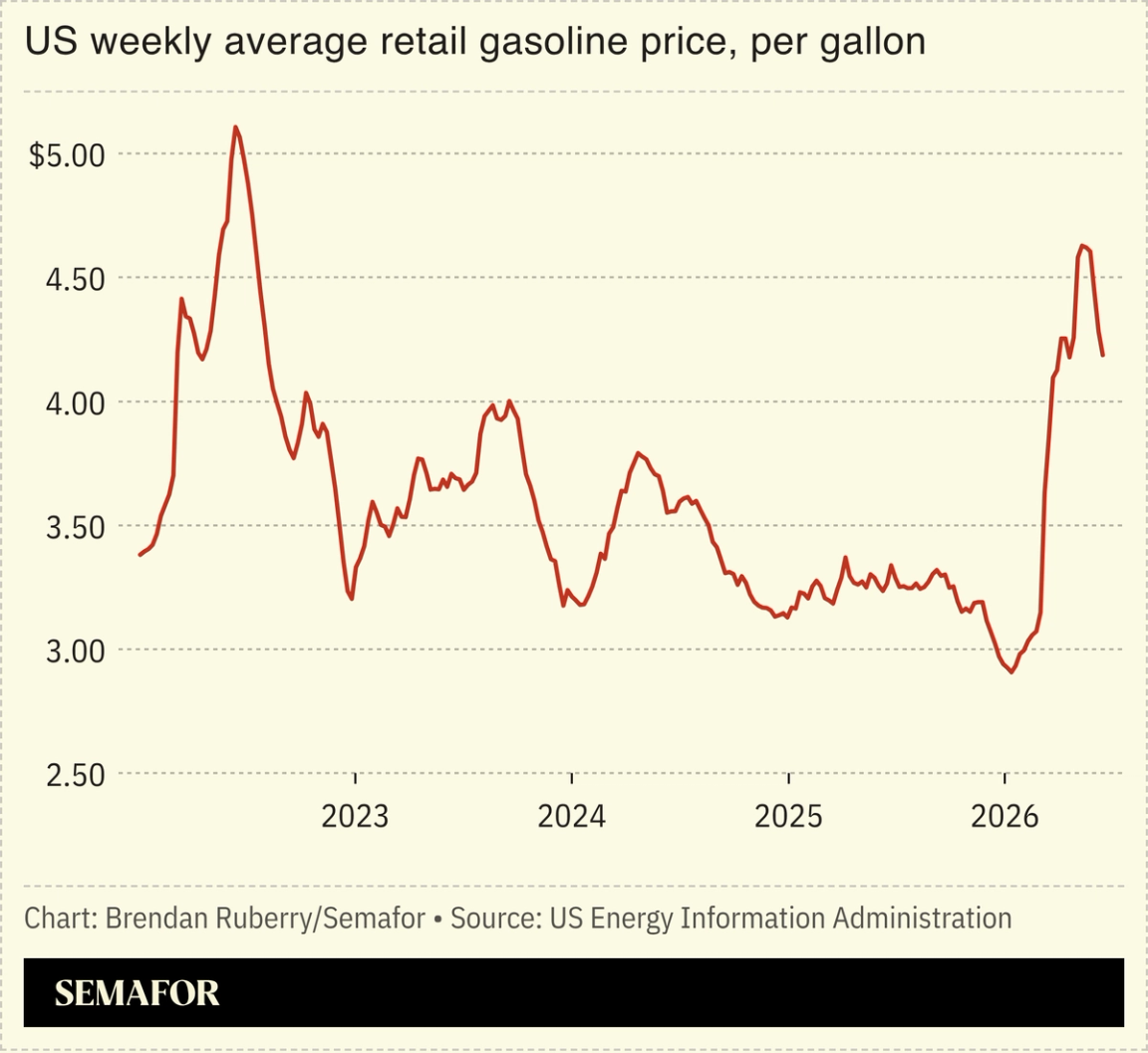 US gasoline fell below $4 a gallon on Thursday, and jet fuel prices tumbled as oil started moving through the Strait of Hormuz again. Washington said 12.5 million barrels traversed the waterway Wednesday night. The deal to reopen the strait is a victory for Tehran, Semafor’s Tim McDonnell argued: It regains access to global markets after having been forced by sanctions to sell most of its oil at a discount to China, a likely $60 billion annual boost. But the weaponization of oil flows is a “wasting asset,” a former security official told McDonnell. Nations were already reducing exposure to fossil fuels, and the crisis has driven producers to build pipelines and find other ways to avoid the Hormuz chokepoint. |
|
Ukraine hits Moscow in biggest drone strike |
 Social media via Reuters Social media via ReutersUkraine launched its largest drone attack of the war on Moscow Thursday, damaging the Russian capital’s main oil refinery and showering its neighborhoods in “black rain.” The attack’s value is both symbolic and economic, bringing the reality of war home to ordinary Russians through widespread disruption and heaping pressure on the production capacity that powers Moscow’s war efforts. Kyiv’s new drone warfare strategy, described as “logistics lockdown,” has brought about a “new phase in the conflict,” The New York Times reported, powered by millions of upgraded mid-range drones capable of targeting refineries and unarmored transports behind the frontlines. Russia’s fuel output is falling, DW noted, and shortages now affect “practically the entire country.” |
|
Execs criticize EU overregulation |
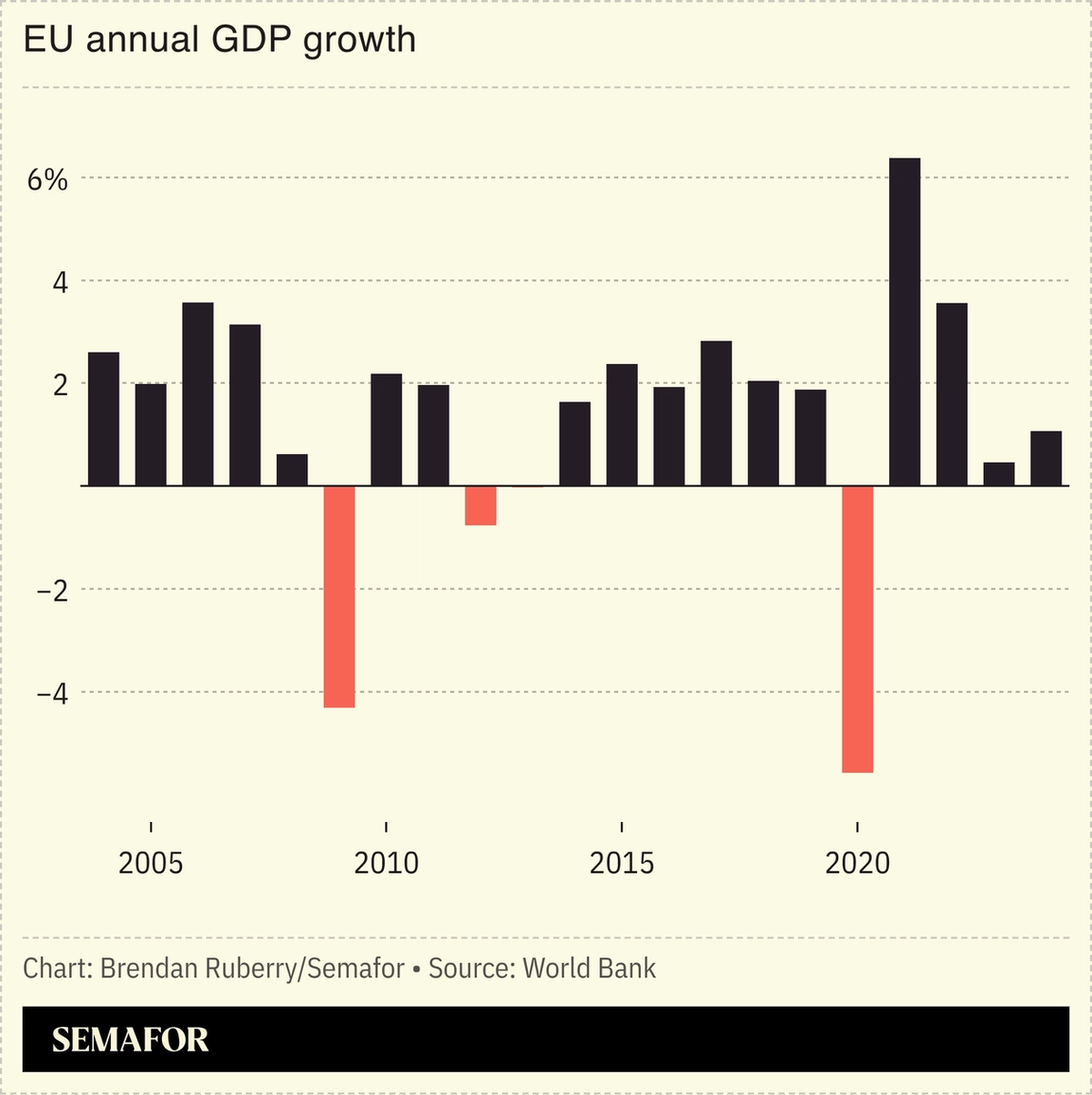 EU overregulation is constraining business, a steel magnate and a Gulf sovereign wealth chief warned. ArcelorMittal’s executive chairman wrote in the Financial Times that emissions trading rules hurt energy-intensive industries, while the governor of Saudi Arabia’s Public Investment Fund said the regulatory environment prevented international investors from pouring more capital in the bloc. Neither figure is impartial, but they echo a 2024 report by former ECB President Mario Draghi that called for Europe to slash legislative restrictions on business. Foreign direct investment into the EU fell 7% in 2025, EY analysis found, with a growing share of companies identifying overregulation as a risk to business. Brussels appears to be adding rather than removing layers, tightening screening of foreign direct investment in March. |
|
JPMorgan restricts Anthropic in HK |
 Eduardo Munoz/Reuters Eduardo Munoz/ReutersJPMorgan Chase reportedly cut off its Hong Kong employees’ access to Anthropic’s AI models, faced with pressure from both the US government and Anthropic itself. The White House, citing national security concerns, blocked all foreign nationals from using Anthropic’s most advanced models — leading the company to shut public access down altogether. Anthropic, meanwhile, has barred all its products from use in mainland China, fearing that Chinese AI firms could train their own models on its output in so-called “distillation attacks.” The bank’s decision, which follows Goldman Sachs similarly restricting Anthropic use, “represents a threat to Hong Kong’s revival as an international financial centre” given AI models’ growing adoption, particularly in coding, the Financial Times reported. |
|
 News, but only the good stuff. Cue Nice News, an easy-to-read daily digest that delivers uplifting, interesting, and intelligent stories. Join over 1 million other readers who wake up with a more optimistic mindset — subscribe to Nice News for free. |
|
Amazon investigates its engineers |
|
AI a game-changer for satellite observation |
For the first time, a satellite used a natural-language AI to find observation targets, a potentially game-changing move for both environmental monitoring and intelligence. Satellite observations are bottlenecked by downlink bandwidth and human attention: Sensors grab vast amounts of data, but most of it is useless, and all of it has to be beamed to Earth for humans to check. The new system, a Google vision-language model running on board the satellite, allows operators to say, for instance, “look out for wildfires” and the satellite will only beam down images of interest. The same technology could be used to observe human activities, whether potential terrorist training camps or the meetings of governments’ domestic political opponents. |
|
Saint Augustine sermons discovered |
|
|


