Gulf Currents is coming to you from London this week, where the former U.S. embassy in Grosvenor Square has become an unlikely new focal point for Gulf visitors to the British capital. Qatari Diar's renovation — worth several hundred million pounds — has transformed the building into a luxury hotel, the Chancery Rosewood, and this week it felt like half of the Gulf had followed.
On Monday, a line of Range Rovers and G-Wagons idled beyond statues of Ronald Reagan and Dwight Eisenhower, which flank the entrance. A gilded eagle statue on the hotel’s rooftop — cast from aluminium salvaged from scrapped B-52 bombers and now fully restored — watched over the square.
That the old seat of American power in London is now a Gulf investment asset is a fitting backdrop for this week's news. Secretary of State Marco Rubio is currently touring the Gulf itself, trying to reassure nervous allies that Washington's fragile peace deal with Iran serves their interests too — even as Tehran and Washington are already offering conflicting accounts of what they actually agreed to. Inside Gulf Currents, we look at what the deal means for Hormuz, what Rubio faces on the ground, and why Gulf football fans are having a very complicated week.
And today, Wednesday, June 24 at 18:40 PM GMT our Energy Correspondent Scott DiSavino is interviewing Gas Exporting Countries Forum Secretary General Dr. Philip Mshelbila. Register here to join the Reuters NEXT event. |
|
|
Top headlines from the region |
|
|
|
-
U.S. Secretary of State Marco Rubio began a three-day Gulf tour Tuesday, seeking to reassure allies sceptical of Trump's Iran deal — particularly a proposed $300 billion fund they fear could rebuild Tehran's military. Rubio's challenge is to defend an accord Trump firmly backs while credibly addressing Gulf concerns about regional security.
- India is in early-stage talks to sell the UAE its BrahMos supersonic cruise missile — jointly developed with Russia and capable of striking targets 290 km away. The potential deal signals deepening India-UAE ties and reflects Abu Dhabi's push to diversify arms suppliers beyond the U.S. following Iran's wartime missile attacks.
- Americans are deeply sceptical of Trump's Iran war, with only 24% saying it was worth the costs and 63% doubting the truce will hold, a Reuters/Ipsos poll found. Just 23% believe the U.S. emerged stronger.
|
| |
|
Hormuz: Technically open, barely moving |
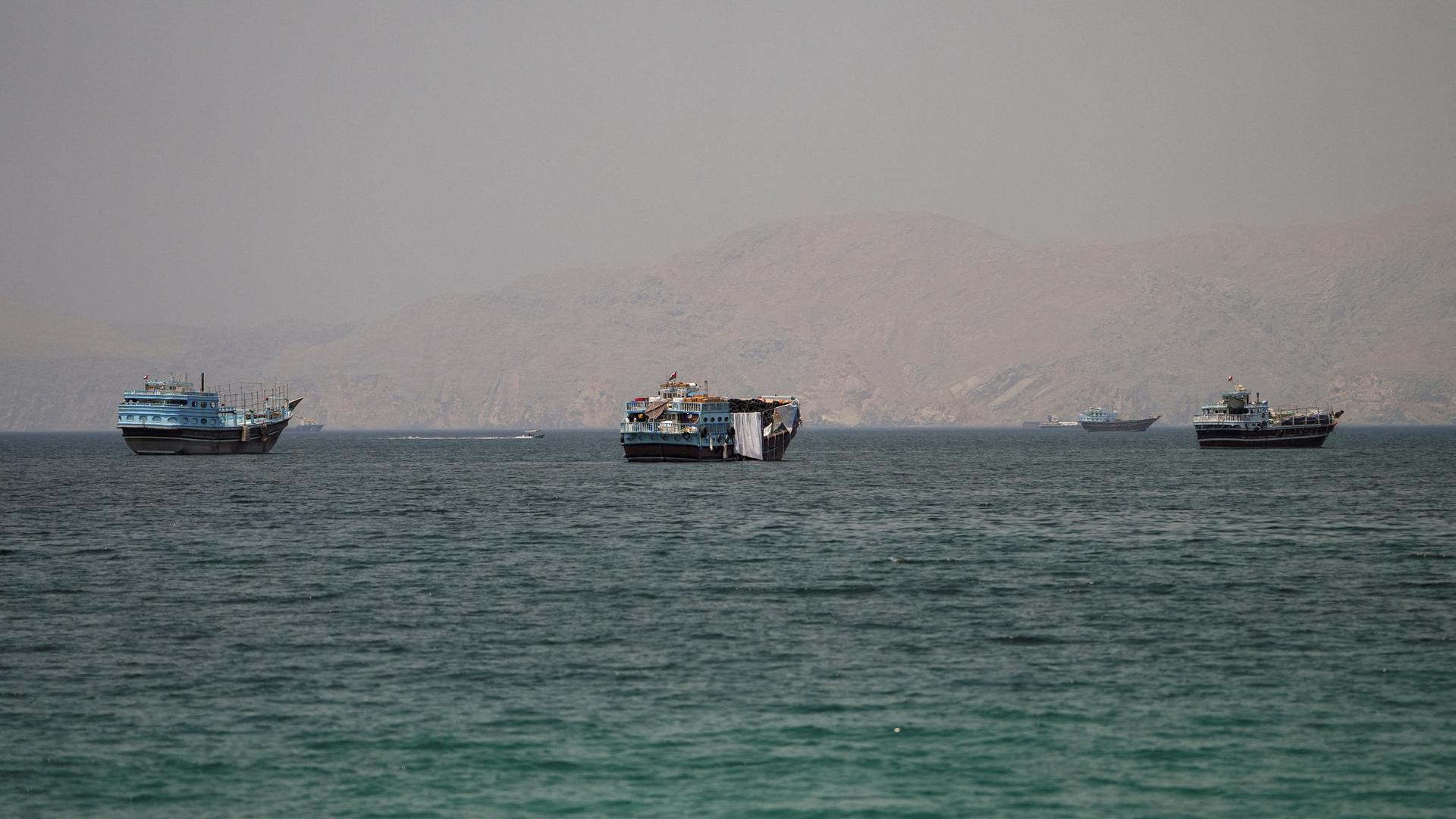
Vessels at the Strait of Hormuz, as seen from Musandam, Oman, June 22, 2026. REUTERS/Stringer |
The ceasefire is holding, ships are moving and the headlines suggest the world's most important energy chokepoint is coming back to life. But the reality on the water this week is more complicated. The Strait of Hormuz is technically open, but it is functioning like a highway emergency corridor under active management.
The clearest sign of that is who is in charge of the traffic. Iran's state media has signalled that daily transit numbers are being controlled by Iranian forces and will vary depending on conditions. The UN's International Maritime Organization has begun contacting hundreds of stranded vessels individually, assigning each an allocated transit day as part of a phased evacuation plan. Oman has separately warned that the standard Traffic Separation Scheme — the established routing system through the strait — is not yet safe to use, with floating mines among the listed hazards. This is a tentative, supervised corridor, not an open strait.
The market is sending the same message. In the months before the war, hiring a supertanker to carry crude in the Gulf had already risen to around $75,000 to $100,000 a day, according to Baltic Exchange data. This week that figure hit a record $470,000 for tankers that need to transit Hormuz, reflecting how scarce available vessels have become with roughly 100 tankers still trapped inside the Gulf. Tanker hire rates outside Hormuz have also nearly doubled in a week. Rates that high are not a sign of a market returning to normal — they are a distress signal.
There are early movers that demonstrate that the strait can be used — but only cautiously. Three supertankers exited Tuesday, and seven empty Qatar-linked LNG tankers have made inbound transits in recent weeks, the largest such movement since the war began. However, widespread ballast movement — empty ships sailing into the Gulf to collect new cargoes — is still largely absent. That is the real confidence indicator: committing a vessel to an inbound run means betting it can get back out loaded. Most operators are not making that bet yet.
Several triggers would indicate a genuine, durable reopening. Analysts and markets will be watching for a broad return of ballast tankers across multiple operators; war risk insurance falling sustainably below its current level of around 3% of vessel value; the IMO transitioning from its evacuation protocol back to the standard routing scheme; and crude loadings from inside the Gulf recovering toward pre-war norms. None of those thresholds have been reached. Things may change soon. Plans are underway in Oman to initiate a negotiating track between Iran, the Gulf Arab states and Iraq over the future operation of the strait.
Until shippers, insurers and energy majors see sustained safe passage, Hormuz remains open in name more than in practice. |
|
|
|
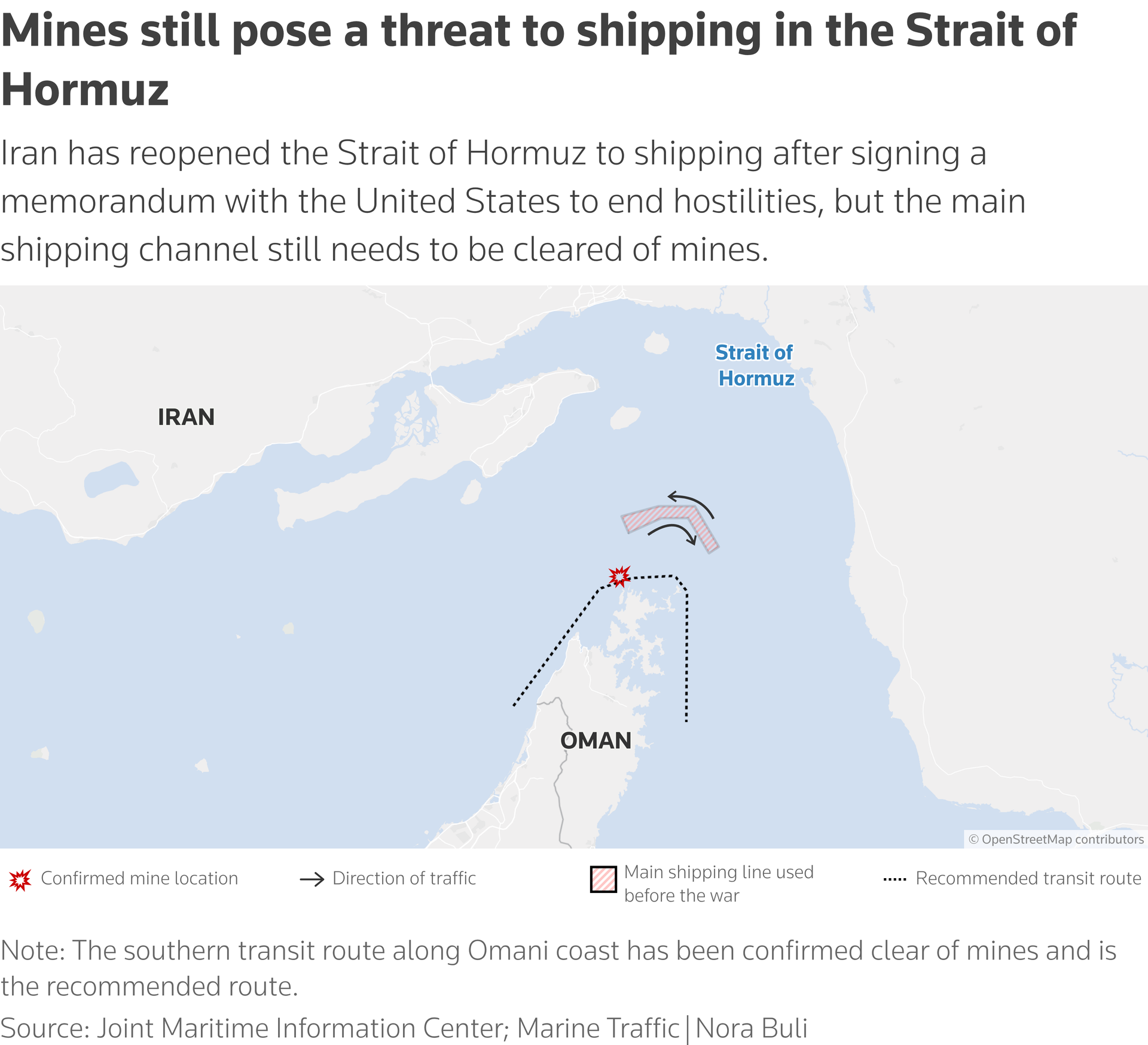
The U.S.-led Joint Maritime Information Center said that mines remain a threat in the Strait of Hormuz, preventing vessels from using the main shipping lane that was in operation before the war. Sailings through the strait are still a fraction of the roughly 125 daily crossings seen before the Iran war began. |
|
|
|
The last wave: Gulf teams fight for World Cup survival |
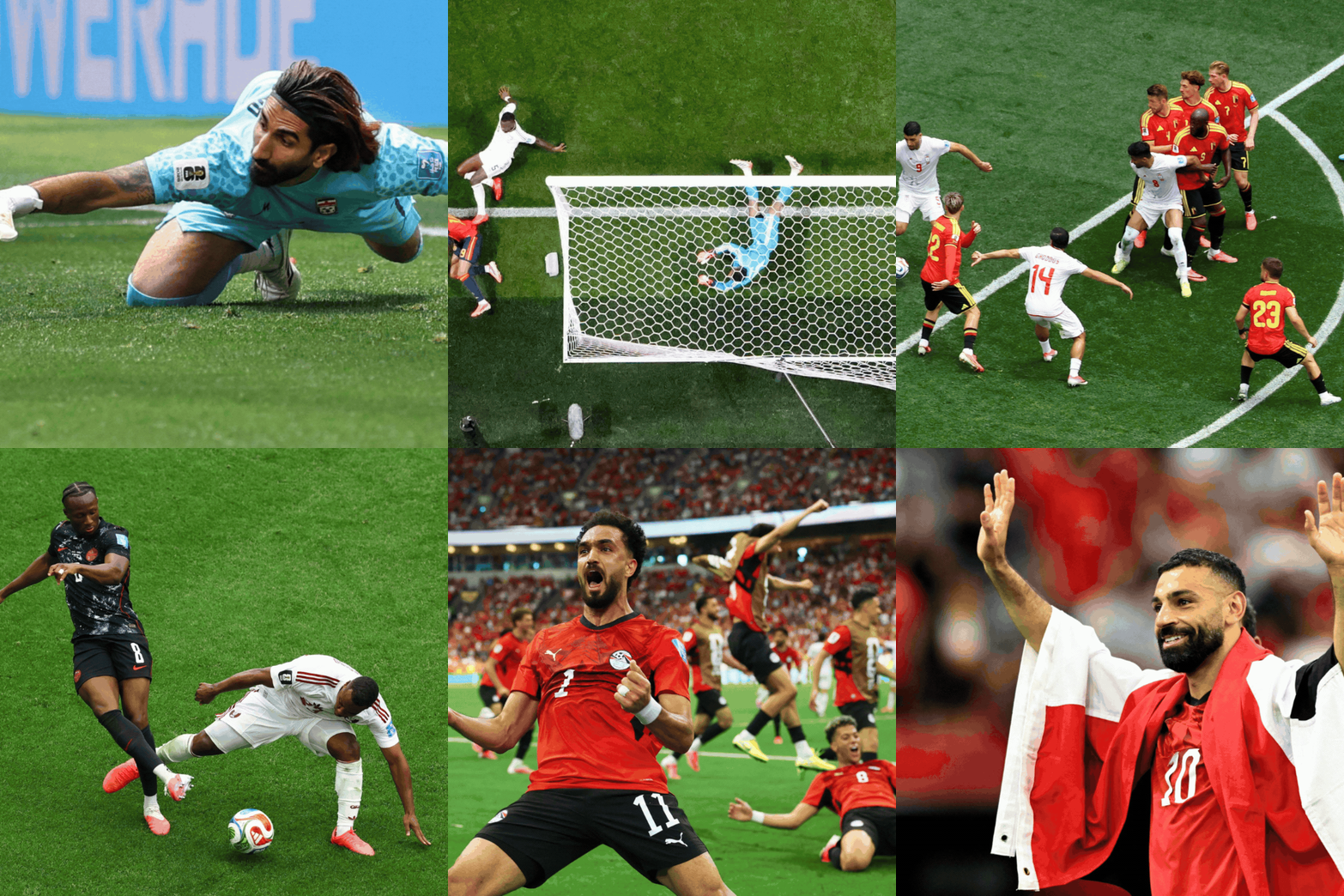
Several shots from different FIFA World Cup 2026 matches. REUTERS |
Iran's team has been as stubborn as its diplomats at the World Cup: a 2-2 draw with New Zealand, then a hard-fought 1-1 against Belgium, with goalkeeper Alireza Beiranvand earning player of the match plaudits. Off the pitch, Washington eased travel restrictions on the squad, allowing them to arrive two days before their next match in Seattle — a small but significant concession.
Saudi Arabia went from dogged to demolished — holding Uruguay 1-1 before being torn apart 4-0 by Spain in Atlanta. Barcelona's teenage prodigy Lamine Yamal ran riot, scoring and tormenting defenders, before Hassan al-Tambakti added the indignity of an own goal.
Qatar's campaign veered from historic joy to historic shellacking: a last-gasp equaliser against Switzerland gave them their first World Cup point, only to be followed by a 6-0 collapse against hosts Canada. Reduced to nine men, Qatar still found the grace to send best wishes to Canada's Ismaël Koné, stretchered off with a broken leg.
The Middle East’s bright spot Egypt also deserves mention, securing their first World Cup win as Mohamed Salah scored in a 3-1 victory over New Zealand. For Gulf fans, the contrasts are stark: Iran resilient but still seeking a win, Saudi Arabia needing a miracle, Qatar oscillating between drama and disaster. |
This newsletter was edited by Aidan Lewis and produced by Rawan Yaghi. |
|
|
|
|