
|
Gibo Wants You To Die: Before You Do, Read This
In this statement, Gibo Teodoro uses words unreflectively. He says, the "West Philippine Sea" is an "existential issue" to the Philippines. Is this even correct?
|

| |||||||||||||||


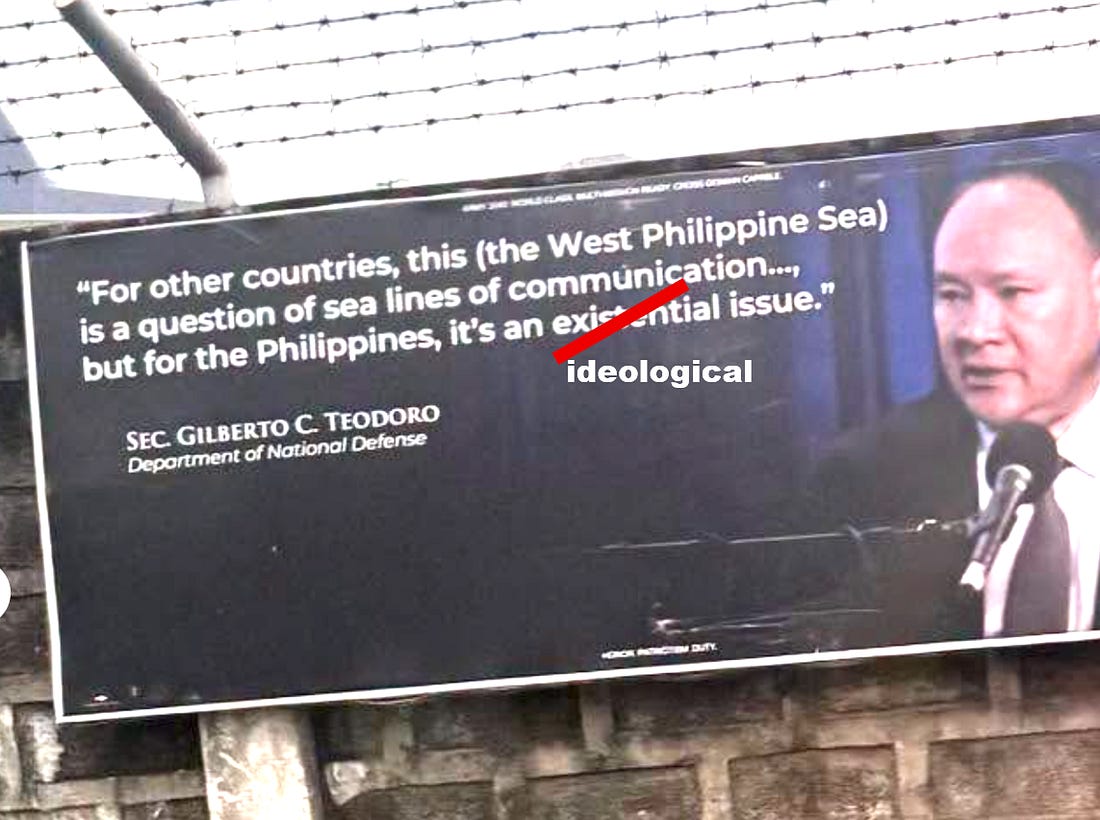 |
In this statement, Gibo Teodoro uses words unreflectively. He says, the “West Philippine Sea” is an “existential issue” to the Philippines. Is this even correct? For us to assess the correctness of his statement, one must understand what it means for something to be an “existential” issue.
𝐄𝐱𝐢𝐬𝐭𝐞𝐧𝐜𝐞: 𝐖𝐡𝐚𝐭 𝐝𝐨𝐞𝐬 𝐢𝐭 𝐦𝐞𝐚𝐧?
To exist is to exist physically (we will call this first-order existence) OR to have a physical substrate host (second-order existence). This definition of existing suggests that it is not a single, monolithic state but a layered hierarchy. First-order existence—the substantive, independent manifestation of physical matter in space-time—and second-order existence, which is the relational, patterned information that can only inhere within a physical substrate.
Your existence is an an example of first-order existence: a tangible organism. Even Descartes “I think therefore I exist” relies on a “doubter”, a physical existent that can doubt to be possible.
The very ability to doubt presupposes a physical brain to house that doubt, debunking Descartes’ ethereal separation of mind and substance. Remove your brain, or temporarily suspend its function of integrating your bodily signals through general anaesthesia and there is no doubt that would arise at all.
In stark contrast, genetic information and the words on this screen are purely second-order form of existence. They possess no intrinsic existence on their own, yet they dictate the entire trajectory of biological evolution and human communication. Without deoxyribonucleic acid, the genetic code vanishes; without silicon or ink, these digital letters cease to be. They are real, undeniably so, but their reality is materially dependent—they exist only insofar as they are hosted.
This framework refutes both crude materialism and abstract Platonism. The materialist errs by conflating the substrate with the pattern, failing to explain why two identical clumps of atoms can produce radically different outcomes—a healthy cell versus a cancerous one—purely based on their informational arrangement. Conversely, the Platonist errs by granting eternal, unhosted existence to forms and numbers, ignoring that information is invariant under physical translation but never independent of physical instantiation. Second-order existence is what crude materialism forgets; it is a mathematical and relational reality that governs physical causality, yet it remains entirely dependent on a physical vessel to exert any influence whatsoever.
𝐖𝐡𝐚𝐭 𝐝𝐨𝐞𝐬 𝐢𝐭 𝐦𝐞𝐚𝐧 𝐟𝐨𝐫 𝐞𝐱𝐢𝐬𝐭𝐞𝐧𝐜𝐞 𝐭𝐨 𝐛𝐞 𝐚𝐧 𝐢𝐬𝐬𝐮𝐞?
Given this definition, we can now answer what we mean if existence is an issue. Is it physical persistence (first order) or informational persistence (second order)?
A 𝐟𝐢𝐫𝐬𝐭-𝐨𝐫𝐝𝐞𝐫 𝐞𝐱𝐢𝐬𝐭𝐞𝐧𝐭𝐢𝐚𝐥 𝐢𝐬𝐬𝐮𝐞 is any threat, limitation, or degradation affecting the physical substrate itself—the biological organism, its metabolic processes, structural integrity, and causal agency in the material world. This encompasses disease, aging, injury, starvation, suffocation, and any force that compromises the tangible machinery of life. The first-order issue is fundamentally a crisis of continuity: it asks whether the physical vessel that hosts all experience and action will remain intact and functional across time. Its resolution lies in medicine, nutrition, shelter, and any technology that extends the lifespan or robustness of the organic body. When we fear death in its most primal sense—the cessation of heartbeat and brain activity—we are confronting a first-order existential issue, because we dread the irreversible dissolution of the very substance that permits us to interact with, perceive, and act upon the universe.
A 𝐬𝐞𝐜𝐨𝐧𝐝-𝐨𝐫𝐝𝐞𝐫 𝐞𝐱𝐢𝐬𝐭𝐞𝐧𝐭𝐢𝐚𝐥 𝐢𝐬𝐬𝐮𝐞, by contrast, is any threat, limitation, or degradation affecting the informational pattern hosted by the physical substrate—the memories, self-narrative, beliefs, values, skills, relationships, and unique relational identity that constitute who we are as distinct individuals. This encompasses memory loss, cognitive decline, ideological corruption, social isolation, cultural erasure, and any force that distorts, deletes, or renders obsolete the specific configuration of data instantiated in neural networks or external media. The second-order issue is fundamentally a crisis of redundancy and fidelity: it asks whether the informational pattern that defines “you” will survive translation across substrates, resist degradation over time, and remain accessible to other conscious hosts. Its resolution lies in education, storytelling, art, archival practices, digital backup, and any technology that copies, transmits, or reinstantiates informational patterns into increasingly durable or numerous physical carriers. When we fear being forgotten, misunderstood, or rendered irrelevant—when we obsess over legacy and meaning—we are confronting a second-order existential issue, because we dread the erasure of the pattern that gives our particular physical configuration its distinctive identity and significance.
𝐒𝐨 𝐰𝐡𝐚𝐭 𝐞𝐱𝐚𝐜𝐭𝐥𝐲 𝐆𝐢𝐛𝐨 𝐓𝐞𝐨𝐝𝐨𝐫𝐨 𝐦𝐞𝐚𝐧 𝐭𝐡𝐚𝐭 𝐭𝐡𝐞 “𝐖𝐞𝐬𝐭 𝐏𝐡𝐢𝐥𝐢𝐩𝐩𝐢𝐧𝐞 𝐒𝐞𝐚” 𝐢𝐬 𝐚𝐧 𝐞𝐱𝐢𝐬𝐭𝐞𝐧𝐭𝐢𝐚𝐥 𝐢𝐬𝐬𝐮𝐞?
Answering this question is important because specific policy flows from how one understands existence. If Gibo Teodoro frames the “West Philippine Sea” as a first-order existential issue, then he is framing it as a matter of life or death. Yes, it is that dramatic. To accept this dramatic framing is to accept the part you must play in it: a person who must die in order to preserve something. But what exactly are you preserving? Is the physical existence of Philippine territorial integrity dependent on the West Philippine Sea? Ask yourself that carefully and reflectively, because if you do not, you will get entrained to the dramatic rhythm of people like Gibo Teodoro and company, swept into a narrative that demands sacrifice without demanding scrutiny.
Territorial integrity requires you to understand the meaning of territory itself. A country’s territory ends 12 nautical miles from its baseline. Most—by most, I mean most, in its almost entire entirety—of the West Philippine Sea lies outside that 12 nautical mile limit.
In fact, the Philippines has physically existed even before the concept of “West Philippine Sea” was officially coined in 2012. Surely, if you existed before the concept existed, your existence does not depend on the concept.
The first-order existence of the Philippine archipelago—its landmass, its people, its actual inhabited territory—is not contingent upon maritime zones that extend far beyond its shores. The nation’s physical persistence, its capacity to feed, shelter, and govern its citizens, does not hinge upon asserting control over every square kilometer of the South China Sea.
The mountains of Luzon, the rice fields of Central Luzon, the cities of Visayas and Mindanao—these are the first-order substrates of Philippine existence. They remain intact regardless of what happens in the waters of Scarborough Shoal or the Spratly Islands. Therefore, framing the West Philippine Sea as a first-order existential issue is a category error: it conflates the physical survival of the nation with the assertion of maritime claims that are, by international law, neither territorial nor essential to the nation’s biological continuity.
What, then, is the West Philippine Sea if not a first-order issue? It is a second-order existential issue—a matter of informational persistence, symbolic identity, national pride, and geopolitical narrative. The dispute is about maps, legal documents, historical narratives, and the international recognition of sovereign rights over resources and shipping lanes. These are patterns of information hosted in treaties, court rulings, media reports, and the collective memory of the Filipino people. They matter—they matter greatly—but they matter in the way that a national flag matters: as a symbol that organizes identity and mobilizes collective action, not as a physical organ without which the body dies.
When Gibo Teodoro speaks of dying for the West Philippine Sea, he is asking Filipinos to treat a second-order issue—a legal and informational claim—as if it were a first-order biological necessity. This is the rhetorical sleight-of-hand that turns abstract maritime boundaries into blood-soaked battlegrounds.
To resist this framing is not to be unpatriotic; it is to be ontologically clear. It is to say: I will defend the physical existence of my people and my homeland. But I will not die for a concept that was born in a government memorandum, whose physical referent lies beyond our shores, and whose loss would not extinguish a single Filipino life or an inch of our inhabited soil. By distinguishing first-order from second-order existence, we liberate ourselves from the manipulative urgency of those who demand sacrifice for symbols, and we reclaim the right to ask the most essential question of all: What, truly, is worth dying for?
Flood control IS the first-order existential issue. Unlike the West Philippine Sea—which is a second-order matter of legal claims, maps, and national narratives—flood control directly addresses the physical persistence of the Filipino people. When rivers swell, when storm surges crash into coastal communities, when rain-swollen mountains unleash landslides, the threat is not to a concept or a maritime boundary; it is to the actual biological substrates of millions of Filipinos. Houses collapse, bodies drown, crops are ruined, infrastructure crumbles, and the metabolic continuity of entire communities is violently interrupted.
This is first-order existence in its most primal, unforgiving form: the physical integrity of human beings and their habitats, threatened by the elemental forces of water and gravity. There is no symbolic mediation here, no legal gymnastics, no diplomatic posturing. The water does not care about your maps or your maritime claims; it cares only about the weight of its volume and the fragility of your flesh. To treat flood control as anything less than an urgent first-order priority is to fundamentally misunderstand what it means for a nation to exist in the most literal, embodied sense.
Consider the arithmetic of survival. A single severe flooding event—like Typh