
|
 |
Bulwark fam, summer is heating up and we’re monitoring the coming blockbuster U.S. Supreme Court decision on birthright citizenship next week. For now, YouTube members can check out my colleague Jonathan Cohn who reacted to the decision Thursday on TPS, and has done excellent coverage of what this means for grandmas in our country. Really incredible stuff.
If you’ve got any questions on TPS, the court’s other decision on asylum seekers at the border, or the coming birthright citizenship opinion, feel free to drop us a line in the comments and we’ll respond to some of them next week.
Meanwhile, I was at an under the radar Latino vote summit this week and I’ve got the tea below on which Republican scares the bejesus out of some Democrats in 2028 and why…
-Adrian
“If Marco Rubio Is the Nominee . . . for President, We Are in Trouble”
While Trump’s approval is floundering, a Latino vote summit in Washington laid out the stakes of engaging Latino voters who have blanched at his mass deportation program.
|
| ||||||||||||


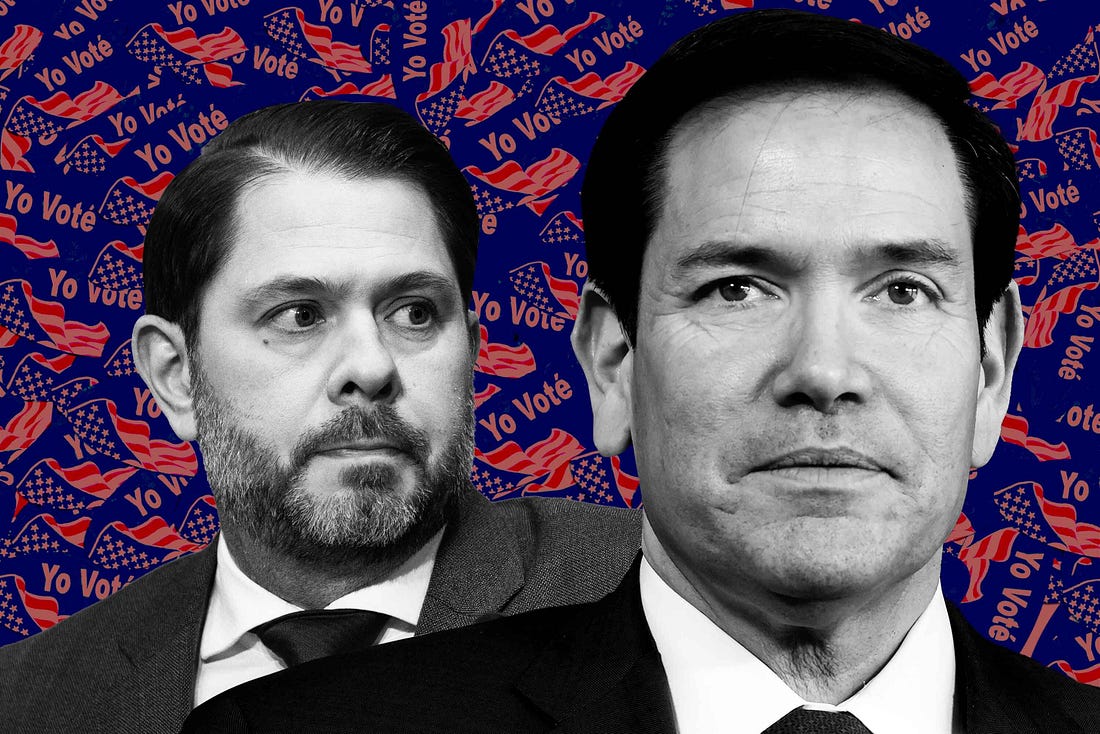 |
DURING A LITTLE NOTICED FIRESIDE CHAT this week in Washington, D.C., Sen. Ruben Gallego (D-Ariz.) told a gathering of fellow lawmakers, beltway types, and activists a scary campfire story.
“If Marco Rubio is the nominee for president,” Gallego warned, “we are in trouble.”
Gallego wasn’t definitively declaring that Secretary of State Rubio would win the Latino vote if he mounts a presidential bid in 2028. He was arguing something more nuanced: that the bilingual Cuban-American would blunt the growing strength Democrats have been showing in states like Arizona, Nevada, Texas, and Florida with voters who have recoiled at Trump’s policies and priorities.
Gallego was doing his best impression of Dr. Strange in Marvel’s Infinity War—looking ahead to see a dark hellscape of a future. But he also had a remedy to offer: If the Democratic party got its act together not just with Latino voters but with better messaging immigration ahead of the 2026 midterms, a presidential election letdown could be avoided in 2028. He had reason to believe that Democrats could do just that.
Polling in recent months has shown how deeply Trump has slipped with Hispanic voters. A March poll of 1,054 Latino adults by Florida International University’s Latino Public Opinion Forum showed 67 percent of those surveyed disapproved of Trump, with cost of living, immigration, and health care as respondents’ top issues. In April, the Pew Research Center showed that Trump had reached a second-term low approval rating among Latino voters who backed him in 2024, with a 27-point drop in approval since his inauguration.
These numbers formed the backdrop for the event at which Gallego spoke: the inaugural Latino Vote Summit convened on Tuesday at the National Press Club. Speaking alongside the senator were Chuck Rocha and Mike Madrid, a duo from opposite sides of the aisle who have worked on campaigns for a couple decades and also host the Latino Vote podcast.
They and others discussed how Trump’s problems with voters stemmed largely from their belief that he had misplaced priorities and that none included a laser-like focus on the state of the economy. Carlos Odio, co-founder of Equis Research, a Democratic-aligned group, said that Trump came into office with a grace period with Latinos, which ended thanks to a combination of flailing on the economy and over-aggressive immigration enforcement last summer.
“With Trump it’s never one thing. It’s the experience of it all—everything, everywhere, all at once,” Odio told me after his panel:
It’s not just immigration, or just the tariffs. It’s an overall sense of priorities in the wrong place. People getting mad about Iran is not that different than when they get mad about the ballroom. They did think there was a problem with the immigration surge and wanted him to take measures to restore enforcement, but they don’t like what they’ve seen from his administration and don’t think it should be the priority.
And here’s where Rubio enters the equation.
Trump may be a singular, disruptive presence in American politics. But someday some Republican will have to take his place. It’s not that Rubio is beloved—though Republicans like him a lot, and more than JD Vance. It’s that a bilingual, bicultural South Florida Cuban-American is by definition different from Trump. Gallego’s worry was that if Democrats stumbled on how they talk to persuadable Hispanics, Rubio could sell a story that recaptured them and their votes.
FOR ALL THE TALK OF HOW the economy and cost of living are the top issues for Americans—and they are—there was one stat from Equis’s polling over the last year that I found particularly instructive. When the Trump administration swarmed Minneapolis in the new year, leading to the killings of Renée Good and Alex Pretti, immigration spiked as a priority for Hispanics, jumping up to 30 percent. That was nearly as high as the 34 percent of those who named the economy as their top issue during that same period in February. It then plummeted down to 13 percent in March and 10 percent this May.
The volatility illustrated the dilemma the Trump administration finds itself in: Immigration becomes top-of-mind for voters when the news around it is alarming. That’s widely different from 2024, when Trump ran successfully on mass deportations and border security.