
|


 |
It’s almost hard to remember nowadays, but before the pandemic a lot of us were worried about falling business dynamism in the United States. For whatever reason, Americans just weren’t starting companies — either high-growth startups or small businesses — at the rate they used to. Much ink was spilled discussing possible reasons for the trend, and potential levers for reversing it.
Then the pandemic came, and the trend shifted almost overnight. Suddenly, Americans were creating new businesses again:
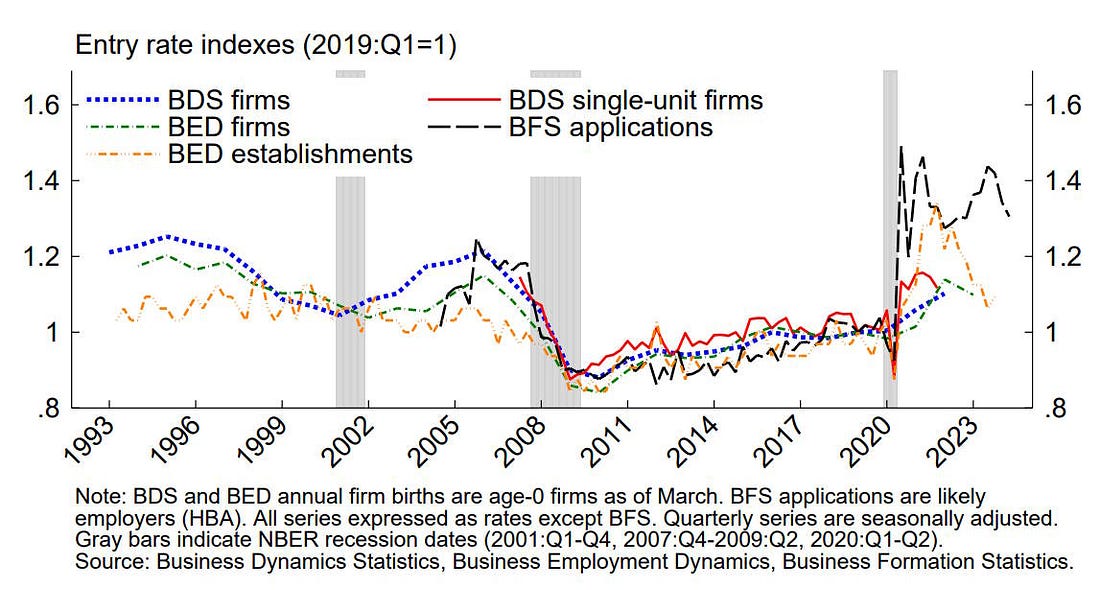 |
Notably, even in 2024 the trend in business applications showed no sign of reverting to its pre-pandemic level. The shift seems at least partly durable.
No one knows exactly why new business creation has surged in recent years. But one possibility is that technology has made it possible for people to start businesses with a lot fewer employees. Stripe Economics has an interesting blog post about the rise of “solopreneurs” — independent businesspeople who don’t employ anyone else at their businesses:

The upshot is that there’s a big trend to “solopreneurship”, and that the pandemic accelerated the shift:
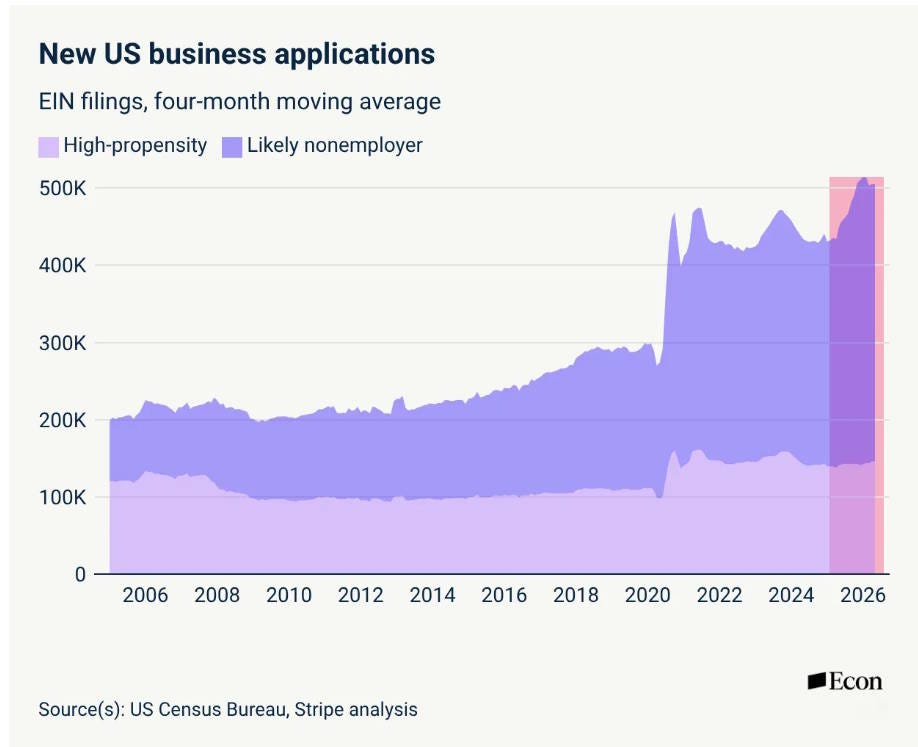 |
Solopreneurship has been increasing since 2008, both in absolute terms and as a percent of new business formation. Some of this is due to legal changes. The Obamacare exchanges make it easier for solopreneurs to buy their own health insurance. The Qualified Business Income deduction, the simplified home-office deduction, and other tax changes have made it more favorable to be a solopreneur.
On top of that, the internet made a lot of solo business models easier to execute, from dropshipping businesses to YouTube channels to subscription-based email newsletters. I am a solopreneur myself — Noahpinion is an S-corporation. Substack made it incredibly easy for me to sell and deliver content online, Twitter/X made it incredibly easy for me to market that content, and Stripe made it incredibly easy to receive payments — all without hiring anyone.
The team at Stripe Economics argues that this latter trend is just getting started. Thanks to AI, the number of business models that can be executed by single individuals is growing rapidly:
An agent can now help you find the best tools for your business and handle your integration with minimal support….The recent growth in nonemployer businesses shows a positive relationship with industry-level AI adoption…
Part of the reason businesses historically tended to be built by groups was that a single individual rarely possesses all the skills needed in the entrepreneurial journey. Whether it’s how to evaluate or size a market, code an app, price a product, write and execute a marketing campaign, or close a deal, AI (and AI-augmented software) can fill many of the gaps that founders previously turned to another human for. Or, as Sam Altman so succinctly put it: “revenge of the idea guys.”
We think this phenomenon is the true engine of the AI surge in business formation we’re seeing today. The availability of this breadth of on-tap assistance allows anyone with sufficient motivation to go it alone. Given this, we think the 20% figure is a floor rather than a ceiling in terms of AI impact.
This makes sense. It’s pretty clear that one big reason to have a multi-person company has always been individual specialization. But Claude is far more versatile than any human being, so in the age of AI agents, specialization will probably be less important in many cases.