
|
 |
One thing that sets Popular Information apart from a lot of other independent newsletters is that we don’t put our work behind a paywall. Why? We produce journalism to hold the powerful accountable and spur change. That means it needs to reach as large an audience as possible.
Our reporting would not have forced the Social Security Administration to abandon a destructive plan to restrict telephone service or secured paid sick leave for 170,000 restaurant workers if it was hidden behind a paywall.
This decision, however, has come at a high cost. Similar newsletters that paywall their content have two or three times as many paid subscribers, on a percentage basis. That means we have fewer resources available to pursue our work than if we took a traditional approach that maximized revenue.
I still believe that forgoing a paywall is the right decision for Popular Information because it is central to our mission. I am being transparent about the consequences, because I hope it will inspire more people to support our work by upgrading to a paid subscription.
You can make a real difference for $50 per year or $6 per month.
Trump’s “Big Beautiful Bill” is making kids go hungry
Hundreds of thousands of children in Arizona have been pushed off nutrition assistance.
| |||||||||||||||


 |
One of the key provisions of President Trump’s “Big Beautiful Bill,” enacted on July 4, 2025, was a major cut to nutrition assistance for low-income Americans, known as Supplemental Nutrition Assistance Program (SNAP). The SNAP cuts amounted to about $18.7 billion annually — about as much as the federal government spent in one week of the Iran War. Although the deepest SNAP cuts have yet to take effect, the impact of these cuts has already been devastating, particularly for children.
In Arizona, for example, enrollment in SNAP programs has plummeted by more than 50% since the state began implementing the changes mandated by the Trump administration. In June 2025, there were about 375,000 Arizona children enrolled in SNAP. In May 2026, that number had plummeted to 178,000.
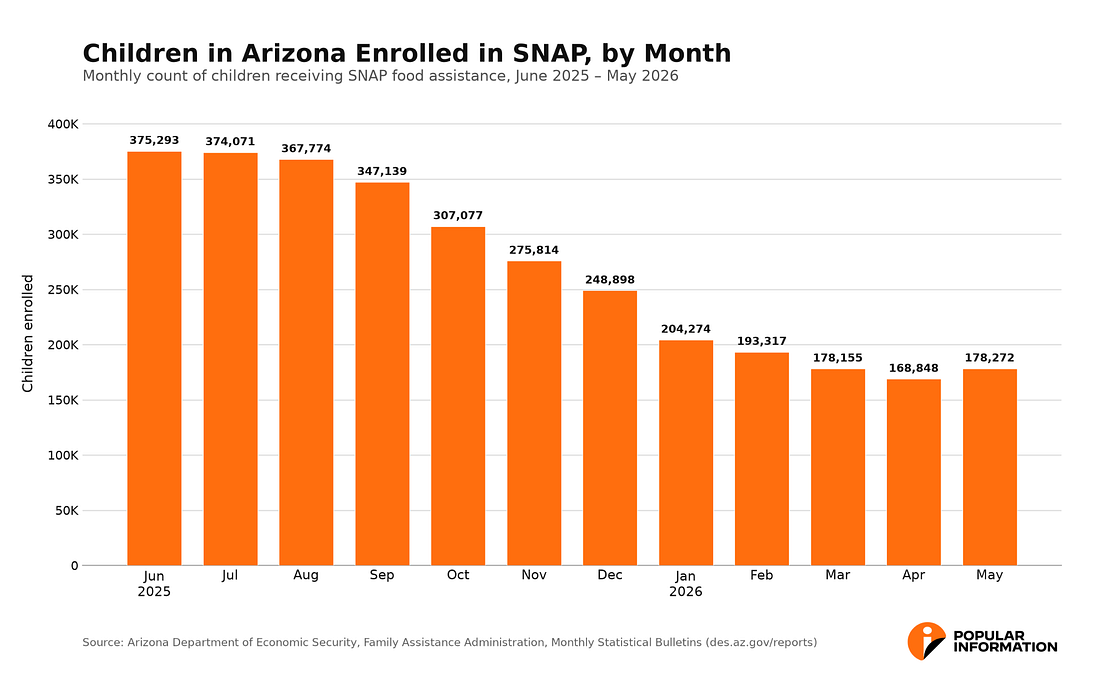 |
There are not 200,000 fewer hungry children in Arizona today. The cost of food in the state is increasing rapidly. The Trump administration, however, has implemented a policy designed to let those children go hungry. Overall, Arizona SNAP enrollment has plummeted from about 910,000 in June 2025 to 452,000 in May 2026.
One major factor is the “Big Beautiful Bill” reduces the federal government’s contribution to the administrative costs of SNAP from 50% to 25%. Although this reduction does not formally take place until October 2026, Arizona has reduced staffing in anticipation of the cut and other federal funding reductions. The number of people at Arizona’s Department of Economic Security [DES] tasked with reviewing SNAP eligibility has fallen from 1,370 in July 2024 to 880. The staff reduction has resulted in “a backlog, with people waiting longer to get qualified.”
In December 2025, there were over 18,000 SNAP applications in Arizona that were more than 30 days old. The backlog has persisted. As a practical matter, this means when state workers review the applications, the pay stubs and other eligibility documents need to be resubmitted, further delaying the process.
Another factor restricting enrollment is the fear that Arizona will soon have to pay a significant percentage of SNAP benefit costs. Previously, the federal government provided 100% of SNAP benefit costs to states. But under the “Big Beautiful Bill” states could be required to pay up to 15% of cost.
The state contribution is linked to the SNAP “error rate.” The Trump administration conflates the “error rate” with fraud, but that is inaccurate. The error rate refers to any overpayment or underpayment of SNAP benefits. This could occur due to error of the state agency and through no fault of the beneficiary. A family, for example, could be underpaid if they have a baby and the change is not processed quickly.
In 2023, established fraud claims amounted to just 0.06% of benefits. Sara Naomi Bleich, a researcher with Harvard University, says the new Trump administration rules will likely not reduce fraud at all since it targets error rates and not fraud.
The federal government will continue to pay 100% of SNAP benefit costs for states with error rates under 6%. In 2025, Arizona’s error rate was 10.8%. If that continues in 2026, the state could soon be on the hook for up to $300 million in SNAP benefits in fiscal year 2028.
To avoid this potential liability, Arizona has taken aggressive steps to reduce its error rate below 6%. This has made it virtually impossible for some eligible families to qualify for benefits. For example, Arizona is “now requiring applicants to complete phone interviews to prove eligibility.” But, due to staffing shortages, “it’s nearly impossible to get someone from DES to answer those calls.” If the interview is not completed, the applicants’ “benefits are cut and they have to reapply again.”
Adamary Olivas, a mother who applied for SNAP benefits, told KJZZ Phoenix that “daily calls to DES routinely went unanswered” and when she finally was able to speak to someone “the paperwork required to prove eligibility for food stamps had expired.” Olivas has been stuck in this loop since October. “We have to call and we call and call and they never answer so that’s the biggest issue,” she said.
Another factor is stricter eligibility requirements. The “Big Beautiful Bill” expanded work requirements to able-bodied individuals 55 to 64, veterans, people experiencing homelessness, young adults who were part of the foster care system, and caregivers with children 14 or older. But this accounts for a maximum of 150,000 people — far fewer than have actually lost benefits.