| | In this edition: South Africa braces for anti-migrant protests, Uganda cracks down on the press, and͏ ͏ ͏ ͏ ͏ ͏ |
| |  Kampala Kampala |  Addis Ababa Addis Ababa | Freetown |
 | Africa |  |
| |
|
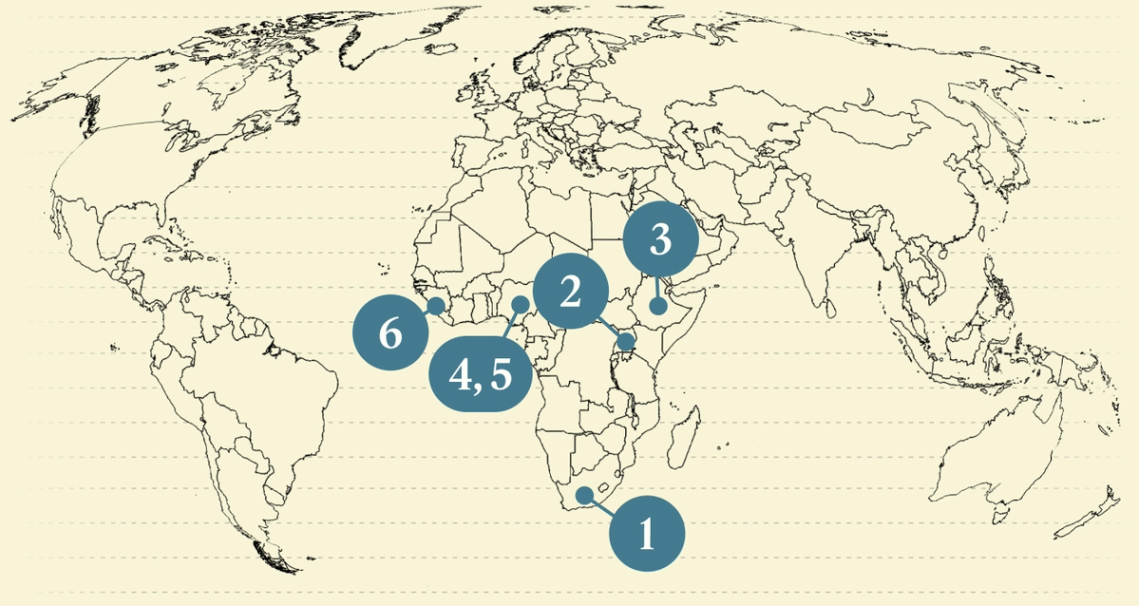 - S. Africa deadline nears
- Uganda’s media crackdown
- Bondholder deal agreed
- Nigeria faces inflation risk…
- … and finds mineral deposits
- Sierra Leone’s oil push
 The Week Ahead, and African nations reach the World Cup knockout stage in record numbers. |
|
 South Africa on Tuesday faces a major test for a state already stretched and carrying the scars of violence from years prior. New civic movements working alongside established anti-migrant vigilante groups are demanding the removal of undocumented migrants and tighter border enforcement, setting their own deadline of June 30. Large protests are expected and, in a country where migration has become an easy target for people suffering from a cascade of social and economic ills, the gatherings risk becoming combustible. The protests come against a grim backdrop of social pressures: Unemployment is entrenched, inequality is widening, and municipal services are unreliable. These conditions make any protest harder to manage because they inflame public resentment. Add to these factors a presidency distracted by leadership battles and impeachment proceedings, and you get a government struggling to project authority at the exact moment the country needs it most. The memory of July 2021 protests sits in the background. Demonstrations sparked by the arrest of the former president descended into looting and torching of trucks in KwaZulu-Natal and Gauteng— sub-Saharan Africa’s largest shipping terminal and the national economic hub, respectively — leaving more than 300 people dead and billions of dollars in assets destroyed. The trauma changed how the country thinks about risk. Malls reinforced their security battalions, landlords fortified buildings to make them tough to burgle or damage, and logistics operators learned to treat highways as a potentially risky territory. Maintaining public order became a permanent security burden carried by businesses, landlords, and ordinary citizens. Pretoria has since rolled out a 600 million rand ($35 million) security plan, complete with joint command centers and official briefings. Tuesday will show whether that plan will work, as Pretoria is confident it will, or whether South Africa must grapple with a new reality, one in which stability has become a community-funded expense, paid for by people least able to carry it.
|
|
S. Africa braces for anti-migrant deadline |
| |  | Tiisetso Motsoeneng |
| |
 An anti-immigration march earlier this month. Ihsaan Haffejee/Reuters. An anti-immigration march earlier this month. Ihsaan Haffejee/Reuters.Shopping mall owners in South Africa are preparing “for the worst” ahead of potentially violent anti-migrant demonstrations on Tuesday, which risk further tainting Pretoria’s reputation as a safe emerging market. The protests in Africa’s largest economy are organized by a civic movement called March and March, which called for all migrants to leave by June 30, and follow months of escalating xenophobic violence in the world’s most unequal society, where one in three people are unemployed. Acting police minister Firoz Cachalia flagged KwaZulu-Natal, Gauteng, and the Western Cape as potential hotspots, citing a new $35 million security plan. “That’s what it costs when there is an effort to destabilize the country.” |
|
Uganda clamps down on media |
 Abubaker Lubowa/Reuters Abubaker Lubowa/ReutersThe leader of Uganda’s military — who is also the son of the country’s long-ruling president — ordered the closure of two of the country’s biggest media outlets, in the latest signs of democratic erosion in Africa. Muhoozi Kainerugaba, who has been touted as a possible successor to his octogenarian father Yoweri Museveni, said he did not “believe in a free press,” adding that the newspaper and broadcaster, both owned by the Nation Media Group, would only be allowed to reopen with his permission. Kainerugaba has tightened his grip in recent months, ordering the arrest of politicians and activists before the media clampdown, which the Committee to Protect Journalists called a “deeply troubling escalation.” Press freedoms across Africa are already fragile, with most nations ranking in the lower half of an influential press freedoms index, while numerous recent coups have contributed to a weakening of democratic norms in parts of the continent. |
|
Addis agrees $1B bond deal |
 Tiksa Negeri/Reuters Tiksa Negeri/ReutersEthiopia agreed a preliminary deal with key lenders to restructure its $1 billion international bond, its finance ministry said. The agreement moves Africa’s second-most populous country closer to resolving its longstanding debt crisis. The country defaulted on the bond in Dec. 2023 and the deal marks a breakthrough after a lengthy restructuring process. A previous deal, struck in Jan. 2026, collapsed when official creditors raised objections, and bondholders rejected a revised offer in late May. Ethiopia’s debt restructuring has become a test case for the G20 Common Framework and highlighted how tensions between official and private creditors can delay wider economic recovery. Restructuring the country’s debt is a key step in realizing Prime Minister Abiy Ahmed’s bid to liberalize Ethiopia’s economy, because it would help to restore investor confidence and reduce financing costs. — Alexis Akwagyiram
|
|
Nigeria faces ‘highest’ inflation risk |
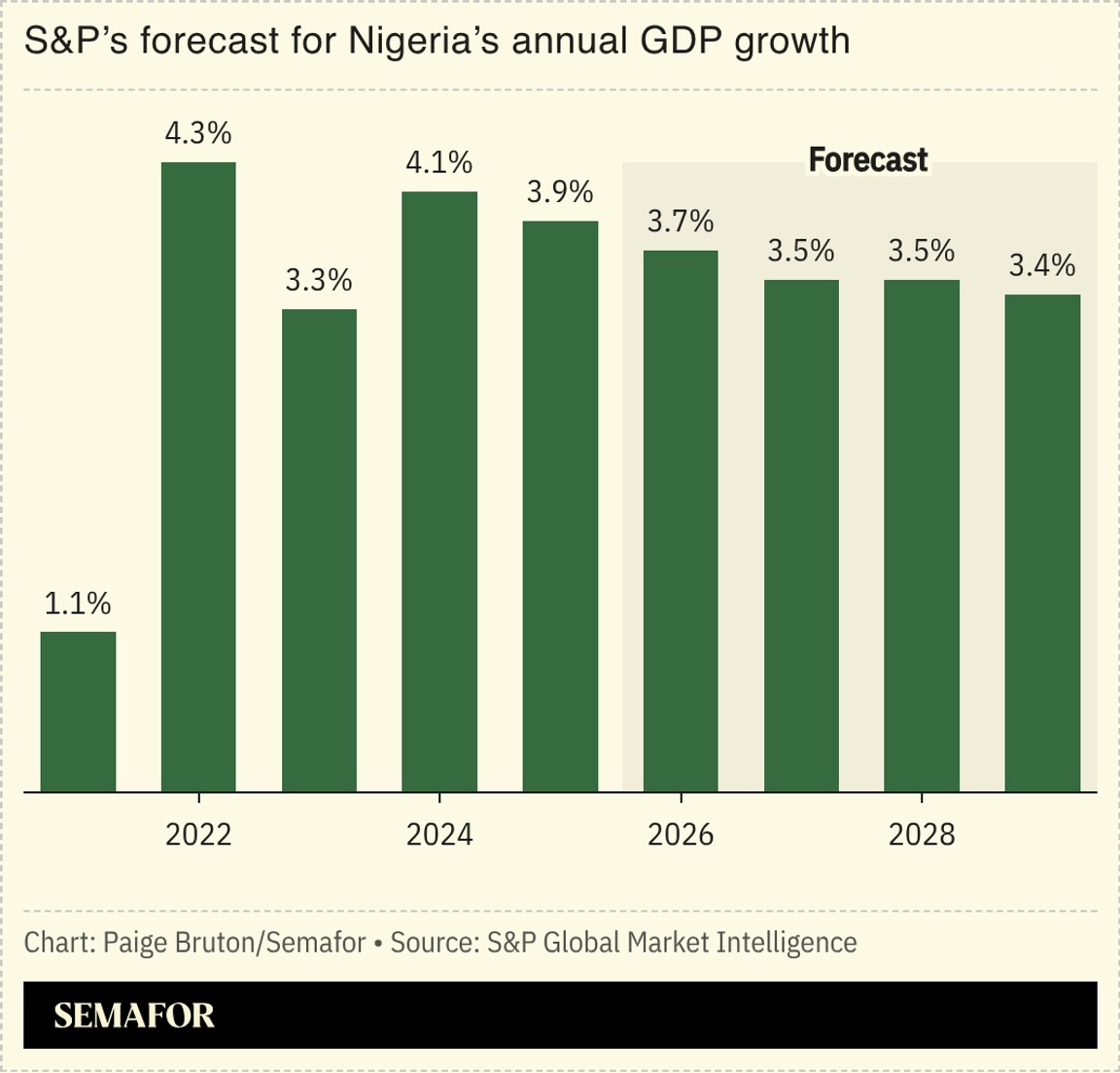 Nigeria faces the largest inflation shock among emerging markets this year, S&P said, citing higher energy and fertilizer prices triggered by the Iran war and El Niño. The ratings agency raised its forecast for Nigeria’s average inflation rate to 16.9% and trimmed GDP growth to 3.7%, citing a “stronger-than-expected passthrough from oil prices.” African economies have been hard hit by soaring oil prices sparked by the Iran war, and even as they have come down, costs at the petrol pump remain high. S&P does not expect central banks in most emerging economies to “loosen monetary policy, and some may tighten policy,” including in South Africa, where the agency raised its average inflation forecast to 4.3% from 3.5% for 2026, and cut growth to 1.3%. South Africa already hiked its interest rate by 25 -basis points last month, as policymakers grappled with the global energy shock. Compounding the strains sparked by the Iran war and the Strait of Hormuz blockade is this year’s El Niño weather phenomenon, which experts warn could further squeeze African countries, especially soft commodity exporters. — Tiisetso Motsoeneng |
|
Nigeria unearths new mineral deposits |
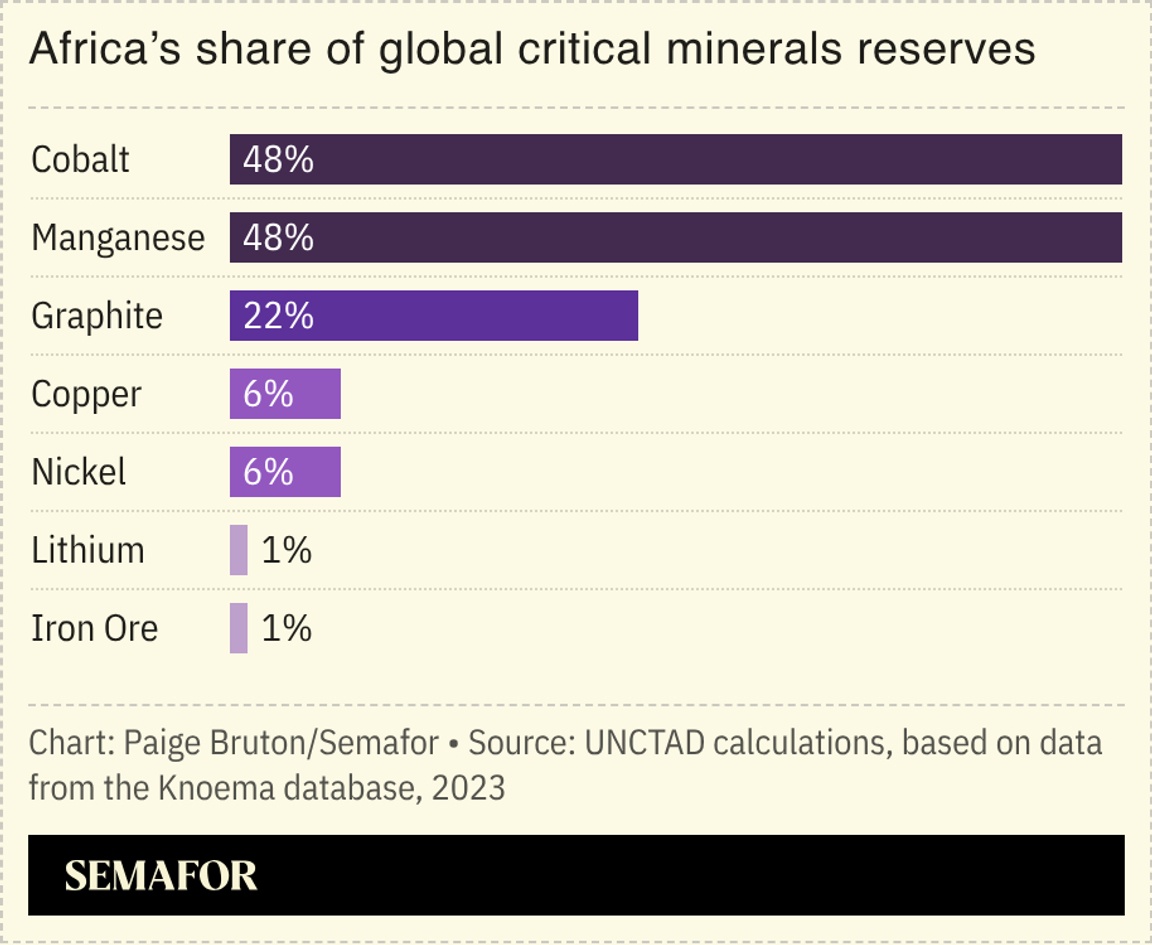 Nigeria said it discovered new deposits of valuable copper, lithium, and rare earth minerals, a potential boost for the West African nation as it seeks to woo more international mining investment in a bid to diversify its oil-dominant economy. The solid minerals minister said there were significant deposits found in the northern Kaduna state, which also include gold and nickel, adding that they were of “exceptionally high grades.” President Bola Tinubu is pushing to revise Nigeria’s mining framework in a bid to grow the sector; Abuja said last month it has attracted $2.6 billion in foreign direct investment into the industry over the past 2.5 years. The country is looking to join continental heavyweights such as DR Congo, South Africa, Tanzania, and Zimbabwe in the mineral extraction sector. Most of their mineral resources are sent to China for processing, but some countries are pushing to capture a greater share of the value of the minerals, which are central for renewable energy and defense manufacturing. |
|
Sierra Leone grants oil block rights |
 Mike Blake/Reuters Mike Blake/ReutersSierra Leone granted exploration rights for four offshore oil blocks to Nigeria’s Marginal Energy, in a bid to reignite investor interest in the industry. The deal comes as Sierra Leone plans to issue more offshore licenses and follows separate agreements between Freetown and energy giants Shell and Eni over the last year to explore more than 20 oil blocks. African energy companies are seeing a boom in oil exploration activities, riding the wave of a favorable financing environment for the sector encouraged by US President Donald Trump’s push away from clean energy. Investment in sub-Saharan Africa’s upstream oil and gas sector is projected to rise by 12% to nearly $24 billion this year, according to the International Energy Agency. — Alexander Onukwue |
|
 - June 30: Russia’s foreign minister holds a meeting to discuss preparations for a proposed Russia-Africa summit.
- July 1: Google Cloud hosts its Leaders Connect Summit in Johannesburg, focusing on AI for businesses.
- July 2: The FashionEVO summit, focused on innovation in Africa’s fashion industry, kicks off in Lusaka.
- July 2: Leaders from MTN, Africa’s biggest telecoms company, deliver a lecture on small businesses and AI in Johannesburg.
- July 5: One of the continent’s largest annual energy conferences, NOG Energy Week, is due to kick off.
|
|
 Business & Macro |
|
|


