|
|
|
|
|
|
|
|
|
A specialist works on the floor of the New York Stock Exchange on Friday. The frenzy over AI and the recent initial public offering of SpaceX has some spawned doubters who are worried that we are in the midst of another equity bubble. Richard Drew/The Associated Press
|
|
|
|
|
The stock market has been delivering dazzling returns over the past year, and a few warnings as well. |
|
|
|
|
The frenzy over artificial intelligence and the recent initial public offering of Space Exploration Technologies Corp. (or SpaceX) has some spawned doubters who are worried that we are in the midst of another equity bubble. |
|
|
|
|
Oh, and no shortage of enthusiasts who expect the good times will keep rolling. |
|
|
|
|
That’s why I asked for your thoughts on the matter, through an online poll a couple of weeks ago. You delivered in a big way – thanks, as always – with over 800 responses. |
|
|
|
|
|
|
|
|
And now, the results ... drumroll please. |
|
|
|
|
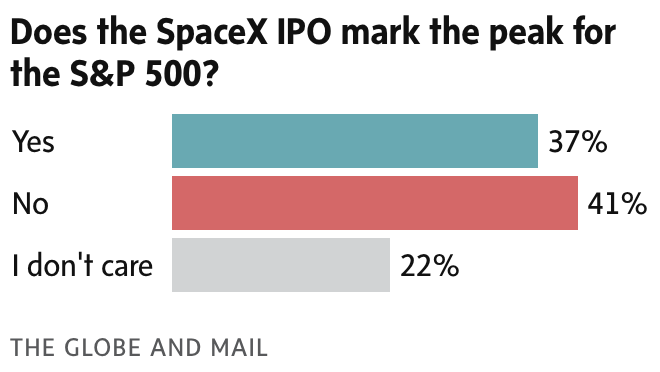
In one question, I asked if you thought that the SpaceX IPO marked the peak for the S&P 500. |
|
|
|
|
The question sprang from some of the cautious commentary that is now circulating. It argues that the record-breaking size of the new listing and the upbeat response from investors to a money-losing company might symbolize a euphoric high for tech stocks. |
|
|
|
|
From here, things can only go down – or so goes the bearish case. |
|
|
|
|
The most popular response to the question – at 41 per cent – was No. That is, the IPO did not mark the peak. |
|
|
|
|
|
|
That lines up remarkably close to two of the most recent weekly sentiment surveys from the American Association of Individual Investors. |
|
|
|
|
Over the past two surveys, an average of 40.75 per cent of respondents felt the S&P 500 will be higher in six months, which is higher than the historical average of 37.5 per cent for the survey. |
|
|
|
|
Collectively, investors are feeling fairly bullish these days, which may offer support for bulls and bears. |
|
|
|
|
Bulls can point to current market support and what looks like plenty of room for enthusiasm to rise even more (41 per cent? Wake me up when it hits 70 per cent). |
|
|
|
|
Bears can see the current level of enthusiasm as further proof that stocks are already reflecting investor ebullience. |
|
|
|
|
For what it’s worth, SpaceX’s share price has retreated 30 per cent from its intraday high on June 16. And the S&P 500 – the blue-chip index that does not include SpaceX as a member yet – is down 2.7 per cent from its peak on June 2, as of Monday. |
|
|
|
|
|
|
|
|
|
|
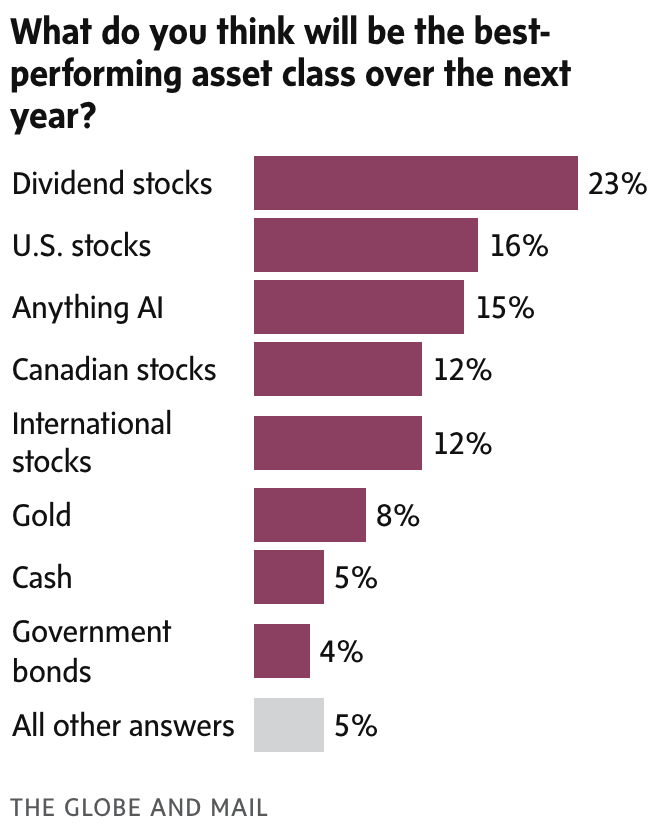
Another question in the On Money poll asked for your view on which asset class will perform best over the next 12 months, from a list of eight possibilities. |
|
|
|
|
|
|
If you were feeling worried about the stock market’s current heights, you might lean toward cash or government bonds. Surprisingly (to me at least), these safe assets were the two least popular choices among respondents to the question, at just 5 per cent and 4 per cent, respectively. |
|
|
|
|
Dividend stocks were the favourites, with 23 per cent of respondents tapping them as the top performers over the next year. They can be resilient to economic downturns and market dips, but dividend stocks have also enjoyed a blistering run over the past year, thanks in part to the rally in bank stocks. |
|
|
|
|
The “Anything AI” asset class – which isn’t an official category but merely a way for me to gauge your interest in many of the hottest stocks out there – also won a lot of support, at 15 per cent. |
|
|
|
|
Perhaps we’ll look at the performance of these asset classes next year, to see how the poll did – or didn’t – get the winners right. |
|
|
|
|
Let me know if you spotted anything in the poll’s results that you found interesting. As always, I’m at dberman@globeandmail.com. |
|
|
|
|
Subscribe to the On Money newsletter
Are you reading this newsletter on the web or did someone forward the e-mail version to you? If so, you can sign up for On Money here. |
|
|
|
|
|
|
|
|
|
|
|
|
|
|
|
| Canada’s economy is on life support
And so is the Canadian dollar. It’s heading toward 70 cents against the U.S. dollar, down from a recent high of 73.6 cents in early May. David Rosenberg, chief economist and founder of Rosenberg Research, thinks the currency will fall even more if the economy continues to struggle. | | |
| The economic cost of Brexit, 10 years onA decade after the U.K. voted to leave the European Union, economists are adding up the benefits. Umm, there aren’t any: The U.K. economy’s growth trajectory has slowed noticeably and trade in goods has disappointed as well. The good news, according to Goldman Sachs, is that the worst may be over. | | |
|
Pet owners tighten the leash on spending
Apparently, pet owners have limits on what they are willing to spend on their beloved furry (and feathered!) friends. The pandemic pet boom, which saw spending surge nearly 20 per cent in 2021, is now easing back as affordability becomes an issue. Tell that to my dachshund. | | |
| Remote working is making it harder for grads to find (and keep) jobsThe rise of artificial intelligence is just one concern weighing on junior workers. Another: Companies that have embraced remote working since the pandemic are less likely to hire younger talent that might need mentoring or training (for subscribers to The Wall Street Journal). |
|
|
|
|
|
|
|