| | In today’s edition: Ben writes to us from a journalistic refuge in Latvia, ’The View″s subtle chang͏ ͏ ͏ ͏ ͏ ͏ |
| |  | Media |  |
| |
|
 - The View’s politics
- Media M&A
- Letter from Latvia
- Unexpected allies
- Social stats
- Mixed Signals
|
|
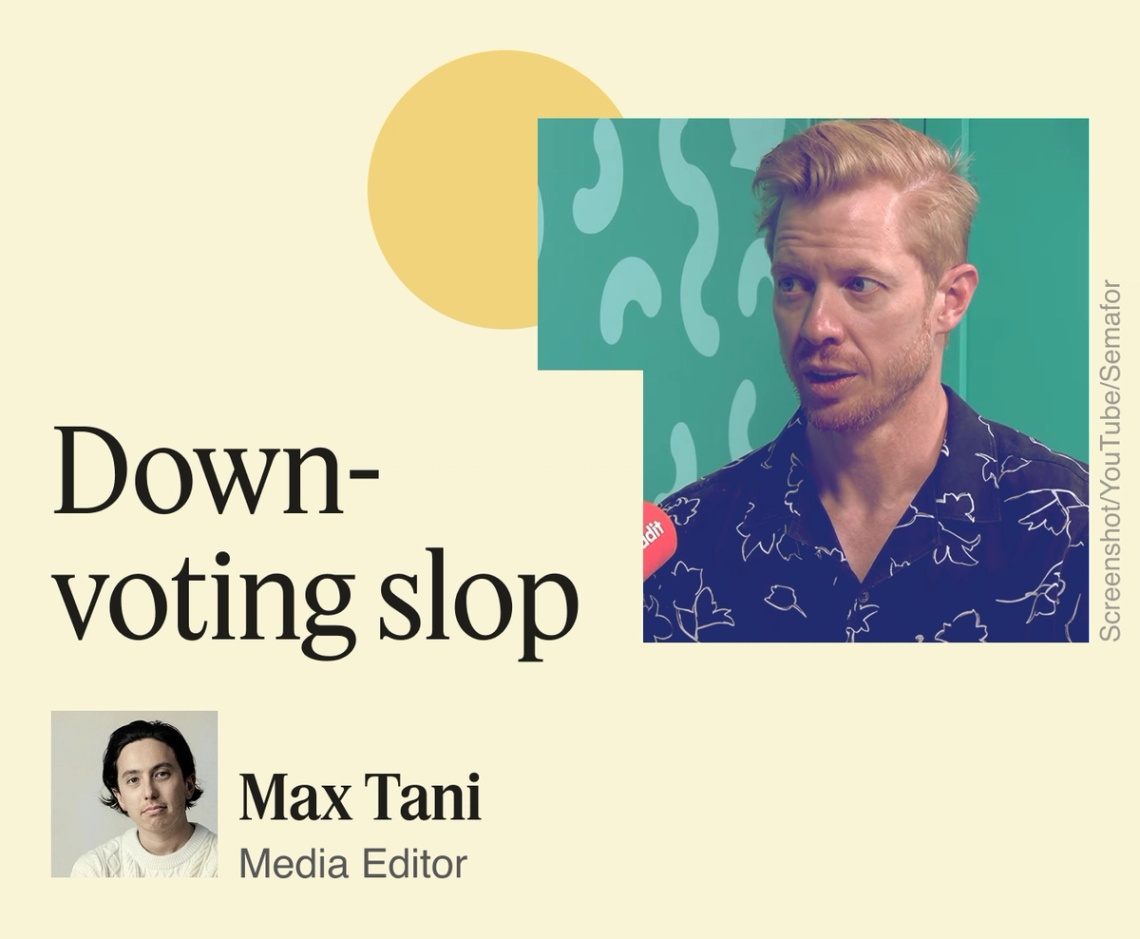 Every social media platform is struggling to contain an onslaught of low-quality, AI-generated garbage content that is threatening to inundate its users. When we interviewed Instagram CEO Adam Mosseri for Mixed Signals last year, he said keeping up with synthetic content was “tough” and that the platform was trying its best to algorithmically identify and downrank slop at scale. Reddit’s solution is simpler: putting its users to work. “Society broadly — and Reddit — will continue to reject AI-generated content,” Reddit CEO Steve Huffman told me in a recent interview for Mixed Signals. “[AI slop] has to be so good that people believe it to be additive, and if it’s not additive, it will be rejected, and I think that’s how it should be.” The conversation also touches on how the widespread adoption of AI writing tools challenges one of the media’s last hard lines: the importance of originality, and an unwillingness to plagiarize or take credit for writing done by someone (or something) else. But Huffman’s optimism offers at least a partial salve to the AI doomers: The way people react to AI writing on Reddit clearly shows that people on the internet still want original, well-informed thought that feels human. Mostly. Reddit can’t actually ban AI-written posts, he said. But, “if you’re lazy, the communities will reject it, and we want to empower them to reject it.” Also today: Ben writes to us from a journalistic refuge in Latvia, The View’s subtle change, and Comcast’s M&A pickle. |
|
‘The View’ slows political bookings amid FCC probe |
 Daniel Cole/Reuters Daniel Cole/ReutersFederal Communications Commission Chairman Brendan Carr’s agency has already changed the shape of one of the country’s top daytime talk shows — before even making any formal demands. The View, which has become a must-visit campaign stop for politicians over the last few decades, hasn’t hosted a candidate in a competitive race since February, when the FCC began investigating the show’s compliance with the agency’s “equal time” rule, a Semafor analysis shows. The View also recently rebuffed a pitch by a representative for New York City Mayor Zohran Mamdani to let fellow democratic socialists Darializa Avila Chevalier and Claire Valdez accompany the mayor on the show, with one person citing how the ongoing FCC investigation has prompted caution regarding active political candidates. Parent network ABC declined to provide a comment to Semafor, but has previously said The View is a “bona fide news program” and isn’t subject to the FCC rule, which requires broadcast programs to give equal time to opposing candidates. |
|
Comcast is a buyer in a seller’s market |
 Dado Ruvic/Illustration via Reuters Dado Ruvic/Illustration via ReutersComcast’s decision to split off NBCUniversal drove up shares of broadband giant Charter Tuesday, in hopes that an NBC spinoff meant some big M&A was on the horizon. But the pop turned out to be transitory, sputtering out by the end of the week. It turns out, one telecom CEO told me, that the conglomerate discount everyone thought was north of 25% turned out to be a quarter of that. It may take years for a deal to happen, CNBC’s Alex Sherman and Lillian Rizzo noted, since both NBCU and Comcast are too big to be prey but not big enough to be predators. Comcast’s advisers for months have told me that the debt load of Charter, nearly $100 billion, makes it an unappetizing target. Both companies are buyers in a seller’s market. There’s also the FCC of it all: both NBCU and Comcast still fall under Carr’s purview and he’s no friend to Comcast chair Brian Roberts. Still, Roberts is an inveterate dealmaker. Mike Angelakis, who will take over as CEO of the broadband business, is cut from the same cloth, having architected the takeover of NBCU in the first place. And Comcast co-CEO Mike Cavanagh, who previously helped run JPMorgan’s investment bank, is far more M&A-minded than media-minded, even all these years later. CEOs loudly tell the world they’re not interested in big M&A right up until they do a big deal. In this, Roberts, Angelakis, and Cavanagh are no different. — Rohan Goswami |
|
Refuge for exiled Russian journalists |
 “Riga” by Jorge Franganillo, CC BY 2.0 “Riga” by Jorge Franganillo, CC BY 2.0The Ukraine war has gradually slipped from the attention of US media and White House negotiators. So I was struck on a visit to Riga, Latvia, last week by how different its media space is from even that of Western Europe. Out here, President Donald Trump is still a source of deep concern — but many of the companies that draw skepticism further west, like Palantir and SpaceX, are often portrayed as heroic forces in Ukraine’s defense. Independent exiled Russian media like Meduza, Proekt, Faridaily, and the Dossier Center continue to provide glimpses into the Kremlin and from the front, as journalists stay connected via Telegram and other apps. It’s been a long four — or, for many, more — years for those Russian journalists. They face all the strains of a long exile as well as “transnational repression,” said Sabīne Sīle, the founder of Media Hub Riga, which provides work space and services to dozens of them (as well as recording space to occasional visiting podcasters like myself). “It’s not just murders or poisonings: Even though they’re safe here, they can face criminal charges, they can be put in Interpol, they can lose access to their bank accounts.” Two weeks ago, one prominent exiled journalist in Latvia died by, apparently, accidental poisoning, adding to the anxiety. Many of the highest-profile outlets, like Meduza and TV Rain, have moved on from Riga to Western capitals, but freelancers and smaller independent outlets can’t afford to. So the Media Hub, with an open office and gleaming video studio, is as bustling as it was when I dropped in three years ago. A bit of infrastructure — and community — goes a long way in supporting vital sources of news. The Latvian government’s willingness to host the journalists has been “extremely important,” said Kirill Nabutov, a TV producer and commentator, and the hub has become “a real center of our spiritual life and professional life.” — Ben Smith |
|
Murdoch’s media empire finds common ground with Democrats |
 Evan Vucci/Reuters Evan Vucci/ReutersLast week, the public got a closer look at the president’s tangled financial picture — between the release of his annual financial disclosure, detailing his investment earnings and crypto venture income, and a New York Times report on his and Commerce Secretary Howard Lutnick’s connections to a Kazakh tungsten mining operation. Joining the usual critics, somewhat surprisingly: the op-ed pages of the Murdoch-owned Wall Street Journal and New York Post, which compared the first family’s “sketchy” conduct to “Hunter Biden-style sleaze” and warned of electoral consequences. “It’s hard to believe the Trump boys would be able to do the same deals if Dad wasn’t in the Oval Office,” the Journal wrote. As recently as last month, the papers’ otherwise (generally) Trump-friendly op-ed desks penned critiques of the president over his planned Iran deal, which was also panned in many corners of the Republican coalition. But the anti-corruption angle has the Murdoch properties joining in with the unlikeliest of bedfellows. — Graph Massara |
|
Support for social media restrictions builds |
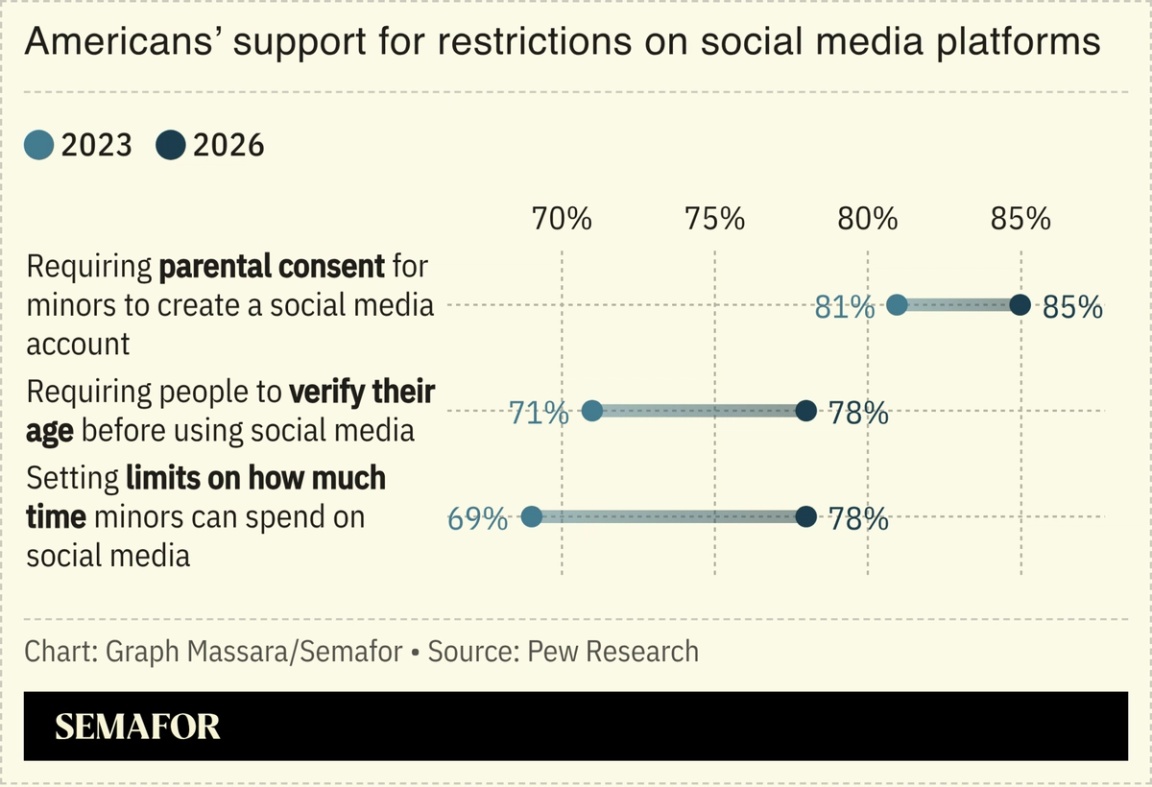 Fifty-six percent of US adults support a ban on social media for users under 16, according to a survey Pew conducted through early June. As efforts to restrict social media access gain momentum at the state level and in countries like the UK and Australia, even more Americans say they approve of policies like age verification (78%, up from 71% in 2023) and limiting the time minors can spend on platforms (78%, up from 69%). Those trends held steady across demographic groups and party lines, Pew found, suggesting that voters may embrace a regulatory crackdown regardless of party. In Washington, the Republican-led House passed the Kids Online Safety Act, though it faces dire odds in the Senate. And last week, as Semafor scooped, Democrats rolled out “Project 2029,” a regulatory framework meant to put “kids over clicks” that includes a 16-and-up social media age limit — as well as AI chatbot guardrails, an issue increasingly hard to separate from the old content moderation fights. — Graph Massara |
|
Reddit’s CEO on ‘Mixed Signals’ |
 Reddit CEO Steve Huffman thinks it is good you can’t get famous on Reddit. On this week’s Mixed Signals, he joins Ben and Max to explain why that may actually be a feature, not a bug, as the platform marks its 21st birthday and embraces its role as the internet’s “anti-social media” hub. They also discuss how Reddit approaches partnerships, why the company is suing Anthropic, and why Huffman believes it’s a good thing users can’t get rich from posting. |
|
Vanity Fair: Margaux MacColl chronicles Politico CEO Goli Sheikholeslami’s attempts to balance AI “survivalism” with the risks of moving too quickly. Drop Site: The Intercept’s Signal account was breached and has been communicating with potential sources purportedly on the outlet’s behalf, Intercept alumni Murtaza Hussain and Ryan Grim scoop. Bloomberg: Netflix’s top shows are struggling to retain their audiences beyond their first season, with hits like Beef and The Four Seasons suffering Season 2 drop-offs of more than 50%, Lucas Shaw reports. |
|
- Inside Philanthropy founder David Callahan is launching Inside Political Money in the coming days, Semafor has learned. The site plans to apply Inside Philanthropy’s coverage and business model to campaign finance, super PACs, dark money, political vendors, and donor networks.
|
|
|


