| | In this edition: South Africa deports thousands of migrants, Nigeria’s oil production hits a six-yea͏ ͏ ͏ ͏ ͏ ͏ |
| |  | Africa |  |
| |
|
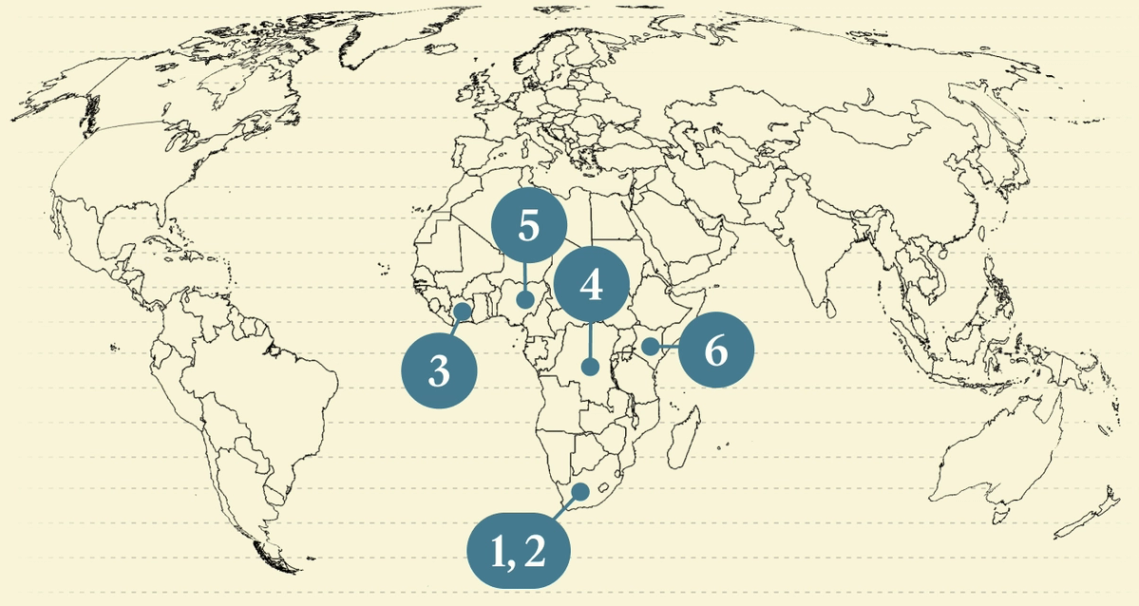 - Pretoria’s deportations
- S. Africa eyes inflation goal
- Africa envoy’s debut trip
- Firms map DRC minerals
- Nigeria’s oil production surge
- Power of corridor finance
 The Week Ahead, and an Ethiopian Instagrammer transforms trash into fashion. |
|
S. Africa removes 53,000 migrants |
 Oupa Nkosi/Reuters Oupa Nkosi/ReutersSouth Africa has removed more than 53,000 migrants over the last five weeks through deportations and repatriations following pressure from anti-migrant groups. Africa’s biggest economy has been on a knife edge for months over growing anti-migrant sentiment and xenophobic violence in a society where one in three is unemployed, and municipal services are deteriorating. Justice Minister Mmamoloko Kubayi, who announced the figures and is part of a government team carrying out a sweeping crackdown, said Malawians, Mozambicans, and Zimbabweans made up the bulk of those sent overseas. Campaigners have vowed weekly protests and given President Cyril Ramaphosa until the end of the year to enforce mass deportations and workplace quotas. The latest announcement may buy the government a reprieve with civic groups, who have begun acting as vigilante labor inspectors, entering factories to check for foreign workers. Government officials say labor inspections are illegal. — Tiisetso Motsoeneng |
|
SARB sees quicker path to inflation target |
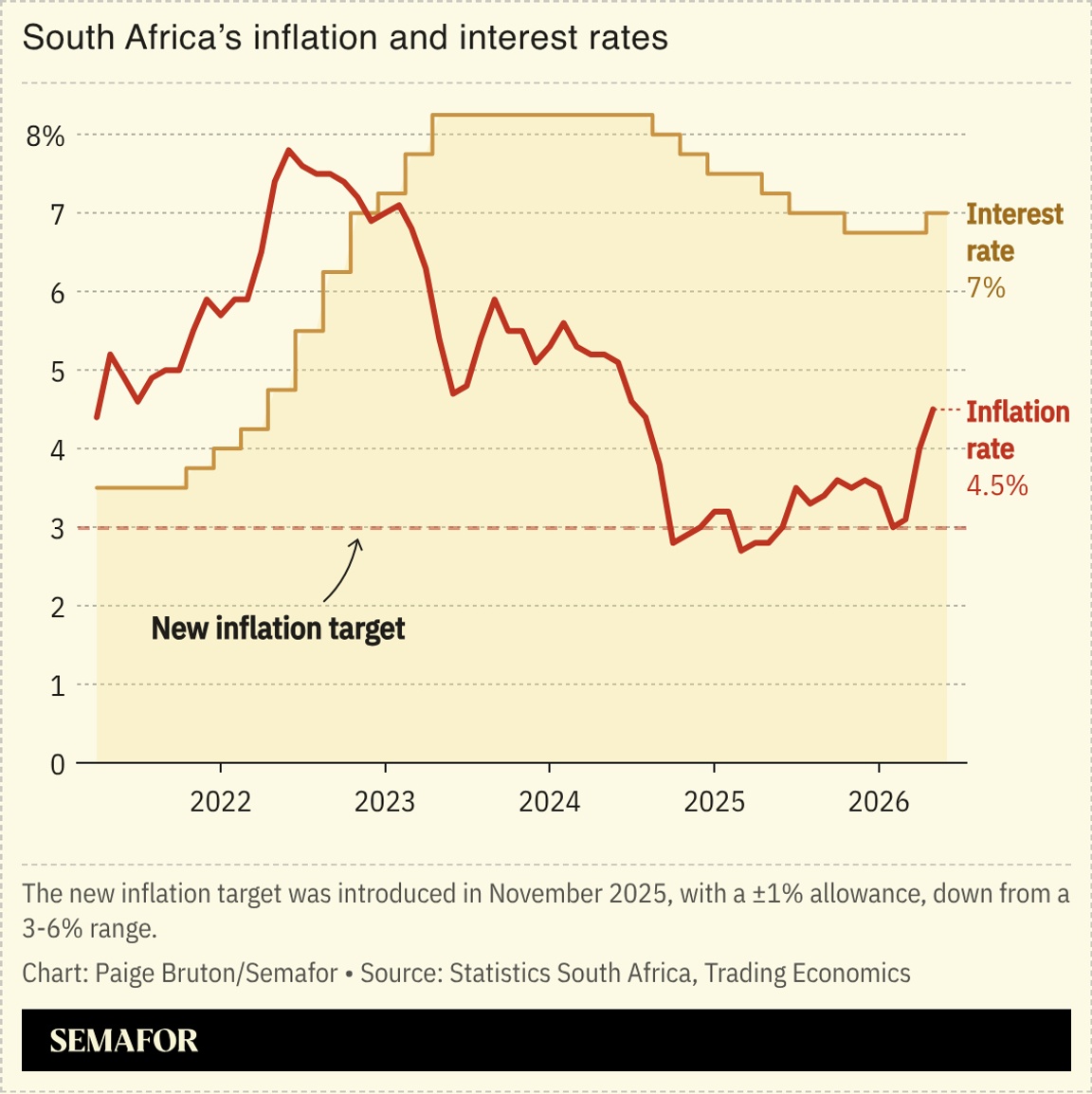 Falling global oil prices are on course to lower South Africa’s inflation rate to the central bank’s 3% target faster than modeled, its governor said ahead of next week’s monetary policy meeting, prompting economists to scale back expectations of back-to-back interest rate hikes. The South African Reserve Bank hiked rates for the first time in three years in May to meet its newly codified 3% inflation. But Governor Lesetja Kganyago said “the recent decline in oil should help too, getting us back to the 3% target a bit faster.” The remarks to foreign diplomats triggered an immediate reaction from Goldman Sachs, which replaced its call for an imminent 25-basis point hike with a decision to hold steady at next Thursday’s meeting. But the respite from global markets may not last indefinitely. Though prices now sit at $79 a barrel, compared to as much as $120 months ago, new strikes between Washington and Tehran have once again brought traffic through the Strait of Hormuz to a halt. — Tiisetso Motsoeneng |
|
Trump Africa envoy makes debut trip |
 Frank Garcia. US Bureau of African Affairs/X. Frank Garcia. US Bureau of African Affairs/X.Frank Garcia, the recently confirmed US assistant secretary of state for African affairs, began his first official trip to the continent this weekend, arriving in Nigeria before planned stops in Côte d’Ivoire and Mali. Garcia, a former Republican Capitol Hill staffer and Navy officer with limited Africa diplomatic experience, will link President Donald Trump’s “America First” agenda to commercial diplomacy, strategic competition, and security cooperation with Africa, especially in the wake of significant cuts to foreign assistance. Nigerian media reported that Garcia was expected to address the Trump administration’s proposed migration agreement in a meeting with President Bola Tinubu. The proposal could accelerate deportations and could tie Abuja’s cooperation to US visa restrictions. US-Africa policy watchers say Garcia’s more traditional State Department role runs alongside that of Massad Boulos, the White House-based senior presidential adviser for Africa, who also serves as the State Department’s senior adviser for Arab and African affairs. Boulos has led US peace negotiations in conflict-ridden eastern DR Congo and Sudan. — Yinka Adegoke |
|
US firms break into DRC mine mapping |
| |  | Ruben Nyanguila |
| |
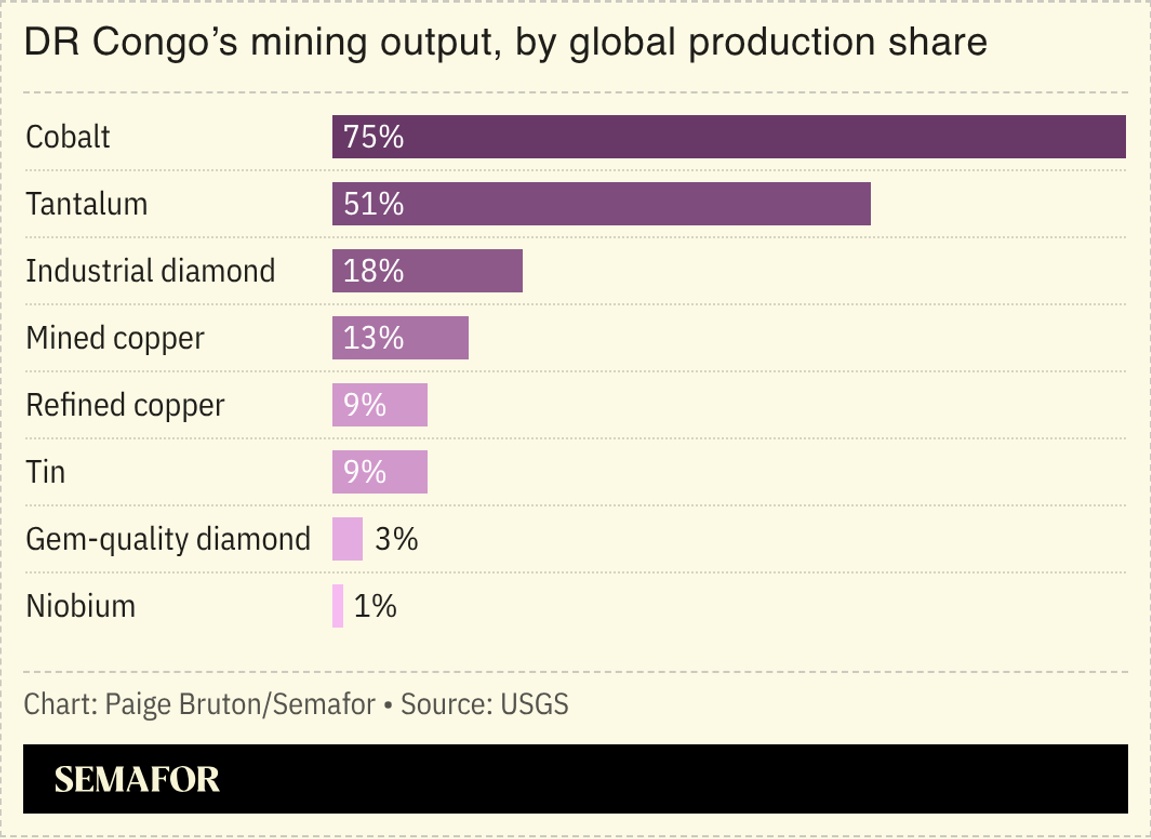 A US aviation firm is readying a proposal to collect geological data in DR Congo, joining other foreign companies mapping key mining information in a bid to unlock deposits potentially worth trillions of dollars. Gathering such data is a key component of new projects — only about 20% of DR Congo has been mapped — and Washington is eager for those projects to gain ground. If Dynamic Aviation’s plan is approved, it would join Spain’s Xcalibur geophysics company and US investment firm Atlas Park to survey mines in the country. US firms are eager to chip away at China’s dominance in the sector, but face an uphill battle: “The Americans are arriving in a copper and cobalt market where the Chinese have almost taken everything,” one expert told Semafor. DR Congo’s mineral wealth is key to its economy: The country produced 3.2 million tons of copper last year, behind only Chile, and the extractive sector accounts for about 14% of GDP. |
|
Nigeria’s oil output hits six-year high |
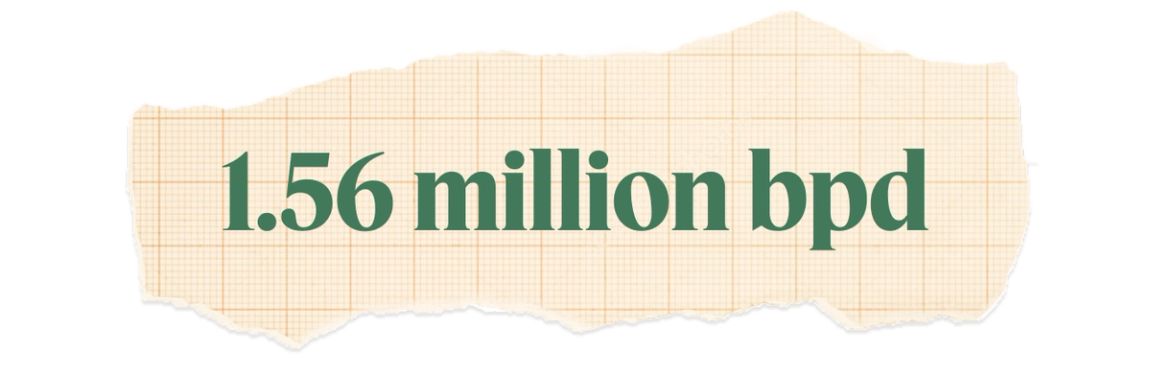 Nigeria’s daily crude oil production reached its highest level in six years last month following a government push to improve security along pipelines, the chief regulator of oil producing companies said. Oil receipts account for more than 90% of Nigeria’s foreign exchange earnings. Its $50 billion budget for this year is benchmarked against production levels of 1.8 million barrels daily. But output has been constrained in recent years by vandalism of facilities. A Senate committee last year estimated Nigeria’s losses from oil theft at $300 billion. The military has stepped up surveillance of oil facilities in the southern Niger Delta region to curb damage and theft. Together with condensates, total production of 1.7 million in June marked a fourth successive monthly increase in average production. The 1.56 million barrels-per-day output keeps Africa’s largest oil producer above its OPEC+ quota. — Alexander Onukwue |
|
View: The power of corridor finance |
  Presidential Press Service/Handout via Reuters Presidential Press Service/Handout via ReutersAcross Africa, governments have spent decades announcing ports without thinking about connecting railways, highways without paved feeder roads, and pipelines without ancillary terminals. Such projects may struggle because they lack “corridor finance,” Bright Simons, honorary vice president at IMANI think tank in Accra, wrote in a Semafor column. The basic premise is that a refinery cannot succeed without reliable ports, power, pipelines, roads, storage facilities, predictable regulations, and customers. A railway needs factories and exporters to justify its construction, argued Simons. Nigerian billionaire Aliko Dangote’s decision to build a $17 billion refinery at Kenya’s Lamu port has brought that problem into sharp focus. Serious investors are beginning to realize that individual mega-assets in Africa operate under a massive “corridor premium” because, without various other pieces of infrastructure — call them dependencies or feeder nodes — they take much longer to fully come onstream, if at all. |
|
 Semafor Gulf is now expanding to five days of coverage per week, reflecting the growing need for deeper reporting on the region. More than ever, developments in the Gulf are reverberating around the world, affecting events, energy markets, and entire economies. We are growing our network of reporters and editors across the region and the world and, starting this week, are expanding our coverage of the Gulf into a daily briefing. Subscribers will get even more of the sophisticated journalism they’ve come to expect, every weekday. For the deepest, most comprehensive, most insightful reporting on one of the most complex parts of the world, subscribe to Semafor Gulf. → |
|
|
 - July 13-15: The India-Africa Entrepreneurship & Investment Summit is held in Cape Town.
- July 13-15: The CCT Africa conference, covering cloud technology and communications, takes place in Wolmar, Mauritius.
- July 14: The UN Office for West Africa and the Sahel briefs the UN Security Council.
- July 14-15: Lagos hosts renewables leaders for the Solar & Storage Live event.
- July 14-15: Manufacturing Indaba, one of the continent’s largest events focused on the sector, is held in Johannesburg.
- July 14-17: Energy and water ministers from across southern Africa are due to meet in Pretoria.
|
|
|


