And, a relief for tech stocks.
 

India File

India File

By Ira Dugal, Editor Financial News, with global Reuters staff

Foreign investors are embracing Indian bonds with uncommon enthusiasm, even as they remain wary of the nation's stocks.

The resulting drop in borrowing costs is delivering immediate benefits for the government and economy, but are risks waiting in the wings? That's our focus this week. Share your views with me at ira.dugal@thomsonreuters.com.

Also, quarterly earnings from India's largest IT company brings relief to beaten-down tech stocks. Scroll down for that. And, catch the best of Reuters reporting on India in our 'must-reads' section.  


This week in Asia

  • Japan pension pivot seen as a slow burn, not a bond market fire sale
  • How the absence of Iran's Mojtaba Khamenei is becoming a liability for the Islamic Republic
  • China lifts fuel export curbs for July, sources say
  • Bangladesh's Hasina plans December return with party colleagues to surrender
 

Bonds get a vote of confidence


A man counts Indian rupee notes at a roadside currency exchange stall in the old quarters of Delhi, India, February 2, 2026. REUTERS/Anushree Fadnavis

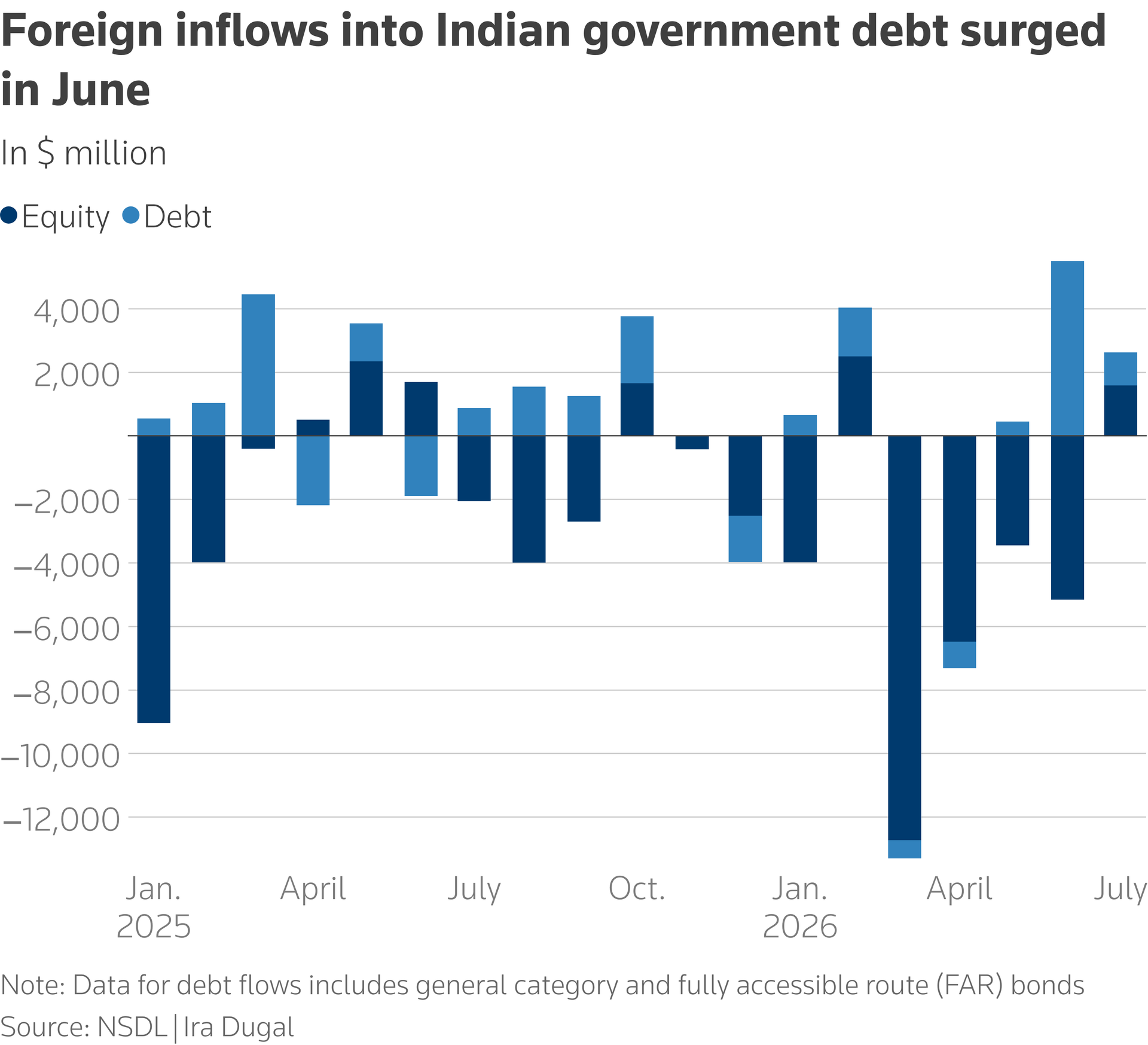
While Indian equity markets have struggled to draw foreign investor interest over the past year, the country's bonds are enjoying a moment in the spotlight.

A confluence of factors has led to nearly $6.5 billion in foreign investment into government securities since the start of June - a month which saw record inflows, pulling down the benchmark 10-year bond yield by 25 basis points to 6.73%, close to the levels seen before the Iran war began.

A relatively dovish central bank, lower taxes for foreign investors and a dollar deposit scheme targeting the Indian diaspora are all playing a part.

"The relative stability in the rupee after the central bank's steps aimed at drawing dollar flows has also been a key positive for bond investors," said Vivek Kumar, an economist at QuantEco Research.

Additionally, some front-running ahead of the potential inclusion of Indian sovereign debt in Bloomberg's flagship Global Aggregate Index could be driving demand, said Abhishek Upadhyay, co-head of economic and fixed income research at Mumbai-based ICICI Securities Primary Dealership.

"It has been a beautiful set-up for anyone considering allocation to Indian government bonds," he said.


Could bond bulls turn vigilantes?

The inflows have given foreigners increasing clout in a market that the government historically has carefully controlled.

Overseas ownership of bonds in a category called "fully accessible route (FAR)" climbed to 7%, Reuters' Dharamraj Dhutia reported. FAR bonds, introduced in 2020, have no foreign investment restrictions and are now part of three global bond indices, buffing their attractiveness to foreign investors.

Prior to 2020, India had tightly limited overseas investment in government debt, even though equity markets were fully open. The worry was that foreign ownership might spur volatility in borrowing costs across the economy, acting as a constraint on policymakers.

For instance, bond vigilantes — investors who demand higher yields when they perceive fiscal risks — could complicate the pursuit of spending priorities such as strategic energy reserves. Yields rise when bonds sell off.

India could eventually become more susceptible to such pressures, but those risks remain limited for now, said Upadhyay.

"Foreign ownership of Indian government bonds is still low, while domestic banks and insurers continue to provide a stable source of demand because of regulatory requirements," he said.

Banks are required to hold 18% of their deposits in government bonds, while investment guidelines for insurance companies also require large holdings of these securities.

India's 7% foreign ownership is lower than countries like Malaysia and Indonesia, where overseas investors own about 22% and 14% of government debt, respectively.

And QuantEco's Kumar noted that much of the investment has come from funds tracking global bond indices, suggesting the inflows could prove sticky.

"These are largely passive investors and they typically don't swing positions very sharply due to near-term macroeconomic developments as their holdings are linked to an index weight," he said.


Market matters

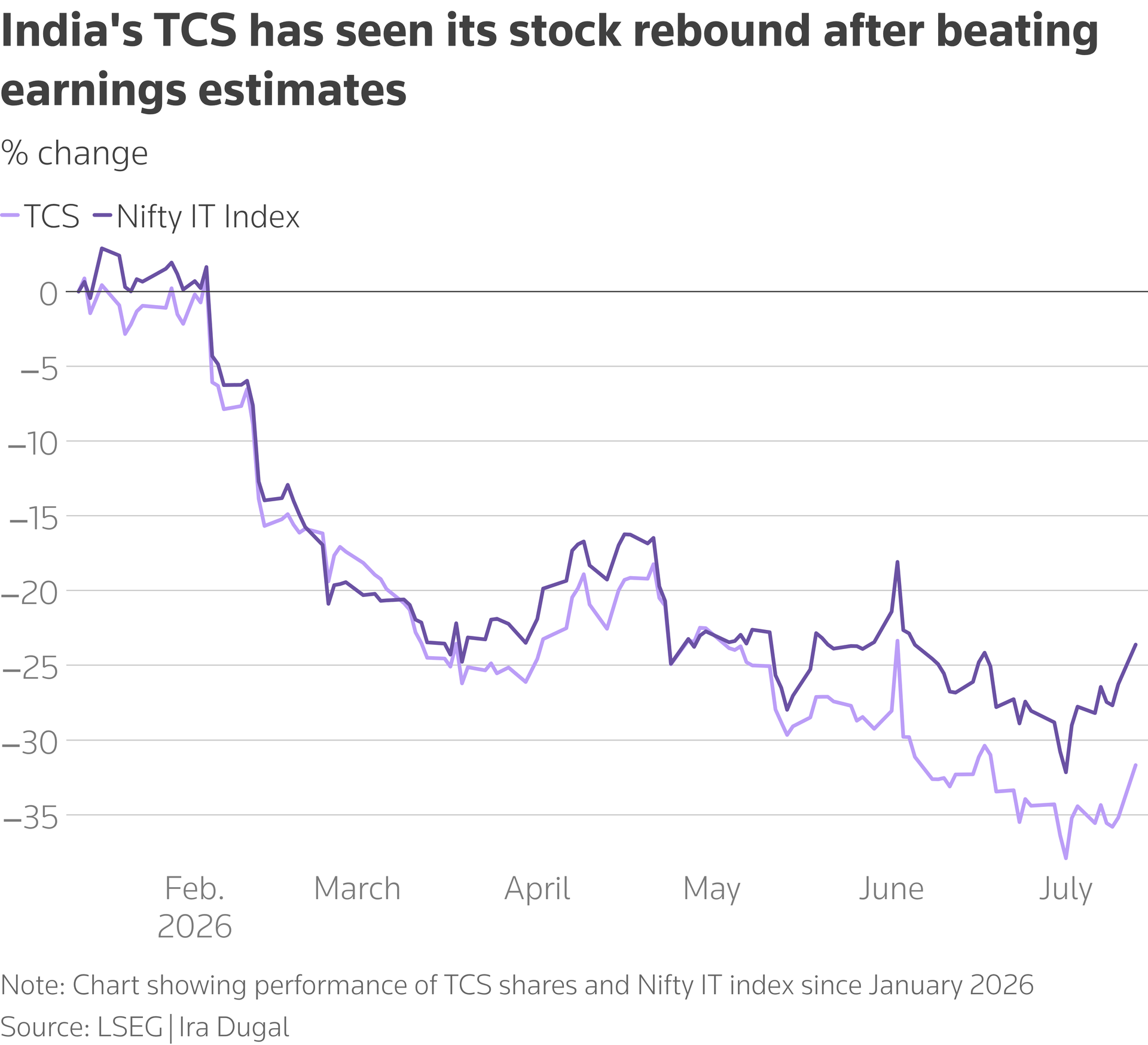
After a sharp fall since the start of the year in technology stocks, earnings from Tata Consultancy Services for the June quarter beat market expectations, bringing some relief to the sector.

Strong banking demand and rising AI revenue helped India's largest IT services firm beat revenue estimates.

Company executives told Reuters' Sai Ishwarbharath B and Haripriya Suresh that it is scouting for acquisitions in the AI space to further bolster revenue. Read more here.


This week's must-reads

  • India is holding out for a better trade deal with the U.S. as Prime Minister Narendra Modi draws confidence from new trading partners and a relatively resilient economy, Shivangi Acharya, Manoj Kumar and Trevor Hunnicutt reported.
  • India's National Stock Exchange (NSE) will pitch its IPO to over 30 global investors this month as a bet on the country's rapid financial expansion and growing capital-market participation, Jayshree Upadhyay reported.
  • An Indian investigation found duty-free shops run by billionaire Gautam Adani's business group at Mumbai international airport breached the law by selling nicotine pouches, Aditya Kalra reported. Adani denies wrongdoing. The Indian government is seeking to throw out a court challenge mounted by the Adani group.