Top News | A federal judge paused Paramount Skydance’s $110 billion acquisition of Warner Bros. Discovery for 14 days after 12 state attorneys general argued the deal would reduce competition in theatrical distribution and cable licensing, threatening the deal’s planned September close. TechCrunch has more here. | France has blocked access to Polymarket, citing illegal gambling, potential manipulation, and significant user losses, as European regulators crack down on prediction markets. Reuters has more here. | | |
VCs, if you're exploring AI for portfolio ops, start here. | AI Use Case Library is a live collection of ready-to-run workflows, complete with prompts, instructions, and example outputs. From board prep to portfolio monitoring and trend analysis, each use case is designed to get the job done in minutes. | | OpenAI Is Scared of Open-Weight Models. Should the US Be? |  | Image Credits: Jason Redmond / AFP / Getty Images |
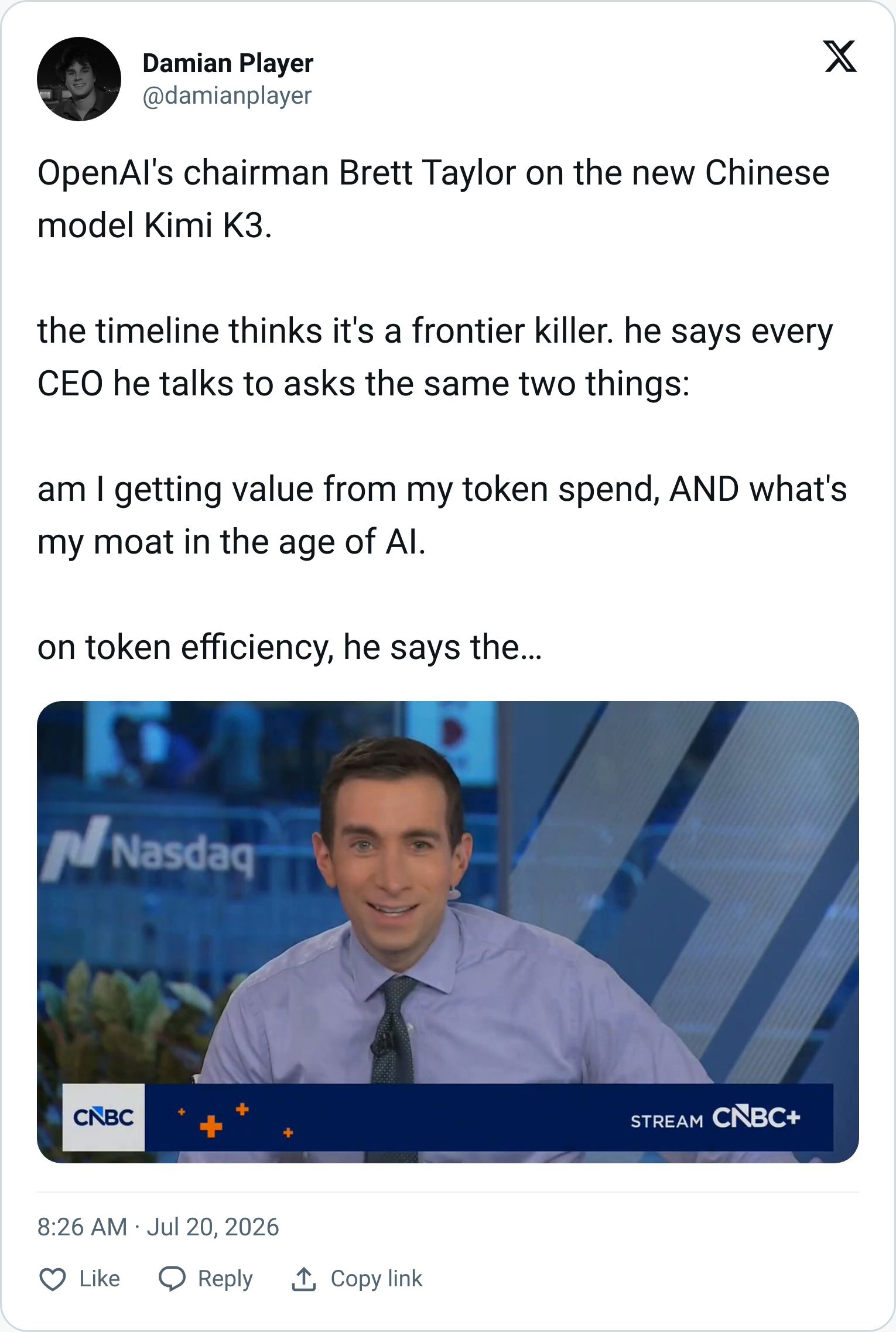
| By Tim Fernholz | The impressive capabilities of Chinese lab Moonshot’s Kimi K3, the biggest open-weight large language model, have kicked off a debate that conflates two things: the economic possibilities of American AI giants and the future of LLMs as a technology. | OpenAI’s head of strategic futures, Dean W. Ball, went so far as to argue that the US government should find a pretext to create regulatory fear, uncertainty, and distrust around the new models, since open-weight models must necessarily deter capital spending by the frontier labs. | People freaked out, with tech luminaries like Yann LeCun and Martin Casado arguing that open software can accelerate innovation and coexist with proprietary projects. Ball soon retracted his claims that a regulatory crackdown was the White House’s “best strategy” and that open-weight models necessarily slow down advances in the technology. | However, Axios reports that the Trump administration is considering banning K3 and other advanced Chinese models at the behest of American frontier labs. Another report from Politico said that the Department of Commerce would not take that step anytime soon. | The benefit for major AI companies is clear: Open-weight models, running on independent infrastructure or inside major enterprises, offer cheaper intelligence than Anthropic or OpenAI’s class-leading models. If users increasingly spend more outside the closed labs, that means smaller return on their massive investments in model training. | That view extends far beyond OpenAI. “Strong, frontier-caliber open source models will place a squeeze on the margins and will bring down the prices of the frontier companies,” Braden Hancock, the co-founder of Snorkel AI and a research partner at the Laude Institute, told TechCrunch. “It will not necessarily mean that the amount of AI usage goes down a little bit. You know, obviously, quite the opposite.” | | | Massive Fundings | Colossal Biosciences, a five-year-old Dallas startup that uses genetic engineering and reproductive technology to revive extinct species and support conservation, is reportedly in talks to raise funding at a $20 billion to $30 billion valuation, according to Axios. TechCrunch has more here. | CuspAI, a two-year-old startup based in Cambridge, UK, that uses AI to help chipmakers and other industrial companies discover materials that reduce research times and reliance on rare metals, raised a $450 million Series B round at a $2.6 billion post-money valuation. The deal was led by Kleiner Perkins, with Bezos Expeditions, Glade Brook Capital Partners, Lux Capital, AMD Ventures, Tru Arrow Partners, StepStone, the U.K.’s Sovereign AI Venture Fund, Invest-NL and John Doerr also anteing up. The Guardian has more here. | Fluidstack, a nine-year-old New York company that builds and operates AI cloud infrastructure for frontier AI labs, announced that in February it raised an $830 million Series A round at a $7.5 billion post-money valuation. The deal was led by Situational Awareness. More here. | | Big-But-Not-Crazy-Big Fundings | Empirical Security, a two-year-old Chicago startup that builds custom predictive models that help security teams prioritize exploitable software vulnerabilities in their own environments, raised a $25 million Series A round led by Brightmind Partners, with Costanoa Ventures and Hyde Park Angels also buying in. The company has raised a total of $37 million. More here. | Infinity, a one-year-old San Francisco startup that develops inference software to help AI chips run models without relying on Nvidia’s CUDA stack, raised $15 million in seed funding at a $100 million post-money valuation. Investors include Touring Capital and Principal VC. TechCrunch has more here. | Natural, a one-year-old San Francisco startup that builds payments infrastructure for AI agents, raised a $30 million Series A round led by Forerunner. The company has raised a total of $40 million. TechCrunch has more here. | RapidPulse, a five-year-old Miami startup that develops catheter-based aspiration technology that helps physicians remove blood clots from blocked brain arteries during ischemic stroke treatment, raised a $48 million Series B round co-led by Medtronic, TechWald Next, and S3 Ventures, with SBI Investment Company and Florida Opportunity Fund as well as previous investors Santé Ventures, Syntheon, Hatteras Venture Partners, and Epidarex Capital also engaging. Refresh Miami has more here. | | Smaller Fundings | Apaluma, a two-year-old Albuquerque startup that helps government agencies organize fragmented regulatory and environmental records into searchable location histories for permits, compliance, and public-records requests, raised a $5.6 million seed round co-led by Crosslink Capital, Kickstart, Haven Ventures, and Overwater Ventures, with Orange DAO and NM Vintage Fund also participating. Pulse 2.0 has more here. | ENGO, a one-year-old startup based in Grenoble, France, that makes lightweight augmented-reality glasses that show endurance athletes performance data in their field of view, raised a $5.8 million round co-led by Ventech, Odyssée Venture, and Bpifrance Amorçage Industriel. EU-Startups has more here. | Sightera Biosciences, a one-year-old startup based in Antwerp, Belgium, that uses patient-derived disease models and AI to design small-molecule medicines for cancer and fibrosis, raised a $3.4 million pre-seed round co-led by Entourage, Anacura, and QBIC. EU-Startups has more here. | | |
General Compute raised $15 million to build the world's first ASIC cloud. By removing the GPU bottleneck, it runs frontier LLMs up to 16x faster than standard GPU clouds. And because ASIC silicon is far more energy efficient, it deploys in air-cooled data centers, making expansion dramatically easier. Learn more at generalcompute.com. | | Going Public | Moonshot AI is seeking shareholder approval for a Hong Kong IPO within six months, according to The Information. The three-year-old Beijing company’s annual recurring revenue has reportedly reached $300 million, and a private funding round could value it at more than $30 billion. Unite.AI has more here. | | People | Harvard mathematician Levent Alpöge says Anthropic’s Claude Fable 5 helped produce a 216-character counterexample disproving the 87-year-old Jacobian conjecture, potentially marking the hardest mathematical problem yet solved with AI. New Scientist has more here. | Veteran venture capitalist Bill Gurley argues that open AI models are a competitive check on Anthropic and OpenAI’s near-$1 trillion ambitions, and that regulating them as security threats would protect incumbent margins and risk manufacturing an AI monopoly. The Washington Post has more here. | Chris Fall has resigned after just three months leading the federal AI testing institute that evaluates unreleased models from Anthropic, OpenAI, Google DeepMind, Microsoft and xAI, marking another shift in the Trump administration’s fast-changing approach to AI oversight. TechCrunch has more here. | Billionaires led by Google cofounder Sergey Brin have reserved nearly $87 million in California TV ads to block a proposed one-time tax on residents worth at least $1 billion, including by backing rival ballot measures that could invalidate it. The New York Times has more here. | A leather jacket worn and signed by Nvidia CEO Jensen Huang sold for $960,000, 16 times Sotheby’s high estimate, cementing his trademark look as the latest tech-founder uniform to become high-priced memorabilia. Fast Company has more here. | | Post-Its | | | |
|