| | In this edition: El Niño could cost African economies $20 billion, Chinese investments surge, and un͏ ͏ ͏ ͏ ͏ ͏ |
| |  Addis Ababa Addis Ababa |  Dakar Dakar | Nairobi |
 | Africa |  |
| |
|
 - El Niño’s economic impact
- China’s investment boom
- Uganda hires lobbyists
- Senegal’s Faye forms party
- Startup funding hits $1.4B
- Energy-linked export woes
 The business case for expanding the Women’s CAF. |
|
 For years, the case for US investment in Africa has run into the same wall: Companies and financiers argued the regulations, infrastructure, and technical capacity needed to make projects bankable simply weren’t there. The US State Department thinks it finally has the answer: The Bureau of African Affairs’ new US-Africa Strategic Investment Program invites businesses, nonprofits, and international organizations to compete for grants — up to $50 million each, out of a budget of $500 million overall — that “de-risk and catalyze” private investment, particularly in critical minerals and what State calls “commercial diplomacy.” This is not development finance. Instead, Washington is funding the work that often determines whether investments happen at all: geological mapping, customs modernization, regulatory reform, and workforce training. The office administering the program is made up of the remnants of USAID’s Africa portfolio, folded into State after the agency’s dismantling in 2025. One African entrepreneur I spoke with said he had already invested several million dollars of his own money in an industrial project, but still needed up to $10 million more for engineering and environmental reviews, workforce training, and feasibility studies before investors would even consider it. The entrepreneur, who asked not to be named while weighing an application for the new grants, said African innovators had little access to such funding available elsewhere. The initiative embodies the Trump administration’s pledge to prioritize “trade over aid,” using development dollars to create the conditions for private investment. Critics argue the administration has the sequence backwards. Daniele Nyirandutiye, who headed multiple departments at USAID over her career, contends that trade follows development, not the other way around; dismantling the institutions that strengthen governance and markets risks undermining the investment Washington hopes to attract. The goal, she told me, should be “trade through development,” not trade instead of development. The new program’s importance extends beyond that debate. It recasts the State Department as a market-maker, using diplomacy to shape investment opportunities rather than simply deliver assistance. If it succeeds, US influence in Africa may increasingly be measured by the private capital it unlocks. If it fails, Washington will have learned that markets cannot simply be de-risked into existence. |
|
El Niño could cost Africa $20B |
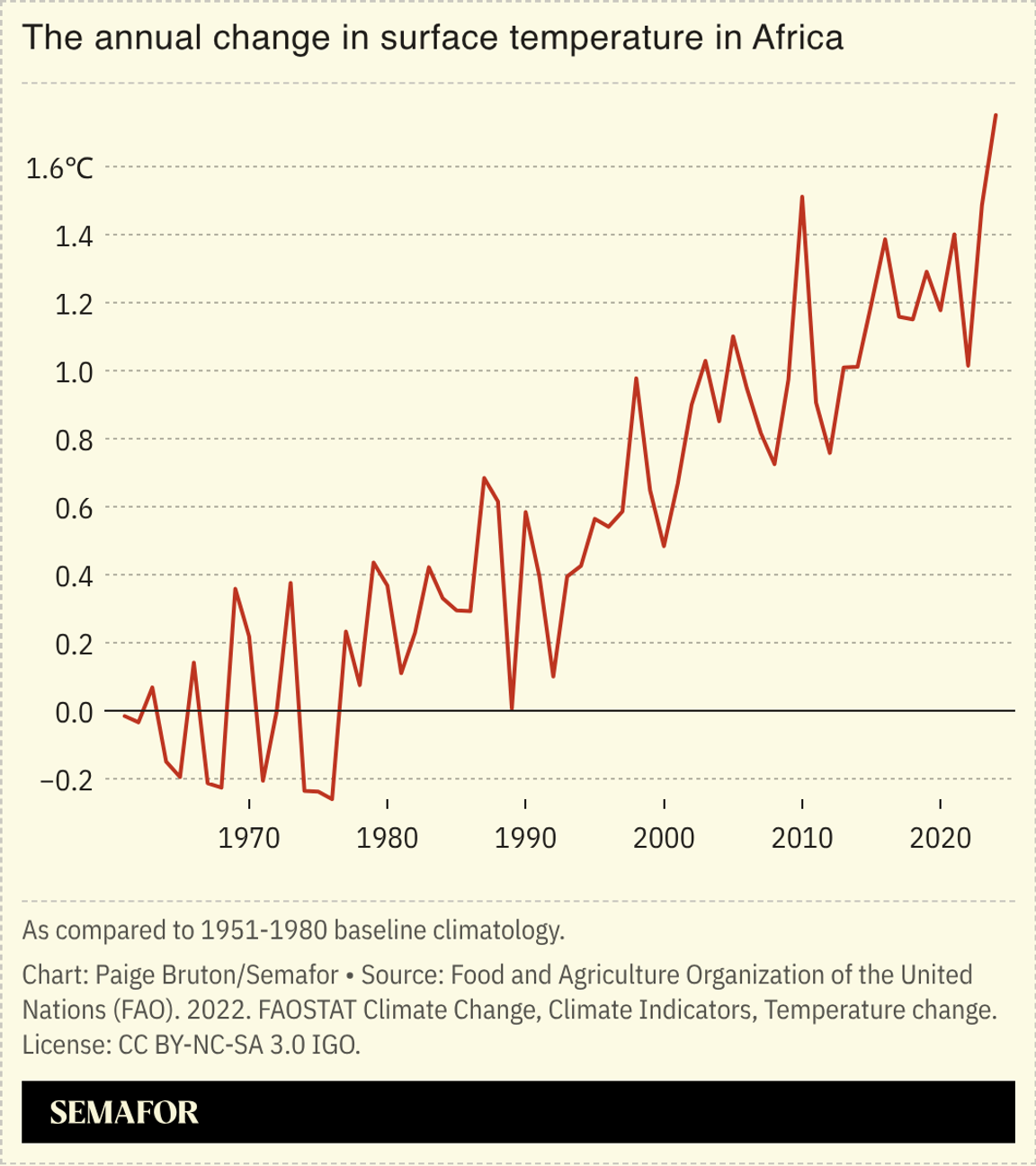 Extreme weather events triggered by a particularly powerful El Niño weather pattern could cost African economies $10 billion to $20 billion and spark mass migration, the African Development Bank’s top climate expert said. Extreme droughts and flooding threaten food and water security, while government finances and banking are under threat if disasters damage infrastructure and leave cash-strapped countries struggling to repay loans. Food shortages could also prompt huge numbers of people to flee their homes. AfDB’s Anthony Nyong said the continent will need as much as $100 billion this year to tackle climate change given the potential impact of El Niño, citing the “climate finance trap” — where governments are forced to use health, education, or infrastructure funding to respond to climate-related emergencies. Economies across Africa are already struggling as a result of fuel and fertilizer shortages caused by the effective closure of the Strait of Hormuz, and key industries such as cocoa and coffee are bracing for further woes. — Jenny Vaughan |
|
Chinese investments soar to $34B |
 Noor Khamis/Reuters Noor Khamis/ReutersChinese infrastructure and energy investment in Africa nearly tripled in the first half of 2026, rising to $33.5 billion — the highest half-year total on record and by far the strongest performance of any region under Beijing’s Belt and Road Initiative, a new report found. The surge was driven by major energy and metals projects, but also reflects manufacturers using Africa’s preferential access to US and EU markets to navigate growing trade barriers elsewhere. Ethiopia recorded the largest increase of any country, led by a $14.2 billion Ming Yang Smart Energy green power and ammonia project. Egypt attracted $12.2 billion, including a $10 billion steel mill, while Zambia announced plans for a 660 MW coal plant, pending regulatory approval. Most other BRI regions, by contrast, saw investment fall even as construction activity increased. According to the analysis from the Shanghai-based Green Finance & Development Center and the University of Queensland in Australia, volatility stemming from the Strait of Hormuz crisis is likely to accelerate Chinese investment in green energy and manufacturing, rather than slow overall overseas spending. — Yinka Adegoke |
|
Uganda hires Washington lobbyists |
 Muhoozi Kainerugaba. Abubaker Lubowa/Reuters Muhoozi Kainerugaba. Abubaker Lubowa/ReutersUganda hired two lobbying firms in Washington, DC as Kampala seeks to combat criticism of its rights record and make the case for ending Ebola-related restrictions. The push comes as American lawmakers question the outsized role of Chief of Defense Forces Muhoozi Kainerugaba — President Yoweri Museveni’s son and a potential successor — who has drawn criticism for crackdowns on opposition figures, the media, and exerting military influence over politics. US Sen. Jeanne Shaheen told Semafor that Muhoozi’s “continued repression” is a “clear indication of his desire to consolidate power.” Moran Global Strategies and Skyline Capitol registered as foreign agents for Uganda this month, according to public filings. The two firms join Scribe Strategies & Advisors, which has represented Uganda since January. Uganda, which discharged its final Ebola patient last week, is in particular pushing to be decoupled from the worse-hit DR Congo in global Ebola-related travel restrictions. — Adrian Elimian |
|
Senegal president forms new party |
 Senegalese President Bassirou Diomaye Faye. Florence Lo/Reuters. Senegalese President Bassirou Diomaye Faye. Florence Lo/Reuters.Senegal’s President Bassirou Diomaye Faye founded a new political party, deepening his split with former Prime Minister Ousmane Sonko and setting the stage for a reelection bid. Faye will lead the new Kiiraay party in local and legislative polls ahead of national elections in 2029, a senior party official said. Faye and Sonko ran on the same ticket in the 2024 elections, but the alliance eroded over how the government should handle a daunting debt crisis. Faye fired Sonko as prime minister in May, leaving Sonko to serve as the speaker of the National Assembly — a hugely influential role overseeing the parliamentary body occupied mainly by lawmakers from Sonko’s own Pastef party. The political fallout unfolded as authorities sought to navigate their way out of a financial crisis: The previous government failed to disclose billions of dollars in loans, pushing Senegal’s debt load above 130% of GDP and prompting the IMF to pause its program. — Adrian Elimian |
|
African startup funding hits $1.4B |
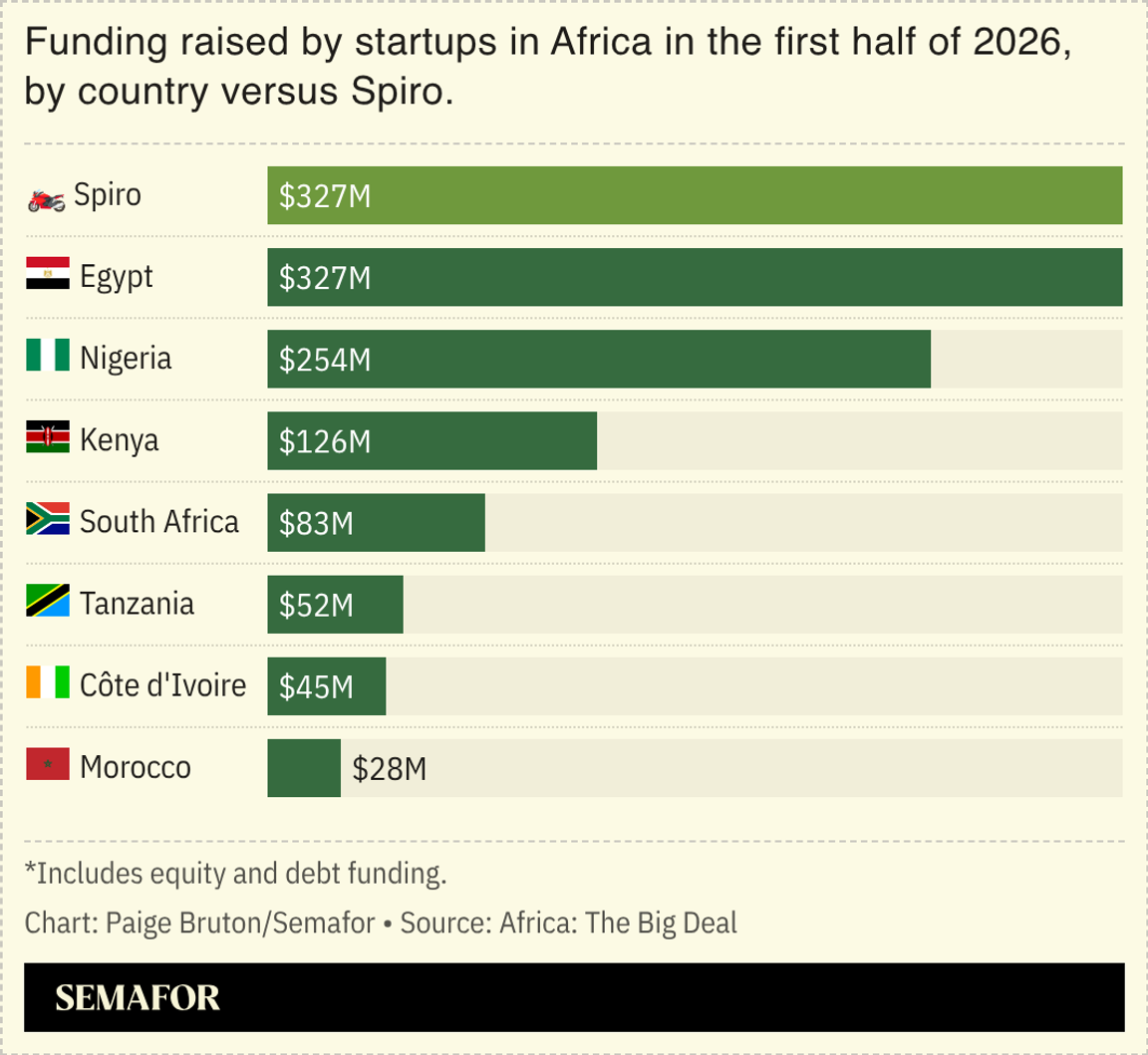 African startup funding dipped by 6% year on year to $1.4 billion in the first six months of 2026, after the number of early-stage companies securing venture capital investment fell, data from Africa The Big Deal shows. The largest agreement for the year so far happened in June, when four-year-old electric motorcycle maker Spiro raised $270 million. That helped raise the total for the half year, but the number of startups raising $100,000 or more fell to its lowest level since 2021, the data showed. African tech fundraising remains way behind the peak days of 2022, as Silicon Valley investors continue a retreat from the continent that started with rising interest rates. But the $3.2 billion total recorded in 2025, the highest amount in three years, reflected increased activity by investors who are stepping in to fill the gap. — Alexander Onukwue |
|
View: Africa’s export growth challenge |
  Thomas Mukoya/Reuters Thomas Mukoya/ReutersAfrica’s export challenge is not simply down to what the continent produces, but whether it can build systems that allow goods to compete globally, argues a former public works minister for Liberia in a Semafor column. Drawing on conversations with Kenyan exporters, W. Gyude Moore, now a fellow with the Energy for Growth Hub, argues that energy costs, logistics, taxation, and government coordination are not separate policy challenges, but parts of one competitiveness equation. Kenyan exporters competing with producers from around the world are not asking for protection, but for governments to remove the barriers that make their goods more expensive. Moore highlights how high electricity tariffs in particular have become a constraint for energy-intensive industries and even horticulture exporters. Africa’s industrial future will depend not only on what the continent grows or manufactures, the author argues, but on whether it can build energy cost-efficient export systems that consistently outperform competitors. |
|
 - July 26-Aug. 16: Women’s Africa Cup of Nations takes place in Morocco.
- July 27: Angola’s largest telecommunications operator, Unitel, is due to announce the results of its IPO.
- July 30: Nigeria’s tech leaders gather for the Build AI summit in Lagos, and Seplat Energy and MTN Nigeria announce their earnings.
|
|
 Business & Macro |
|
|


