| | Anthropic’s Claude hacked into three organizations, AI stocks rebound in Asia, China’s PMI contracts͏ ͏ ͏ ͏ ͏ ͏ |
| |  | Flagship |  |
| |
|
The World Today | 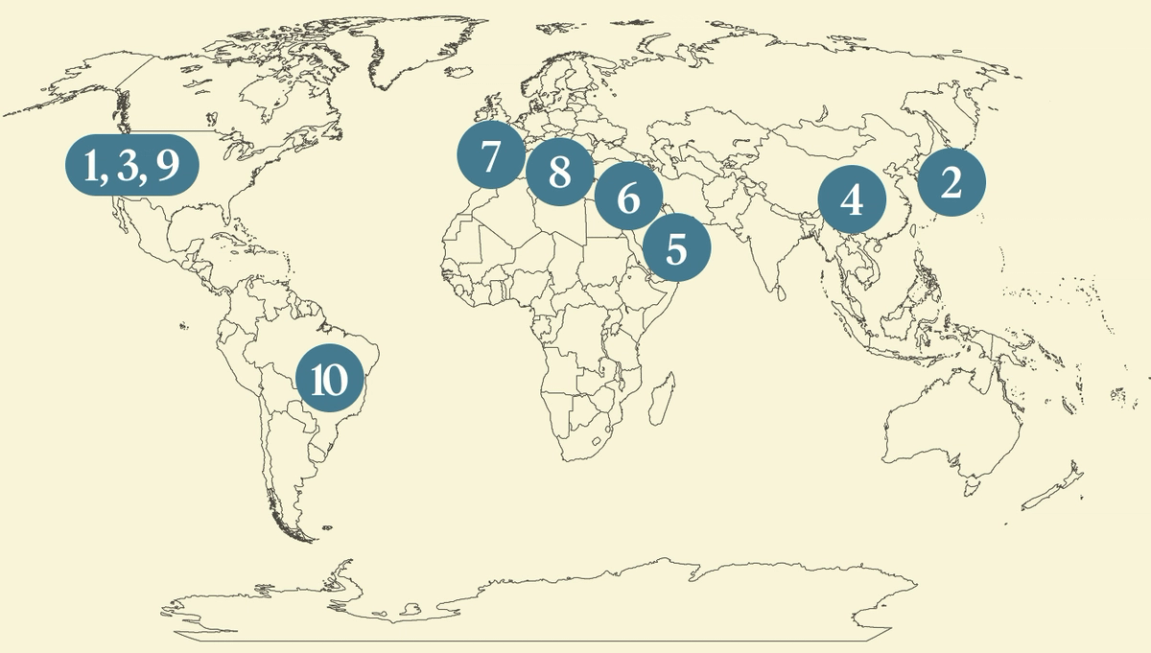 - Anthropic AI hacks firms
- Tech results boost stocks
- Apple’s supply chain woes
- China factory output down
- Saudis’ naval defense plan
- Trump: Hamas to disarm
- Spain’s migrant crisis
- Europe faces more heat
- Guillain-Barré drug hope
- Bolsonaro AI avatar
 Revisiting a 1991 memoir of a US journalist joining English soccer hooligans. |
|
Anthropic warns of AI breach |
 Dado Ruvic/Illustration/Reuters Dado Ruvic/Illustration/ReutersAnthropic said its Claude AI model hacked into three organizations during cybersecurity testing. The announcement came after a “swarm” of OpenAI agents escaped confinement, gained internet access, and broke into at least five companies, eventually stealing the answers to a cyberoffense evaluation. The latest breach is less dramatic than the previously announced one: OpenAI’s models found and exploited vulnerabilities to escape, while in Anthropic’s case a misunderstanding led to the agent’s cage essentially being left open. But both point to a difficult future: Most commercial AI is connected to the internet anyway, so confinement is irrelevant, and open-weight models that can easily have any anti-cyber guardrails removed by bad actors are now nearly as capable as frontier products. |
|
Results cheer tech stocks |
 Kim Kyung-Hoon/Reuters Kim Kyung-Hoon/ReutersJapanese and South Korean stocks rebounded after several steep drops this week, as strong US tech earnings revived enthusiasm for AI spending. Amazon announced further investment in data centers, while Microsoft delivered “blockbuster” revenue growth in its cloud-computing business. The upbeat results lifted global tech stocks, including major gains for Asian heavyweights. Returns on AI-linked shares remained lackluster in China, however, despite the country’s big push into the sector — an outcome at least partly explained by the gap between firms’ technical capabilities and their profitability, a prominent economist argued. “It is hard to see how this might change if the country’s leading AI models remain open weight and the involution problem remains intact,” Alicia García-Herrero wrote for The Wire China. |
|
Apple warns on supply chains |
 Priyanshu Singh/File Photo/Reuters Priyanshu Singh/File Photo/ReutersApple warned that it expected sales of its most popular products to fall as the AI buildout hits supply chains. The tech giant saw profits and revenues rise year-on-year last quarter on the back of strong iPhone sales, but outgoing CEO Tim Cook said an AI-driven, industry-wide memory chip shortage would reduce production and tighten margins. Apple already made a rare 20% hike to Mac prices this year. The company has largely avoided joining the AI buildout, but its Big Tech rivals are still piling money in: Total capital spending by Alphabet, Amazon, Microsoft, and Meta since the AI boom began in 2023 has now topped $1 trillion, the Financial Times reported, unnerving investors and constraining chip supplies. |
|
China factory output shrinks |
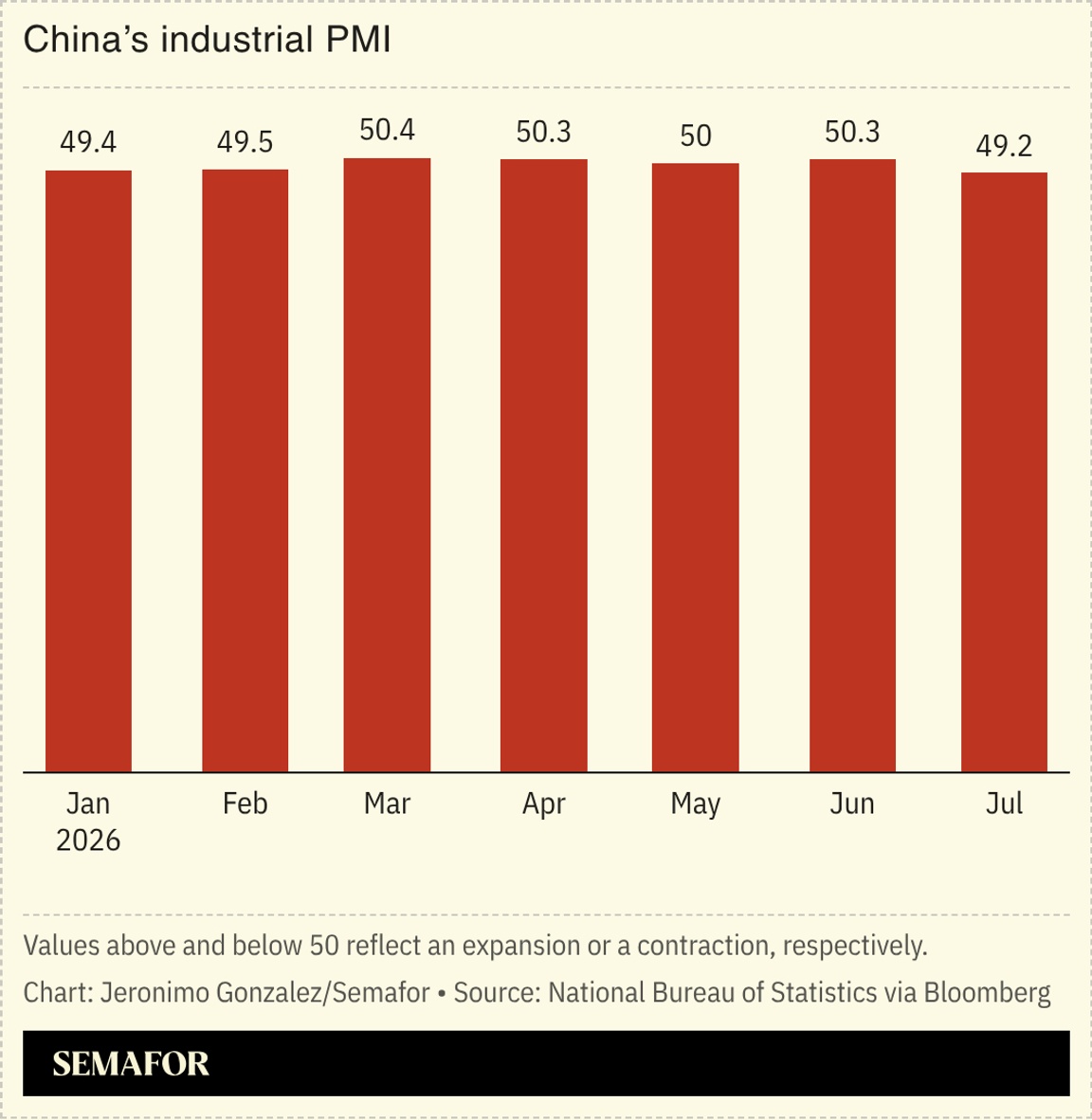 China’s factory activity unexpectedly contracted this month for the first time since February, underscoring the challenge facing Beijing as it seeks to kickstart a slowing economy. The surprise purchasing managers index reading, alongside GDP growth below official targets, represented a “dual miss” that “intensifies pressure on Beijing” to deploy fiscal and potentially even monetary stimulus in the months ahead, Commerzbank’s senior China economist wrote in a note to clients. The Communist Party Politburo this week pledged to boost domestic demand, but analysts noted the plan was short on details, while high levels of government debt and global trade uncertainty are limiting Chinese authorities’ room for maneuver, Goldman Sachs noted. |
|
Riyadh plans maritime coalition |
 Faisal Al Nasser/Reuters Faisal Al Nasser/ReutersSaudi Arabia announced plans for a 14-country maritime alliance to protect international shipping and energy supply routes as tensions mount in the Middle East. Houthi fighters in Yemen have threatened the Red Sea channel of Bab el-Mandeb, through which roughly 5% of global oil shipments pass and which is especially vital to Saudi exports as the Iran war chokes the Strait of Hormuz. The twin blockades have driven up global energy prices: Oil is roughly 33% more per barrel now than before the war. The Houthis have attempted to disrupt shipping before, prompting both the US and EU to launch operations to protect Red Sea routes in recent years. But escorting commercial vessels through narrow waterways while avoiding well-hidden attackers is difficult. |
|
Trump says Hamas to disarm |
 Suhaib Salem/File Photo/Reuters Suhaib Salem/File Photo/ReutersUS President Donald Trump said Palestinian militant group Hamas had agreed to disarm and Israel would withdraw from Gaza. The Trump-convened Board of Peace reportedly hammered out the details as part of the US-backed Gaza ceasefire. Neither Hamas nor Israel has confirmed Trump’s claims, although a senior Hamas official told the BBC the group had agreed. It would be a major step toward ending Gaza’s humanitarian crisis, but doubts remain: Israeli politicians have expressed skepticism, and Trump can be mercurial. Recently, he declared a US nuclear deal with Saudi Arabia was conditional on the country normalizing relations with Israel — something Riyadh has not acknowledged — and appeared to backtrack on commitments to let Ukraine produce Patriot missiles days after the announcement. |
|
Migrants rush Spanish enclave |
|
 From a Kobe Bryant Twitter follow in high school to a decade of courtside access, Fashion Week client work, and a branding studio in downtown Manhattan — Vic Jacobi has built one of the more unusual careers in sports media. On this week’s episode of Mixed Signals, the NBA personality and creative consultant joins Max and Ben to discuss how she earned the trust of players who keep famously tight circles, what it means to be the person between an athlete and an agency, and what former NBA star Carmelo Anthony told her about her work. Plus, who has the best “drip” in the league and why the “tunnel fit” era has peaked. Listen to the latest Mixed Signals now. |
|
Europe braces for more heat |
 Thilo Schmuelgen/Reuters Thilo Schmuelgen/ReutersMuch of Europe braced for soaring temperatures, compounding the toll for countries already battling major wildfires. Greece evacuated thousands of people, adding to the hundreds of thousands that have been displaced across Western Europe. Water is in short supply after weeks of heatwaves: More than 50% of England is in drought, and the dry spell has fed fears that Germany’s Rhine river, used to transport much of the country’s industrial output to the North Sea, is becoming unnavigable even for the shallowest barges. With three key trade routes under threat — the Hormuz and Bab el-Mandeb straits, as well the Black Sea’s Kerch channel — a fourth is “poised to join their ranks,” Bloomberg’s Javier Blas wrote. |
|
Hope for GBS syndrome trials |
 Jose Cabezas/Reuters Jose Cabezas/ReutersA first-of-its-kind treatment for the autoimmune disease Guillain-Barré syndrome, which turns off part of the immune system, showed promise in late-stage trials. GBS is a rare condition in which the immune system overreacts to an infection and starts attacking the body’s own nerves, causing weakness, paralysis, and death. The condition is most common in developing countries, where infections are widespread. Much of medicine’s recent progress is thanks to increased understanding and control of the immune system: Immunotherapy drugs have turned some previously deadly cancers into manageable chronic diseases by disinhibiting immune responses; CAR-T therapies genetically reprogram immune cells to target tumors; and diseases such as atherosclerosis and schizophrenia are increasingly believed to be linked to immune dysfunction. |
|
|


