| | In this edition, Washington’s plan to evaluate AI safety in secret draws criticism, Sapiom’s windfal͏ ͏ ͏ ͏ ͏ ͏ |
| |  | Technology |  |
| |
|
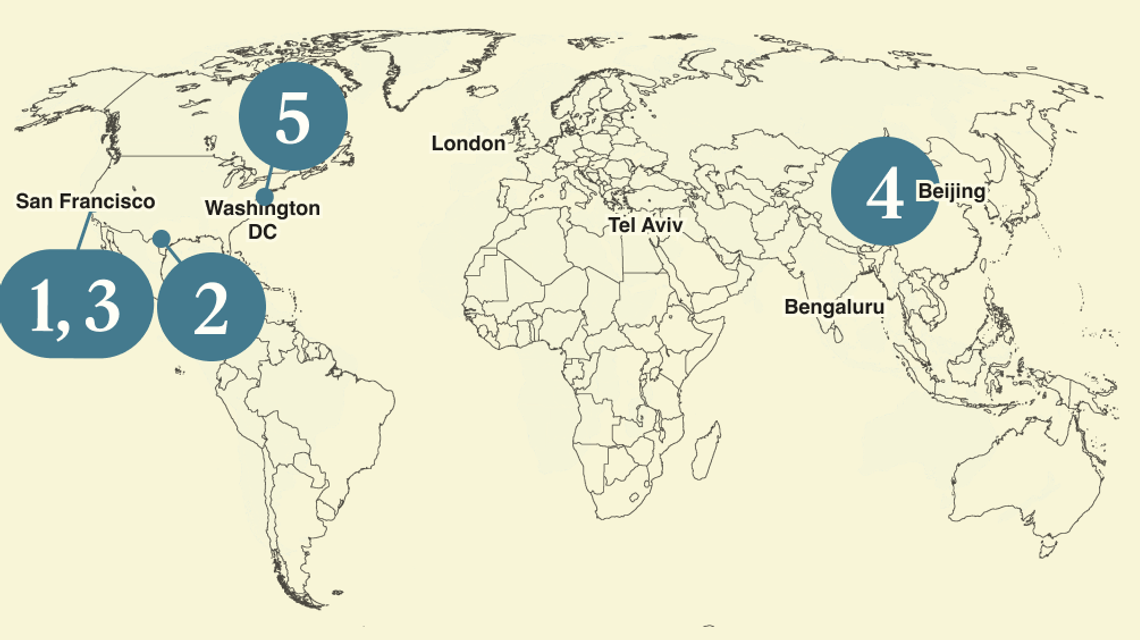 - How to route AI costs
- Investors punish SpaceX
- The surviving SaaS
- China shrugs off robot ban
- Surveillance safety
 Washington’s AI safety checks are a moving target, and how Mythos’ math shows cracks in security systems. |
|
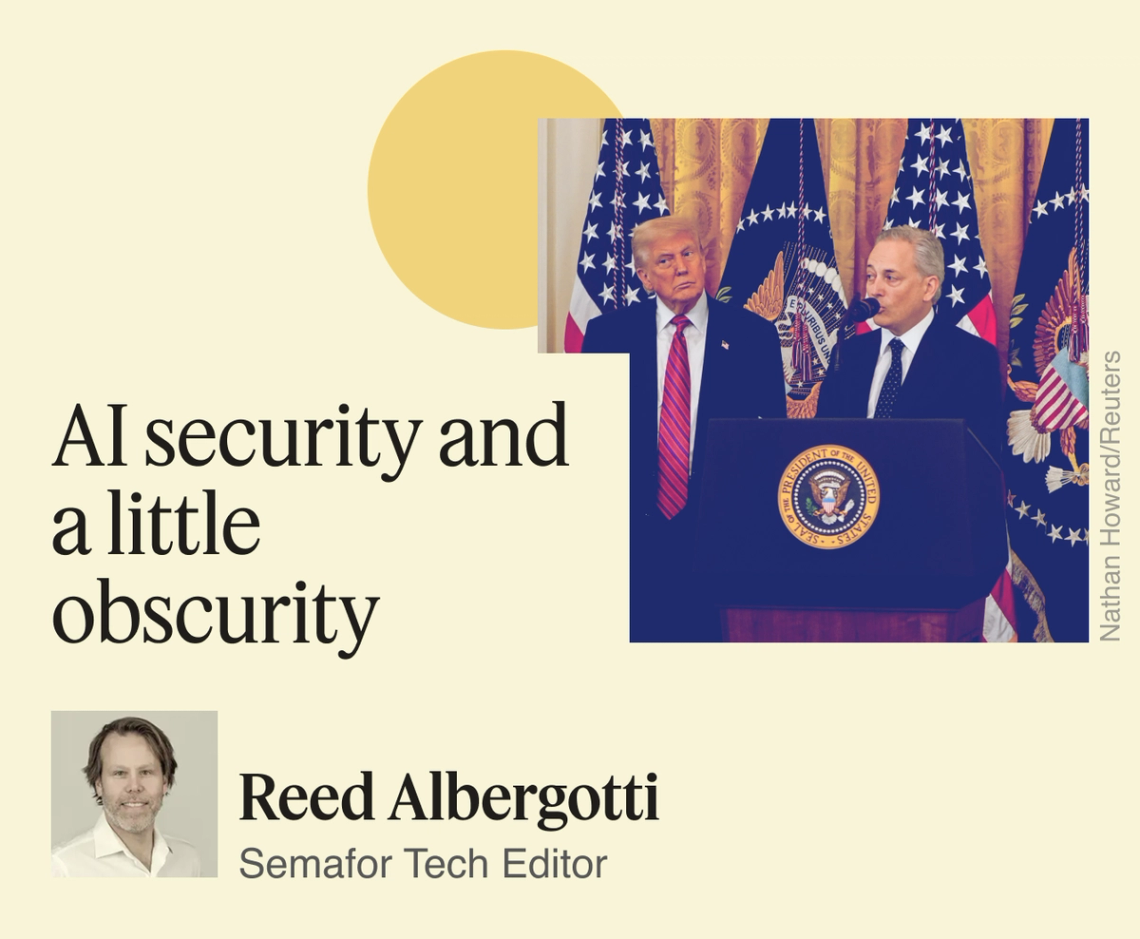 The White House says it discussed a framework for evaluating the cybersecurity risks of frontier AI models with OpenAI and Anthropic, but it doesn’t plan to release details publicly. The secrecy (frontier labs are being asked to submit the most powerful models for assessment 30 days before releasing them) has drawn criticism from AI safety advocates. There’s a reason we don’t have secret methods of approving new pharmaceuticals or secret tests for car safety: Keeping the whole process secret does not inspire confidence in the government’s ability to sufficiently evaluate the models and keep people safe. But the takeaway shouldn’t be fear that the US government is hiding the ball. It’s that there isn’t a ball to hide yet. Think about the early airplanes of the 1920s: suddenly people had a way to fly, but it was also a good way to die. It took decades of new regulation and advances in science and technology to push air travel to be one of the safest ways of moving around. We still don’t know exactly how large language models work or whether they can be completely controlled. But there is a lot more study and knowledge of AI safety in the private sector and the real use case for these guidelines is about giving the US government a head start on what’s coming. That could be strategically valuable when it comes to offensive cyber capabilities and defenses, something you’d want to keep private anyway. There’s little expectation an AI model can truly be certified as “safe” — the technology is used in literally every industry and safety evaluations rely on valuable knowledge from past mistakes. No lab, nonprofit, or government agency can address the worst fears of the most extreme AI-safety critics: that AI models could one day be so powerful that humanity loses control of them. If you buy that argument, this is the first technology in history where we can’t afford to learn that way. |
|
Startup aims to cut costs by routing AI |
 Dado Ruvic/Illustration/Reuters Dado Ruvic/Illustration/ReutersSan Francisco startup Sapiom is raising $35 million in a new fundraising round and launching a product that competes head-to-head with OpenRouter, one of Silicon Valley’s buzziest startups. Sapiom is all about bringing costs down, which has become a big topic for not just large companies experiencing token sticker shock, but also for startups that want to sell AI products that are unaffordable when they run on frontier models. Sapiom is unusual in the space because it does more than offer a way to easily switch between different AI models. It has its own data center in San Jose, where it serves open weight models directly to its customers. Instead of paying for API calls to dozens or even hundreds of different providers, Sapiom’s customers pay just for compute costs. Sapiom also helps customers save money on outside vendors, like payments platforms and SMS providers. As AI expands across industries, expect more companies like Sapiom to pop up at various layers of the AI stack. Like with technology that came before the AI boom, a lot of Sapiom-like companies are needed to lay the groundwork for AI’s applications. — Reed Albergotti |
|
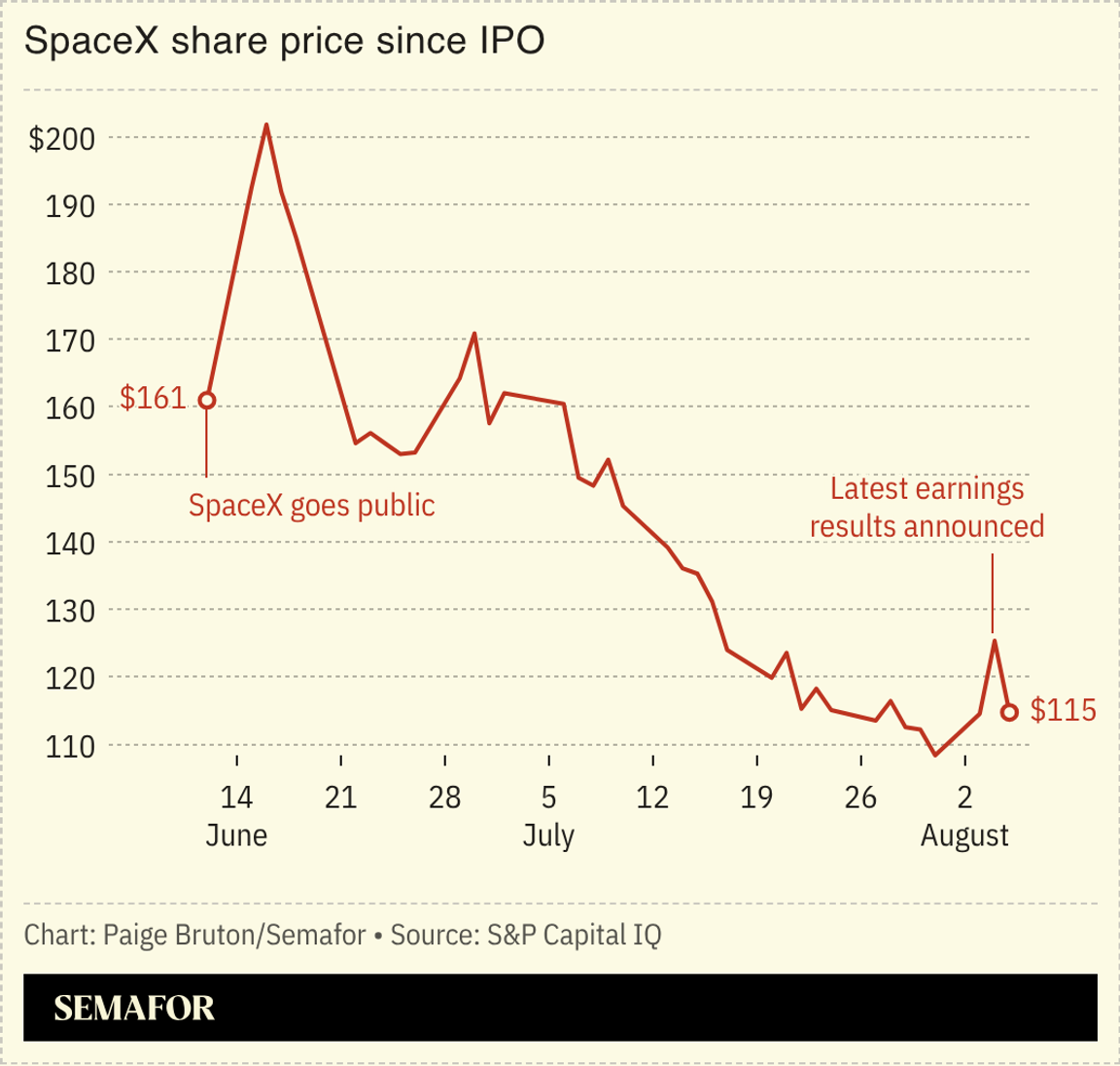 Shares of SpaceX fell 8% after its first earnings report Tuesday, joining a parade of tech companies being punished in the markets for high capital spending on AI infrastructure. The decline sends a signal that the newly public company is being received in the market as an AI company with short-term cash flow issues, rather than a rocket-ship company with ambitious long-term plans. SpaceX spent $18.4 billion in the second quarter, up from $2.8 billion a year ago, with the vast majority of that spending on AI, as opposed to space or connectivity. Executives told investors to expect the same or more going forward. Shares of Alphabet and Meta fell 6% and 10% respectively after they both reported increases in AI spending and declines in their free cash flow as well. Amazon, by contrast, reported high spending levels, but its revenue from AI and its cloud services ramped up enough to offset investors’ concerns. SpaceX doesn’t report free cash flow, but analysts say it is expected to have negative cash flow for some time. “This is the culmination of the story of this entire earnings season,” said Nic Puckrin, an analyst and founder of Coin Bureau. “Spending on AI is getting out of hand, with no signs of slowing down anytime soon.” —Liz Rappaport |
|
The SaaS that won’t survive |
 Brendan McDermid/Reuters Brendan McDermid/ReutersThe SaaS-pocalypse has claimed its most prominent name yet. Italy-based Bending Spoons’ $1.28 billion deal to buy workflow software maker Airtable is “what capitulation looks like,” Semafor’s Rohan Goswami wrote: It’s a sign firms like Airtable “are bowing to reality and taking whatever money is available.” It’s a far fall from its 2021valuation of $11 billion. But not all SaaS is created equal. Airtable is the type of bring-your-own-data company that was ripe for this kind of disruption, given that AI now allows companies to more easily build their own apps, trackers, and dashboards — tools they might have once relied on Airtable for. While Thomson Reuters and Intuit, for example, were both hammered in a software stock rout earlier this year, both are still much more protected thanks to their proprietary data and regulation-heavy services that customers can’t recreate on their own. For newly public Bending Spoons — which scoops up tech companies that are past their prime, like AOL and Eventbrite — the acquisition makes a lot of sense. Airtable still has a strong user base and brand, even though it spun out its big AI bet — a unit called Hyperagent — before being bought, giving execs and engineers a possible emergency exit. — J.D. Capelouto |
|
China’s muted reaction to US robot ban |
 Tingshu Wang/Reuters Tingshu Wang/ReutersChina is seen as the primary target of the US ban on new foreign-made robots, but Beijing’s reaction has been relatively muted. China made a broad threat of retaliation, but because the US decree technically blocked all foreign humanoids and quadrupeds — not just China’s — Beijing is less likely to directly hit back, a US industry executive told Semafor on condition of anonymity: “They’re not viewing it as a death blow. There’s still the rest of the world.” The exec added that “China is a huge customer for itself” in robotics, and the idea that Chinese robots would thrive in the US always seemed far-fetched. Washington has already blocked Chinese drones, EVs, and routers. Still, the US market made up 13% of 2025 revenue at China’s Unitree Robotics, a global leader in humanoids: The company flagged the new restrictions as a risk ahead of its IPO in Shanghai; share price talks start this week. The company’s market debut will test investor appetite for Chinese firms that lead the world on robotic hardware but are still catching up on software. Unitree’s R&D expenses made up just 9% of its revenue last year, according to its IPO prospectus. —J.D. Capelouto |
|
A call for better public records laws |
 Marco Bello/Reuters Marco Bello/ReutersSurveillance technology without accountability is a recipe for authoritarianism, but with strong guardrails and transparency, it can help stop crime, including crimes committed by law enforcement. An article in the Washington Post chronicled how police officers were caught abusing surveillance technology to stalk ex-wives and, in at least once case, an actress a police officer wanted to meet. Critics of surveillance technology could point to this as rationale for blocking law enforcement agencies from using it, but the 50 police officers were caught by the very technology they were abusing. These software programs can log users’ every keystroke and click, and all that information belongs to the public. In other words, surveillance technology is responsible for taking 50 crooked cops off the beat. A better debate than if technologies should be used to fight crime is whether public records laws should change as a result of tech’s use in law enforcement, and they should. Abuse of power has and always will exist, and with more powerful technology, the consequences of the abuse get larger. The public should have greater and more granular visibility into how the technology is being used. In other words, the surveillance needs to go both ways. |
|
 Plot of the Jacobi polynomial function P n^(a,b). WalkingRadiance, CC BY-SA 4.0, via Wikimedia Commons. Plot of the Jacobi polynomial function P n^(a,b). WalkingRadiance, CC BY-SA 4.0, via Wikimedia Commons.Anthropic’s most powerful AI model found vulnerabilities in two important cryptographic algorithms. Claude Mythos Preview is highly cyber-capable and so far only released to select organizations to plug security flaws. Anthropic tested it against HAWK, an algorithm for verifying identity online, designed to survive the rise of quantum computers; Mythos found a hidden problem that halved its effective strength. Mythos also examined a deliberately weakened version of the cipher that secures most internet traffic, and sped up possible attacks several hundredfold. Neither directly endangers existing systems, but it underscores that AI models’ ability to solve math problems — it recently disproved the Jacobian conjecture — has real-world implications: Cryptanalysis is research-level mathematics, in which successful work could crack open your bank account. |
|
| |