| | In this edition: Campaign ridicule wins, progressives’ big night gets an asterisk, and Talarico’s mo͏ ͏ ͏ ͏ ͏ ͏ |
| |  DETROIT, MI DETROIT, MI |  LAWRENCE, KS LAWRENCE, KS | CHARLESTON, SC |
 | Americana |  |
| |
|
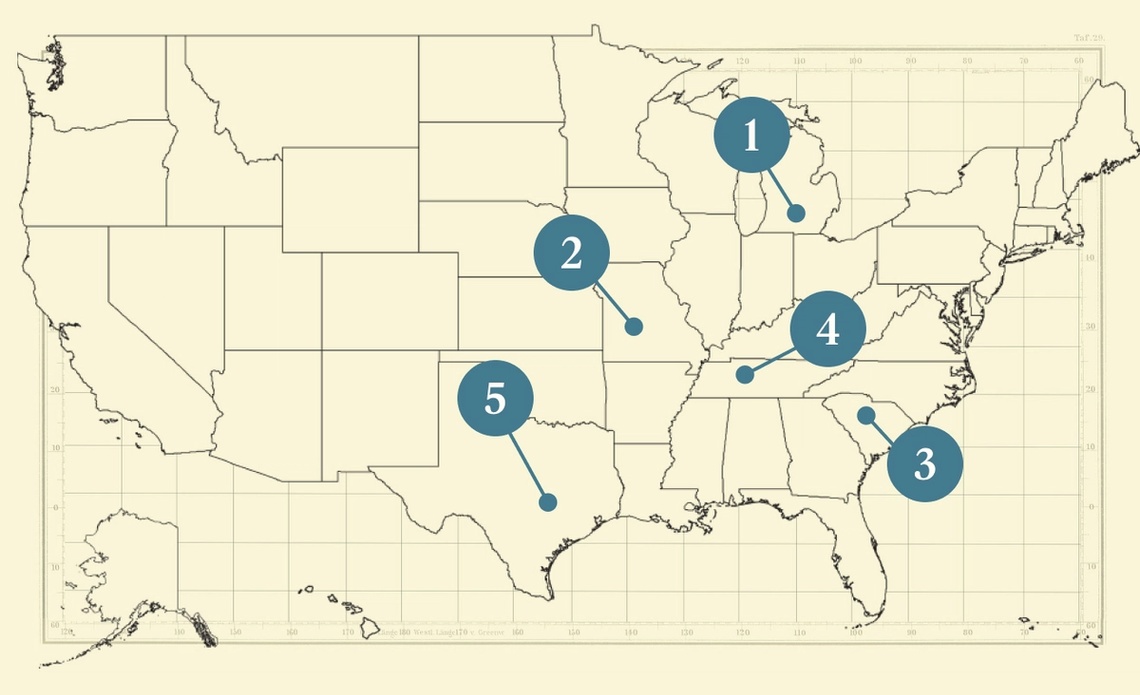 - The primary dust clears
- Republicans’ primary speed bump
- A new Graham debates
- Tennessee Republicans’ ads
- Talarico’s momentum, polled
|
|
 I doubt that anybody who bundled up for “Menorah in the D,” the 2023 kickoff of Hanukkah in Detroit, knew how much it would end up shaping the 2026 Senate primary. The event took place two months after Hamas’ Oct. 7 attacks on Israel — in hindsight, a high point of American enthusiasm for the Jewish state. Rep. Haley Stevens, D-Mich., was one of just a few politicians to speak after meeting families of hostages taken by Hamas. “I take Menorah in the D with me to the United States Congress,” said Stevens. “I will continue to fight for Israel’s existence! Israel comes to me in my dreams! I see Israel’s future! And I know that Israel will continue to exist for the Jewish people!” By the time Stevens conceded this year’s Senate primary to Abdul El-Sayed, that video had been seen countless times by people voting against her. Barely noticed at the time, it repeatedly went viral on X and TikTok. In July, El-Sayed’s campaign hosted the 19-second clip of her comments on a loop at HaleyFacts.com — “yes, she really said all of this” — with a donation button promising to “make it stop.” El-Sayed’s narrow victory was the culmination of nearly a decade of work by left-wing activists who are not always active players in the Democratic Party. While his margin of victory was not nearly as high as the polls his team had circulated in the final weeks of the campaign, it was a clear win over AIPAC, the pro-Israel powerhouse that spent in the neighborhood of $30 million for Stevens. El-Sayed’s nomination is also a win for ridicule. Online Israel critics, whose numbers multiplied throughout 2026, humiliated Stevens. They mocked the congresswoman for reasons beyond her stance on Israel, sharing video of her shouting through a 2020 speech about Covid first responders (“You will see darkness!“), images of her addressing a nearly-empty festival, and supercuts of her pumping her fists. This struck Stevens and her allies as immature, insulting, and more than a little sexist. They noted, glumly, that left-wingers on social media were often re-sharing Republican clips, creating a feedback loop of Stevens mockery. Last month, when I asked Stevens about the virality of the “Israel in my dreams” clip, she again reminded me of the context: She was on stage with the families of hostages, weeks after a terrorist attack, with emotions running high. “Broadly,” she said, “I think the internet isn’t the best place to have discourse around serious and emotional subjects.” It’s not. But her opponents weren’t trying to have a serious discourse. They were making fun of her, folding a serious argument (that Stevens was captured by her pro-Israel donors) into a silly argument (about Stevens’ personality). President Donald Trump figured out this truism a decade ago by attaching unflattering nicknames to his own opponents. At this point, the only reason not to ridicule candidates is the fear of backlash. That fear keeps diminishing. |
|
The left’s big primary night carries an asterisk |
 Rebecca Cook/Reuters Rebecca Cook/ReutersProgressive Democrats white-knuckled their way through Tuesday’s primaries, winning key races in Michigan, but underperforming some of their own polling. El-Sayed beat Stevens for the party’s Senate nomination by less than a percentage point, after polling conducted for a pro-El-Sayed super PAC put him up by as much as 19 points. In Detroit, Rep. Shri Thanedar narrowly lost his seat to state legislator Donavan McKinney, a progressive endorsed by Justice Democrats, the Democratic Socialists of America, and numerous local Black elected officials who were tired of the wealthy Indian-American businessman representing a historically Black district. Sunrise Movement co-founder Will Lawrence prevailed in the primary for Michigan’s 7th District, in a blow to Sen. Elissa Slotkin, who endorsed a Democratic military veteran seen by the GOP as more electable than either Lawrence or the runner-up, former US ambassador to Ukraine Bridget Brink. In other state primaries, left-wing candidates fell short. In St. Louis, Mo., Rep. Wesley Bell fended off former Rep. Cori Bush by 22 points. As in Michigan, turnout was far higher than it had been in the last competitive primaries; Bell ran 20,000 votes ahead of his 2024 margin, when he beat Bush, and more than 1.5 million votes were cast in Michigan’s Democratic primaries, smashing the 1.2 million midterm vote record of 2018. In Washington state, where hundreds of thousands of mail ballots remain to be counted, there were no progressive breakthroughs. A progressive challenger to Rep. Marie Gluesenkamp Perez, who benefited from protests of the centrist’s votes on defense spending and GOP messaging bills, had just 15% of the vote by Wednesday morning. Former Seattle city council member Kshama Sawant, who raised more than $600,000 to challenge Rep. Adam Smith, did poorly as well. Neither progressive made the November runoff, which will pit the Democratic incumbents against Republicans. |
|
Republicans hit primary speed bump |
 Ken Cedeno/Reuters Ken Cedeno/ReutersRepublicans are already trying to make this November a referendum on their ideas versus Democrats’ turn toward “communism” — but they faced a few setbacks in their own primaries. In Michigan’s 8th District, a swing seat that was on the GOP’s “MAGA Majority” target list, Trump-endorsed Republican Amir Hassan lost to Thomas Smith, a fringe candidate who had ended his campaign to endorse the third-place finisher. In Kansas and Missouri, Trump’s endorsed candidates for governor and a re-drawn 4th District prevailed. But state-level Republicans couldn’t convince voters to pass two ballot measures that would have expanded their powers. By 22 points, Kansas rejected a proposal to elect state supreme court judges, which Republicans put on the ballot out of frustration that the current bench had been overwhelmingly picked by Democratic governors. The GOP defeat was more lopsided in Missouri, where more than 80% of voters rejected two of its amendments — one that would have made it much harder for activists to put new amendments on the ballot, and one that would have phased out the state income tax in favor of a higher sales tax. |
|
S.C. Republicans vie for the late Lindsey Graham’s mantle |
 Jonathan Ernst/Reuters Jonathan Ernst/ReutersSouth Carolina Republicans are racing to their Aug. 11 special election for Senate, as appointed Sen. Darline Graham used this week’s debate in Greenville to position herself next to the president. Her late brother Lindsey had opposed scrapping the filibuster to pass Trump’s preferred voter ID bill; she countered that she would do whatever it took to pass it, filibuster be damned. “This is where I differ from my brother,” Graham said, predicting that Democrats would eventually nix the filibuster anyway. “I completely support the president’s agenda. I’m 100% behind him.” Republicans don’t expect Graham, whose brother always faced primary challengers, to avoid a runoff by getting more than 50% of the vote next week. All of her rivals competed with her on the totality of their support for Trump, with the minor exception of ex-Gov. Mark Sanford, who said he could break with the president on issues of debt and conscience. “It’s okay to occasionally disagree on things that are tied to spending, things tied to the constitutional framework of our government, or things tied to local interest,” Sanford said. Every other candidate joined Graham in standing to the right of her brother. Mark Lynch, who unsuccessfully challenged the late senator in the May primary, repeatedly accused rivals of supporting amnesty for undocumented people. Both lawmakers running in the special election, Reps. Ralph Norman and Russell Fry, supported ending the filibuster: “Wake ‘em up, keep ‘em up, and make ’em talk,” said Norman. Lynch said it was time to bring troops home from Iran, and Sanford wanted a bigger role for Congress in approving military action. But none of them criticized the decision to attack Iran, which Darline Graham’s brother had advocated for. |
|
Volunteer State Republicans make a play for the right |
 Marsha Blackburn/YouTube Marsha Blackburn/YouTubeTennessee Republicans don’t worry about Democratic competition in November. Democrats aren’t competitive in statewide elections, and the new congressional map rubbed out their only House seat. This is why GOP advertising for Thursday’s primaries is pitched to conservatives, and to Trump. In “Soft Senate,” Rep. John Rose, R-Tenn., goes after GOP Sen. Marsha Blackburn for running for governor instead of finishing her term in Congress — where she can listen to Trump and end the filibuster. (He doesn’t mention that he’s a congressman.) “Took It Back,” from Blackburn’s campaign, focuses on the Memphis Safe Task Force, a national law enforcement operation approved by Trump: “Blackburn stood with police; gave them the support they needed.” Advertising in the state’s safe GOP House seats is largely about whether Trump has weighed in or not. Rep. Andy Ogles, the only incumbent with a real primary challenge, has cut Trump’s recorded endorsement into a series of radio and video ads, focusing on his character instead of specific issues. Ogles got that help as the Invest in Tomorrow Coalition, which is funded by clean energy investors and trying to unseat Republicans who repealed electric vehicle credits, bought $1 million of ads against him. |
|
Texas Democratic Senate candidate shows off his strength |
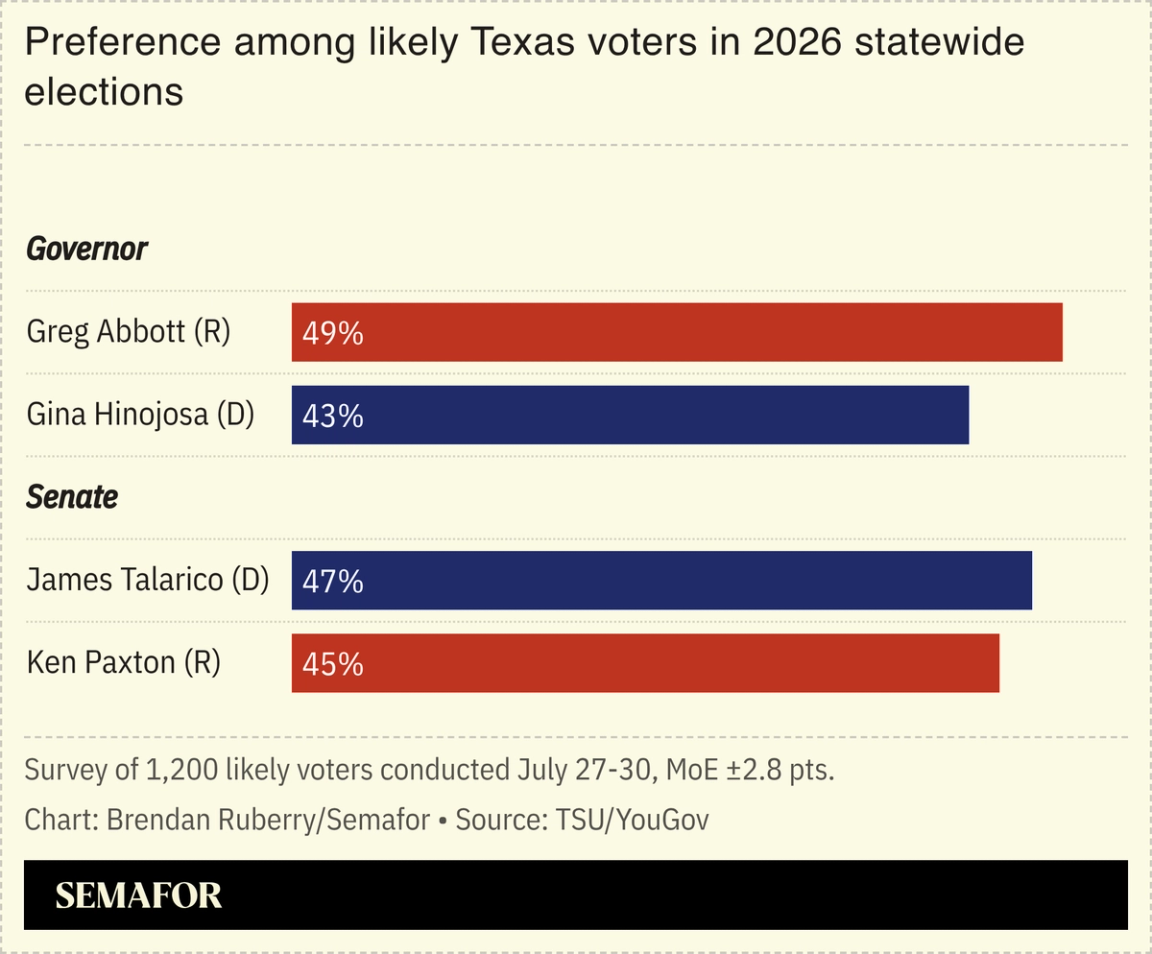 In the two and a half months since Ken Paxton beat Sen. John Cornyn, and became the GOP’s Senate nominee in Texas, his party has largely ignored him. His Democratic opponent has stayed active, tripled Paxton’s fundraising, and stayed on the air with earned media and digital ads. The result: Talarico is hitting the numbers with Latino (57%) and Black (79%) voters that Texas Democrats used to get before 2024, and he’s running unusually strong with white voters, winning 39% of them. In 2018, when Beto O’Rourke came close to beating Ted Cruz, he ran stronger with Latinos (64%) and weaker with white voters (34%) — a Talarico who hit 2016 or 2018 numbers with Tejanos would be polling above 50%. Hinojosa runs a little weaker with every demographic, winning just 55% of Latinos against a three-term governor who’s courted that vote for 12 years. Republicans can make up some of what they’re losing with white voters by racking up a stronger Latino vote. But they’ve never had to do that before. |
|
 On Tuesday, September 15, Sen. Andy Kim, D-N.J., Member, Senate Committee on Health, Education, Labor, and Pensions; Dr. Emily Aaronson, Chief Medical Officer, Walmart; The Honorable Alex M. Azar II, 24th Secretary of the US Department of Health and Human Services; and Chris Butler, Vice President & Head of Drug Discovery, Isomorphic Labs, will join Semafor’s The Future of Health to unpack innovation and access of US healthcare. From breakthrough therapies and AI-enabled care to the investments and policy decisions shaping the next generation of medicine, on-the-record conversations will explore how innovation can expand access, improve patient outcomes, and build a more affordable, effective healthcare system.
|
|
 Al Lucca/Semafor Al Lucca/SemaforOne of this newsletter’s long-running themes is the power of ideological media and how it’s replaced traditional media for politically plugged-in voters. For The AP, Ali Swenson wrote the story I wanted to write when I was asking candidates like El-Sayed how changes in the media diet made |
|
|


