| | In tonight’s edition: A subtle change to Spotify’s user interface is panicking the podcast industria͏ ͏ ͏ ͏ ͏ ͏ |
| |  Stockholm Stockholm |  New York New York | Washington |
 | Media |  |
| |
|
 - Spotify ad-pocalypse
- Carlson 2028?
- Mixed Signals
- Court TV
- Legacy media readout
|
|
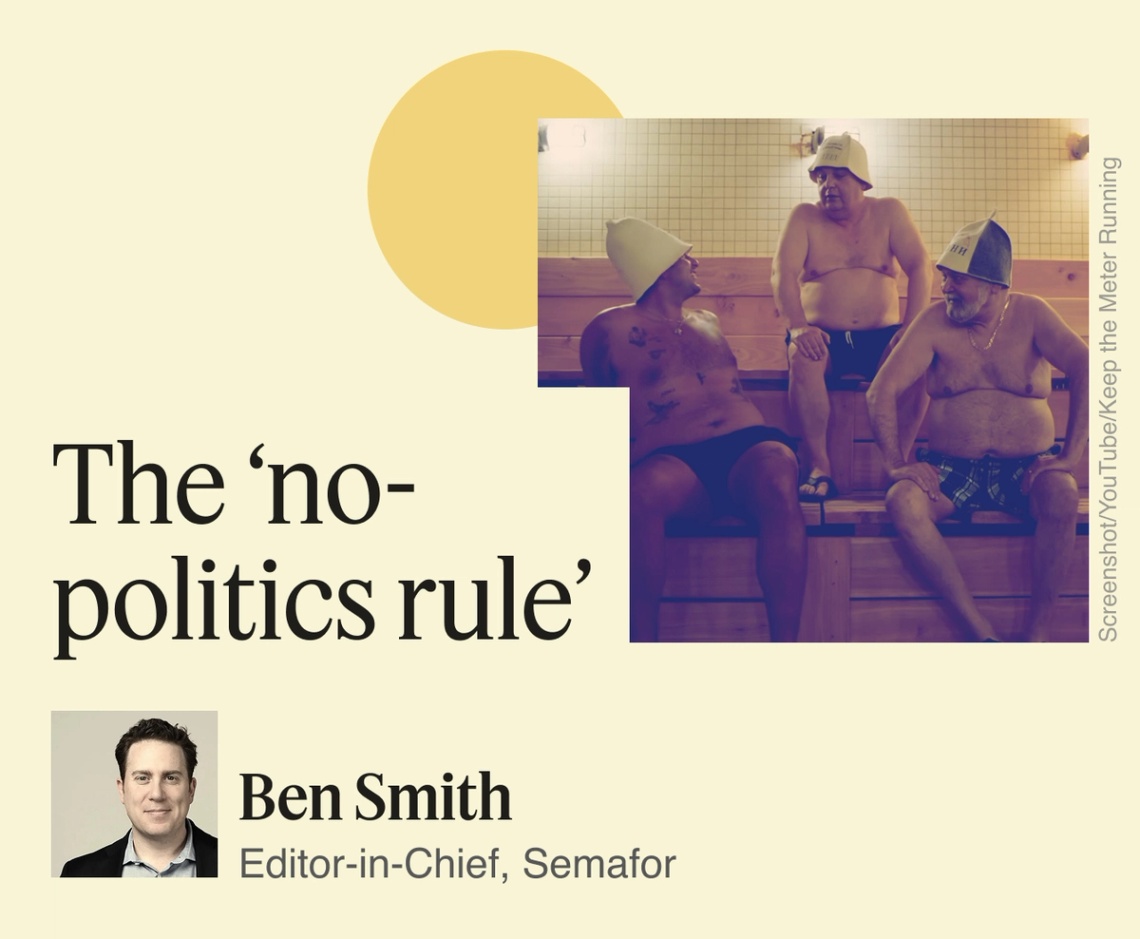 In the first episode of Kareem Rahma’s charming new YouTube show, Keep the Meter Running, a Russian cabbie takes him to his favorite bathhouse. There, the millennial New York producer (best known for the social media show SubwayTakes) bonds with older Russian men over food, saunas, and their (very) different politics. Shirtless and wearing a felt banya cap, Rahma reveals he likes Mayor Zohran Mamdani while driver Eugene has kind words for President Donald Trump. It’s a minor moment, and they quickly move on to vodka and pickles. Internet media hasn’t grown any less divisive, America’s splintering politics are as toxic as ever, and X remains the central sewer. But there’s something less bitterly partisan about this new moment. Rahma told us on Mixed Signals that despite the occasionally divisive Take, he’s come to prefer when people offer deeply held mundane opinions, like Sterling K. Brown’s contention on his show that Red Delicious apples are disgusting. Rahma said after recording a never-aired botched Subway Take featuring then-Vice President Kamala Harris, he now has a “no-politics rule,” which he violates occasionally for local New York pols. He thinks a lot about the possibly inevitable moment that the White House calls to pitch a Take. Trump will be a “difficult no,” Rahma said, “because I know how fun it will be.” Also today: A subtle change to Spotify’s user interface is panicking the podcast industrial complex, and Tucker Carlson’s 2028 trial balloon. |
|
The Spotify ‘skip’ button scramble |
 Screenshot/Max Tani/Semafor; Brendan McDermid/Reuters; Lucas Jackson/Reuters Screenshot/Max Tani/Semafor; Brendan McDermid/Reuters; Lucas Jackson/ReutersLast week, Spotify tweaked its streaming interface, adding a feature that allows some users to more effectively skip through the parts of a podcast no one wants, like filler, promotions, and ads — as long as those ads aren’t sold directly by Spotify, Semafor’s Max Tani reports. The Swedish streaming giant cast the move as streamlining a feature that already exists, the Spotify app’s 15-second skip button. But the new button terrified major podcast networks. Its effects on whether audiences hear the ads marketers pay dearly for could reshape a nascent corner of the media business, which is already reckoning with a migration to YouTube and the melding of once-distinct video and audio formats. Tommy Vietor, a co-founder of the liberal podcast network Crooked Media, put it bluntly on X: “Very cool of @Spotify to try and destroy the podcast industry. What a great partner!” |
|
 Kevin Lamarque/Reuters Kevin Lamarque/ReutersIs Tucker seriously thinking of running? After he got pushed out of Fox News in 2023, prominent figures in conservative media wondered if he would shake up the 2024 Republican primary. He settled into life as a successful podcaster instead. But last week, in a heavily promoted segment, Carlson laid out a 10-point manifesto for the future of America. Paired with a highly publicized meeting with former Rep. Marjorie Taylor Greene, R-Ga., and freshly primaried Rep. Thomas Massie, R-Ky., plus overtures from ex-counterterrorism aide Joe Kent about a third-party bid, Carlson’s 98-minute-long stream kicked off broad coverage across political media and speculation that he could actually mount a bid for the presidency. Still, despite Carlson’s public flirtations, two people who speak regularly with Carlson said he hasn’t spoken seriously about running, and they haven’t detected a real shift in his actions that would suggest he’s gearing up to run. Business is good for Carlson at the moment, too: His podcast is one of the biggest in the country, and his nicotine pouch joint venture nets him millions each year and is growing rapidly. Carlson did not respond to a request for comment. |
|
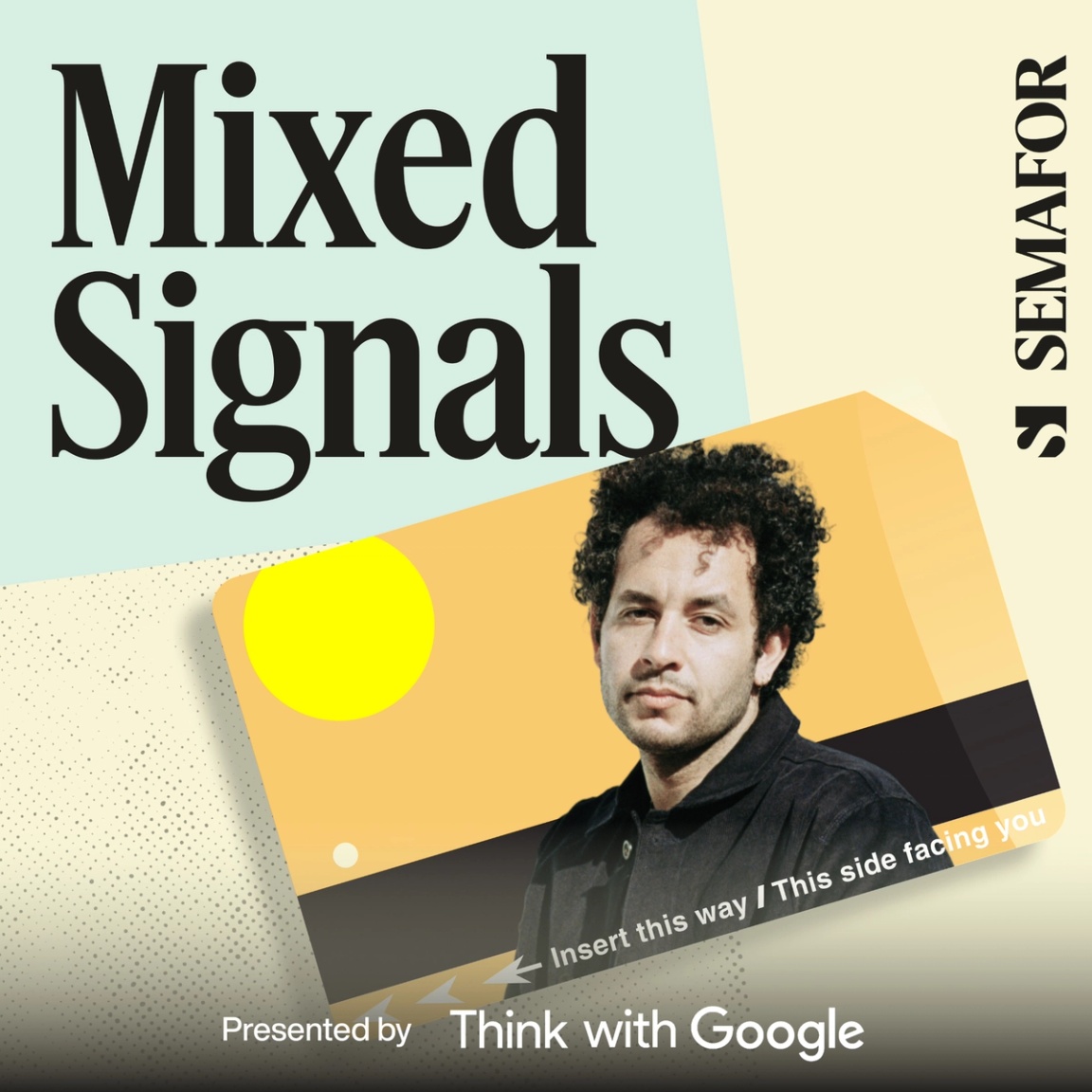 On this week’s episode of Mixed Signals, Rahma talked to Ben and Max about how SubwayTakes is reinventing the talk show for the vertical video era (beyond just staying away from politics). He also described how he built a show that feels spontaneous but runs like a TV production, and took them through his business model, his costs, and what he learned from watching Vice go bankrupt. |
|
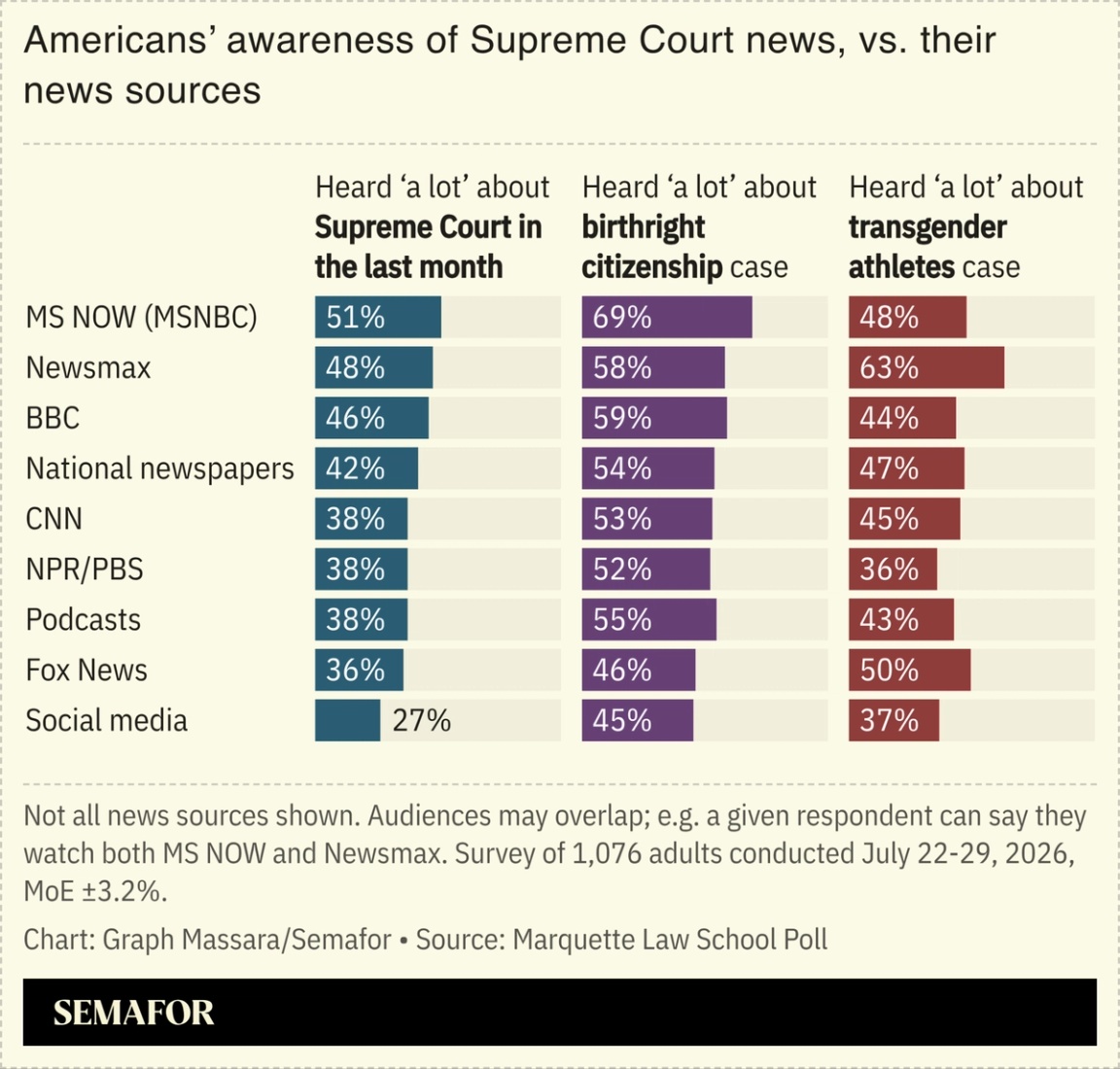 Where Americans get their news may shape how closely they follow Supreme Court decisions, a new Marquette Law School poll found. A larger share of cable TV news audiences said they’d heard “a lot” about the nation’s high court over the last month, compared to people who said they get news through broadcast, local outlets, or social media. Audiences’ familiarity with major cases also differed by outlet, with culturally charged questions around gender and immigration dominating. Across news outlets, more people said they’d heard a lot of news about the Supreme Court upholding birthright citizenship than said the same of some of the court’s other rulings this term (on wonkier topics like late-arriving ballots’ legality). A relatively greater proportion of Fox and Newsmax viewers also said they’d heard a lot about the case upholding bans on transgender athletes in women’s sports, as trans people remain frequent subjects of right-wing news coverage. — Graph Massara |
|
 Brendan McDermid/Reuters; Mario Anzuoni/Reuters Brendan McDermid/Reuters; Mario Anzuoni/ReutersLegacy media’s earnings calls this week seemed to reveal haves (News Corp, thanks to the World Cup) and have-nots (Warner Bros. Discovery) — and looming over them all, Netflix and Amazon. But Fox’s victory may be transitory — the World Cup juiced its advertising numbers by 78%, the same way the Olympics boosted NBCUniversal, but those rights will undoubtedly get more expensive the next time they roll around, four years from now. That’s why Lachlan Murdoch is trying to make his media company look more like a tech company by purchasing Roku, while Versant takes some swings at tech-adjacent M&A. At Warner, HBO’s streaming results looked strong. And for their part, tech companies like Google, Amazon, and Netflix are starting to look more like media companies: They’re going after sports rights, the one thing that linear TV still has going for it. (The New York Times’ big earnings print, which showed slowing subscriber growth, added to speculation about how the paper counts its active users and led to a 13% drop in shares.) — Rohan Goswami |
|
 Join Semafor Deputy Editor-in-Chief Shelly Banjo and Media Editor Max Tani live in New York City on September 2, as they moderate The Business on Luxury: The New Global Luxury Economy, an exclusive conversation with executives and cultural leaders shaping the future of the luxury industry. The evening will explore how leading brands are responding to a changing global market while preserving exclusivity, creating new forms of value, and remaining culturally relevant. Jenna Lyons, Executive Creative Director of FundamentalCo (The Real Housewives of NYC and former President and Executive Creative Director, J.Crew), and Jonny Bauer, Founder and Executive Chair of FundamentalCo, will take the stage, with more speakers to be announced soon. New York City | September 2 | Request Invite |
|
Variety: Todd Spangler probes whether David Ellison can make good on his 30-films-a-year promise to antitrust regulators if they let the Paramount-Warner Bros. deal through. (Less covered, Rich Greenfield notes, is that the two studios are set to release at least 34 movies next year.) The Guardian: The BBC hopes it’s found its Gen Z whisperer in the form of a media mogul who started at age 13, Michael Savage writes. WSJ: People Magazine’s innovation chief is leading his company’s efforts to block AI from cannibalizing its content, Alexandra Bruell writes. Pirate Wires: “Vice was a cult,” remembers Mitchell Jackson. “It was also one of the best business schools in modern history.” Front Office Sports: Clay Travis is preparing to launch a new media company focused on sports and politics, Michael McCarthy reports. |
|
 - Last week, we wrote that The New York Times was screentesting new potential hosts for its podcast Hard Fork, including tech journalists Mike Isaac and Kashmir Hill. Additionally, the company also approached tech journalist Max Read and Search Engine host PJ Vogt about the gig, Semafor has learned. (Read did not respond to a request for comment; Vogt declined to comment.)
- USA Today became the latest (though not the first) media company to partner with software provider Palantir on analytics.
- Local TV chain EW Scripps announced deep cuts, driven in part by AI “automation.”
- Jeff Zucker, onetime NBC executive, is playing himself in A24’s new drama about the NBC show To Catch a Predator.
- Former State Department and National Security Council spokesperson-turned-Substacker Emily Horne uncovered a network of around 200 AI-powered local news-style websites created by a four-person tech startup based in Tel Aviv.
|
|
|


