
|
How to make people care about your startup
Three founder archetypes—and how to turn your origin story into a communications strategy
|

| |||||||||||||||


👋 Hey there, I’m Lenny. Each week, I share deeply researched product, growth, and career advice. For more: Lenny’s Podcast | Lennybot | How I AI | Become an AI-Native Builder and other favorite AI/PM courses
P.S. Get a full free year of Cursor, Notion, Replit, Lovable, Factory, Wispr Flow, Linear, ElevenLabs, PostHog, Brain.fm, Waking Up, and more, by becoming an Insider subscriber (while supplies last). Learn more.
Kristen does such an incredible job of introducing this piece that I’ll just skip my regular intro and jump right into it.
Kristen Lowe is an executive ghostwriter and narrative strategist, and the incoming Director of Founder & Editorial Communications at Scribe. Previously the Director of Operations at Hinge, she has built founder communication platforms across LinkedIn, Substack, X, and keynote stages, and written for leaders in every format from essays to TED Talks. You can find more of her work on AI, careers, and storytelling on Substack and TikTok.
 |
It’s never been easier to start a company. It’s also never been harder to get someone to care that you did. Anyone can now go from idea to business in less time than it takes to hire a single engineer. But the same tools that make building simple make standing out a challenge.
As channels like X and LinkedIn flood with soulless AI slop, startups are having to work harder to grab people’s already fractured attention amid all the noise. But this moment presents an opportunity for founders who can say something honest and connective by “going direct”—or what I call founder-led communication. Today, a solid founder-led communications strategy is one of the lowest-cost, highest-leverage tools at your disposal to get people’s attention.
Most founders seem to know this. When I started writing for founders as an executive ghostwriter and comms strategist, the biggest surprise was the constant stream of inbound clients at all stages who thought they “should” be building a public platform but didn’t know how to start. I’d assumed people would want ghostwriting help because they just hated writing, but the number one reason founders reached out for help was “I have no idea what to say.”
There’s a discouraging misconception that for comms to be impactful, you have to be vulnerable, contrarian, or profoundly entertaining in every message you put out there. I hear from founders all the time who are daunted by that expectation. But in my experience, the only thing most people need to build a credible comms strategy is an answer to the question “Why did I start this company?”
This answer is usually the most narratively powerful idea to share about your business. Starting a company is a life-altering pursuit with a famously high failure rate. Whatever reason sent you down that path, it was once compelling enough to rearrange your whole life around and recruit others to do the same. Founder communications work because people care about and root for other humans, not entities or widgets.
More importantly, if you’re not excited about the story of why you started this company, you should probably look for a different line of work. As more people stray from traditional career ladders and as entrepreneurship becomes more popular, there will be a wave of founders who start companies simply because they can, or because it looks like a fast track to a lot of money. People can tell when you’re in it for the wrong reasons—which includes no reason at all. There’s no comms strategy for that. But for everyone else: if your reason was convincing enough for you, it’s convincing enough to make other people care too.
Once you know your “why,” this guide will help you figure out the right strategic communications choices for your business, so all you have to do is start writing and hit post.
The three founder archetypes
While every founder’s “why” is unique, they almost always fall into one of three categories, each mapping to a founder archetype that can help you define your comms strategy:
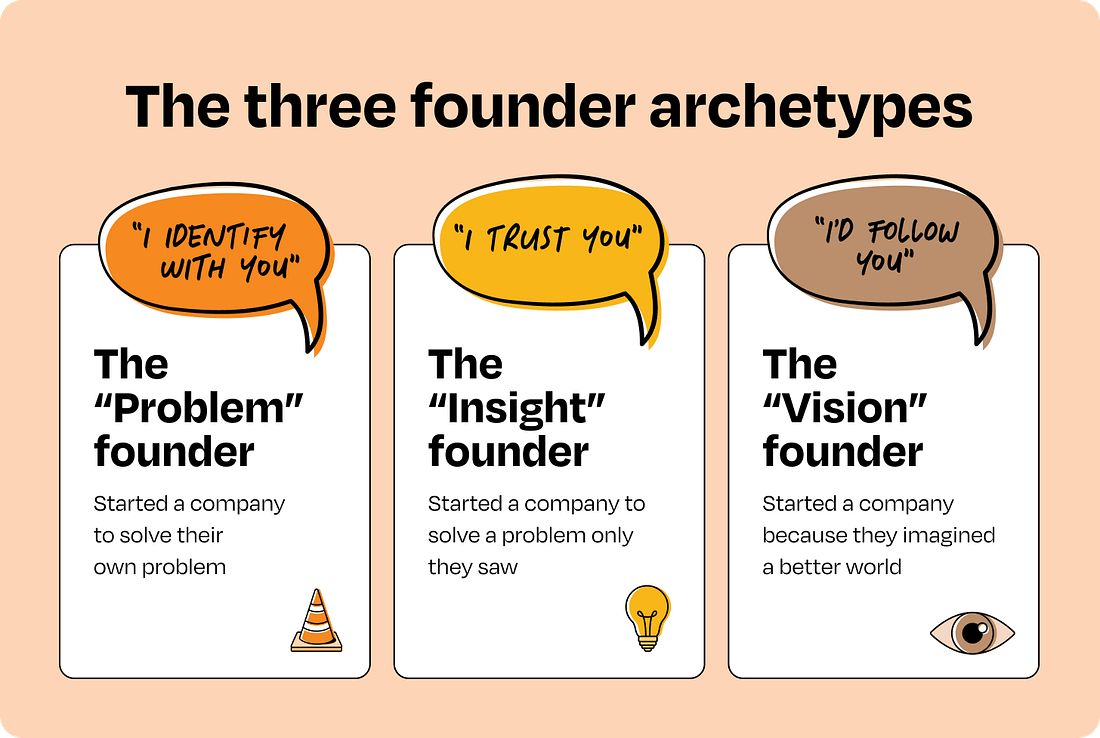 |
The “Problem” founder: The person who started a company to solve their own problem
The “Insight” founder: The person who started a company to solve a problem only they saw