|
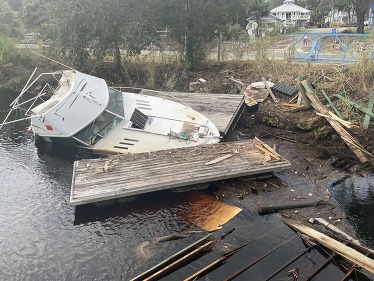
A derelict vessel and associated debris in Steinhatchee, FL after Hurricane Idalia in September 2023 (Photo Credit: NOAA).
With funding from the NOAA Marine Debris Program, the National Fish and Wildlife Foundation (NFWF) is seeking proposals under the Hurricane Response Marine Debris Removal Fund. NFWF will award up to $11 million in grants to support projects that assess and remove marine debris in communities in Florida, Georgia, Guam, North Carolina, and South Carolina impacted by Hurricanes Idalia, Helene, Milton, and Typhoon Mawar from 2023-2024 and improve those impacted coastal environments. Full proposals are due on October 21, 2026, 11:59 PM EDT. An informational webinar for potential applicants will be held by NFWF on Thursday, August 20, 2026, 2:00 PM EDT.
For more information and to register for the webinar, please visit the NFWF website.
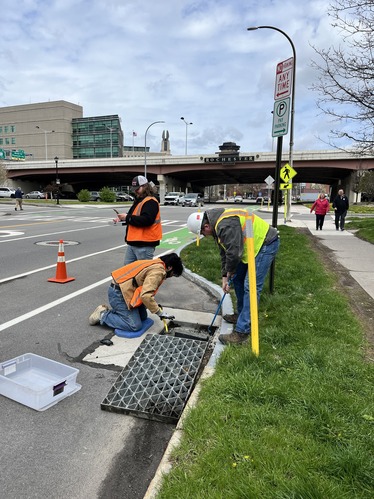
Researchers from the Rochester Institute of Technology removing debris collected from a LittaTrap device installed in a storm drain in Rochester, New York (Photo Credit: NOAA).
On August 18, the NOAA Science Seminar Series will feature research supported by the NOAA Marine Debris Program. Christy Tyler, Ph.D., and Matthew Hoffman, Ph.D., from the Rochester Institute of Technology will present results on debris input, transport, and degradation in the Lake Ontario watershed. Data was collected using LittaTraps deployed across storm drains in Rochester and Brighton, New York over the course of two years. Tune in to learn more about how stormwater data shows how marine debris enters the Great Lakes.
Register for the webinar.
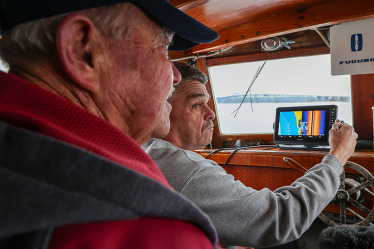
E.C. Hogg (front) and Ralph Bonniville (back), both TRAP participants, gather bathymetric data (Photo credit: John Wallace, William & Mary’s VIMS & Batten School).
A partnership between NOAA, William & Mary's VIMS & Batten School, and Chesapeake Bay crabbers is transforming routine vessel activity, including crab trap removal efforts, into a new source of bathymetric data. The NOAA Marine Debris Program is supporting commercial crabbers with side-scan sonar technology to locate and remove lost and abandoned crab traps. Data collected during those recovery efforts is now helping researchers map and better understand the Chesapeake Bay.
Learn more about this exciting data partnership.
 Register for the Turning the Tide Summit hosted by the BoatUS Foundation.
Registration is now open for the Turning the Tide Summit hosted by the BoatUS Foundation on December 6-9, 2026 in New Orleans, Louisiana. The conference will gather environmental agency staff, policymakers, industry leaders, boating enthusiasts, and others to discuss challenges and lessons learned while managing abandoned and derelict vessels and sustainable disposal solutions for boating related waste, including fiberglass and shrink-wrap. This will be a hybrid event with an option for virtual participation.
Register online on the BoatUS Foundation website.
 Check out the back to school resources.
As you prepare your classroom and check off your back to school shopping list, the NOAA Marine Debris Program has resources for both students and educators to prepare for the school year ahead. Educators can search through over 200 marine debris curricula, activities, and lesson plans. Our online resources are a must-have for this back to school season!
Check out back to school resources. |