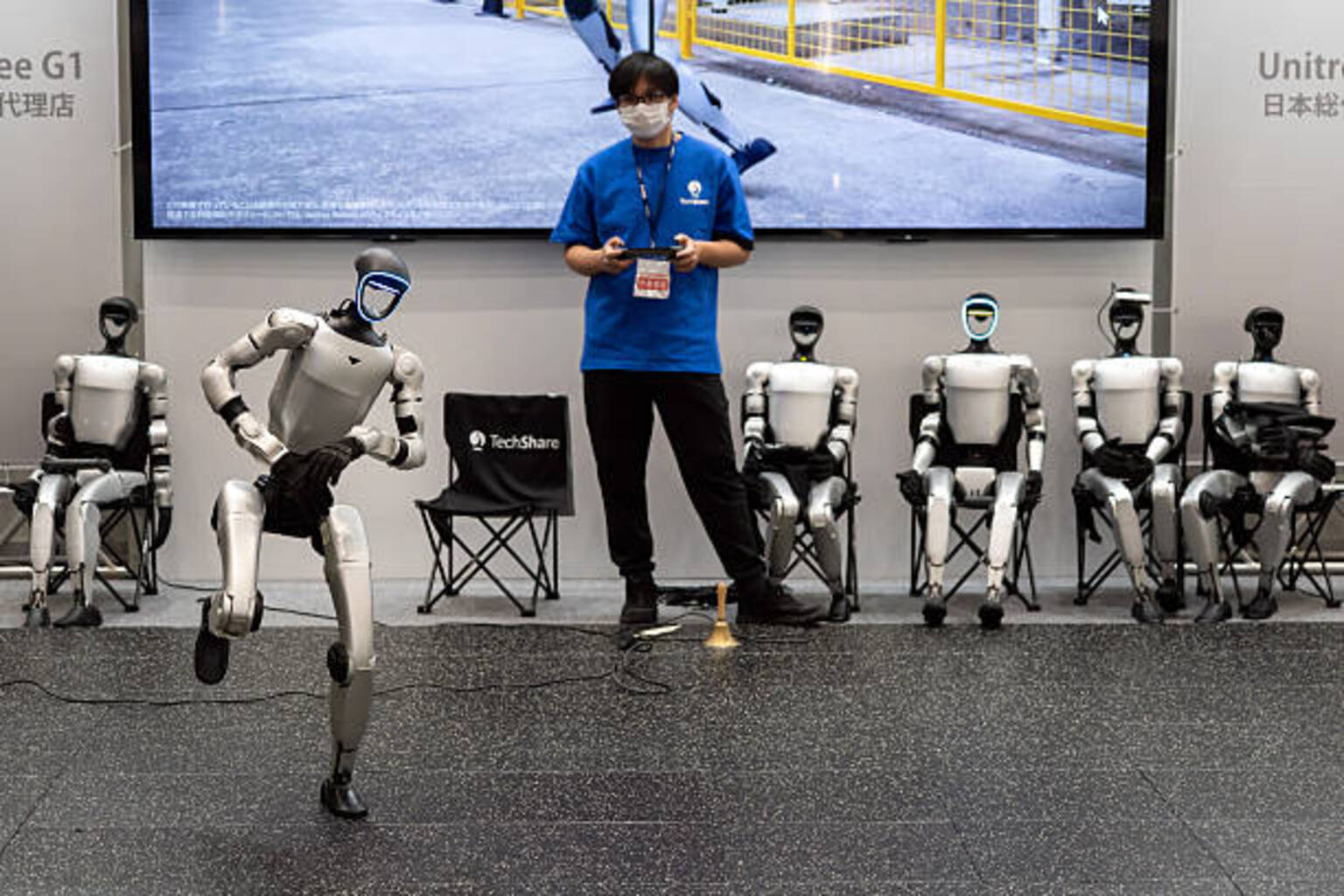
China's robotics industry just got a big boost, with top humanoid robot maker Unitree surging
more than fivefold in its stock market debut in Shanghai on Wednesday. Unitree — known for its robots that perform dance routines, martial arts and backflips — raised about $900M in its IPO.
Stellar debut: Shares of Unitree — known for its robots that perform dance routines, martial arts and backflips — soared as much as 629% on Wednesday and later pared gains to end over 460% higher. Unitree's IPO subscription period set a
record for demand on Shanghai's tech-focused STAR market. "The Unitree IPO is regarded as a key milestone for the humanoid industry and can serve as a benchmark for other IPOs in the pipeline," stated Counterpoint Research Associate Director Ethan Qi. Unitree is backed by Chinese tech giants including Tencent (
TCEHY), Alibaba (
BABA) and DeepSeek (
DEEPSEEK) as well as state-owned enterprises. Unitree quickly gained attention for its quadruped robots and its stated goal to offer advanced robotics at a fraction of the cost of Western competitors, such as
Tesla (
TSLA) and
Hyundai's (
HYMLF) Boston Dynamics.
Sector outlook: The humanoid robot market is expected to grow exponentially over the next decade, with global sales estimated to swell from $2B in 2025 to roughly $300B by 2035. Unitree's blockbuster IPO underscores China's push to
dominate global robotics. "China already accounts for roughly 75% of both the humanoid and autonomous vehicle markets," John Lyie, equity strategist at J.P. Morgan, wrote last week. He pointed to China's manufacturing advantage – integrated supply chains, government support, quickly developing AI capabilities and economies of scale. Lyie also noted China's cost advantage, with Morgan Stanley estimating that a typical humanoid robot's materials cost ~$46,000 in China vs. $131,000 in the U.S.
Challenges ahead: But a new hurdle has emerged – the U.S. banned new foreign-made advanced robots, citing
"unacceptable risks" to national security. The U.S. accounted for ~13% of Unitree's overseas revenue in 2025. In addition, Unitree's robots are largely used in research and educational institutions for now. "Humanoid robotics remains at an early stage, and a significant share of current shipments are going into research, demonstrations and pilot projects rather than mature commercial applications," Kangyuxiao Li, equity analyst at Morningstar, wrote. "The real competitive test will be whether companies — Chinese or American — can achieve reliable performance and attractive returns on investment in large-scale industrial and commercial deployments."
Humanoid Robotics In 2026: The Race From Pilot To Platform