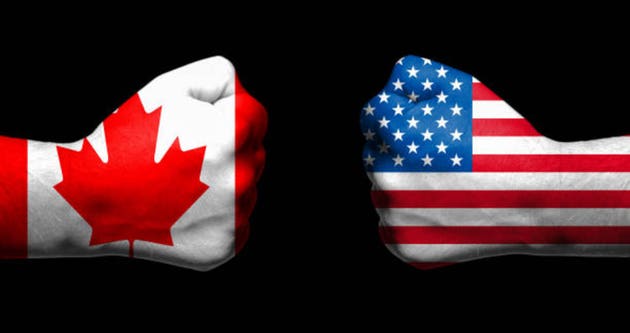
A trade spat between the U.S. and Canada is morphing into a trade war after talks between the two sides broke down over the weekend. Tensions have long been simmering between the two neighbors under the Trump administration, which has cited unfair trade, border controls, and industrial subsidies. President Trump has also repeatedly referred to Canada as an economic free-rider, issuing calls for it to become the 51st U.S. state, but the latest tariff blitz that threatened 50% tariffs on about $20B of its exports might have been a step too much.
What happened? The Trump administration was prepared to eliminate prior levies on softwood lumber imposed under Section 232, according to United States Trade Representative Jamieson Greer. It also offered to reduce tariffs on cars and metals, like steel and aluminum, which was a top priority for Canada. Similarly, the U.S. would have suspended the latest proposed 50% tariffs on Canadian dairy, cement, textiles, hockey sticks and other goods that went into effect on Saturday.
However, terms that would exclude pickup and semi trucks were a major sticking point between the two countries, as well as the amount of tariffs on cars made with both U.S. and Canadian content. There were also said to be requests by the U.S. that would impact Canada's cultural protections, as well as the inability for Canada to ink third-party trade agreements. While Canada offered to pull its retaliatory tariffs and press its provinces to resume the sale of American liquor, the entire deal was quickly becoming seen as a threat to sovereignty, and would be a hard sell to the Canadian public.
"We are masters in our own home... You're at war when you get attacked. We got attacked. That's fine. We've got the reserves. We've got the resilience. We've got the plan," Prime Minister Mark Carney said at a press conference in Ottawa. "Canada wants the benefits of being a State, without being one!!! They have also charged our great farmers, for many years, massive amounts of Tariffs. No more!!!" President Trump replied on Truth Social.
Outlook: The new 50% tariffs are deliberately being imposed under Section 338 of the 1930 Tariff Act, which will circumvent the US-Mexico-Canada Agreement that Trump signed in his first term. Canada has threatened counter-tariffs in response and pledged financial aid for businesses caught up in the dispute, but a lot is at stake for both countries if things continue. Trade of goods between the two nations totals around $2B per day, or nearly $715B annually, with deeply intertwined supply chains hanging in the balance. Until things are resolved, Canada will likely suffer more overall pain at the macro level, while the U.S. will face concentrated supply chain shocks and price spikes in specific industries like autos, energy, and homebuilding. (16 comments) Take the WSB survey!