August 27, 2026
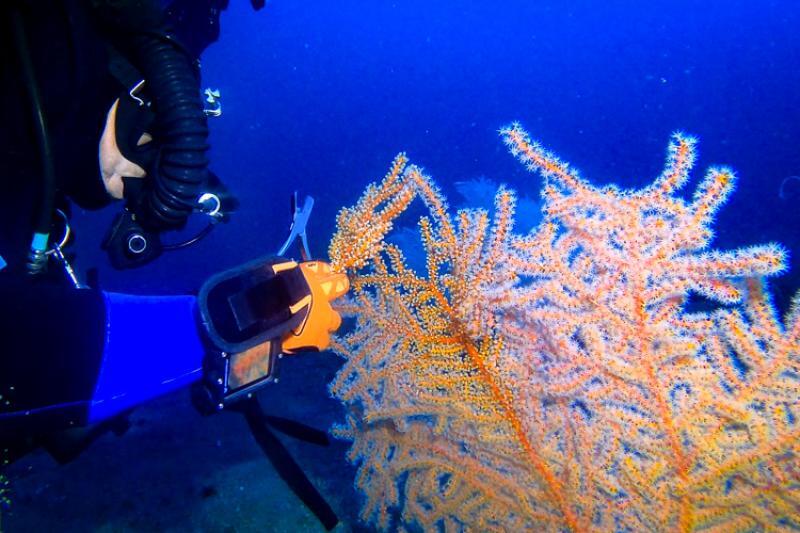
Deep in the Gulf of America lies a vital but little-known habitat. In the "mesophotic" (middle light) zone are coral ecosystems that are essential to the Gulf’s food web. In 2010, the Deepwater Horizon oil spill injured extensive areas of this important environment. Today, scientists across federal agencies and partner organizations are working together to restore these foundational habitats.
In the spring of 2026, a mission on board NOAA Ship Nancy Foster set out to achieve ambitious restoration goals. The team focused on planting propagated corals of species Swiftia exserta, Muricea pendula, and Thesea nivea, and collecting samples to better understand the seafloor and local water quality. Some of the corals were planted on new dome-shaped concrete structures. They were specially designed by Marine Applied Research and Exploration to support coral growth and provide habitat for other small marine animals.
This mission saw the debut of the "coral torpedo," an invention by Chris Gardner, fisheries biologist with NOAA’s Southeast Fisheries Science Center. Designed with a streamlined shape, the "coral torpedo" travels quickly through the water column, acting much like the pneumatic tubes at a drive-through bank teller window to deliver precious coral cargo to the seafloor efficiently and safely.
Read more: https://www.fisheries.noaa.gov/feature-story/deep-diving-and-innovation-restore-gulfs-mesophotic-corals
Not all benthic areas in the Gulf were injured by the oil spill. Dozens of sampling trips by the DWH Trustees documented no evidence of exposure to DWH oil, dispersants, or disruptive responses within Flower Garden Banks National Marine Sanctuary. However, long-term monitoring studies within the sanctuary have provided crucial data to support Mesophotic and Deep Benthic communities restoration throughout the Gulf. By developing a better understanding of healthy, unimpacted habitat, experts can more effectively implement restoration and evaluate progress in impacted areas. Recent efforts to install deep mooring buoys, remove marine debris, and remove invasive species also provide additional protection to these habitats within the sanctuary.
 |
While the sanctuary is well known for the beautiful coral reefs perched atop East and West Flower Garden Banks, these areas only account for a tiny fraction of the entire sanctuary. The majority of sanctuary habitats exist 130-725 feet (40-221 meters) beneath the waves in an area known as the mesophotic or "twilight" zone.
|
|