
|
Almost Timely News: 🗞️ Advice I Would Give to a New PR Practitioner (2026-09-06)
If you enjoy masochism and poverty...
|

| |||||||||||||||


Almost Timely News: 🗞️ Advice I Would Give to a New PR Practitioner (2026-09-06) :: View in Browser
 |
The Big Plug
✍️ Enroll in my new course, AI for Writers and learn how to make AI write better.
Content Authenticity Statement
99% of this week’s newsletter was made by me, the human. You will see some AI slop from a PR practitioner that they pitched me with. Learn why this kind of disclosure is a good idea and might be required for anyone doing business in any capacity with the EU in the near future.
Watch This Newsletter On YouTube 📺
Click here for the video 📺 version of this newsletter on YouTube »
Click here for an MP3 audio 🎧 only version »
What’s On My Mind: Advice I Would Give to a New PR Practitioner
This week, I answer a question Farzana Baduel had over on LinkedIn: what would you tell a brand new PR person about what they’ll need to succeed in their career, especially in the age of AI?
Having worked at a PR firm for 5 years prior to co-founding Trust Insights with Katie Robbert, I have a lot of thoughts on this topic. This will be an uncomfortable newsletter for a lot of people because the truth is that public relations, as a profession, is not adapting to the realities of the world today, and a lot of new PR professionals are being given advice for a world that no longer exists.
Now, to be clear, that’s not every PR firm, that’s not every shop, that’s not every practitioner, but there’s a lot of bad advice and obsolete perspectives in the PR industry that are hindering its growth and hindering practitioners’ ability to have fruitful careers.
In terms of what new practitioners need to know, I’ll structure this following Katie Robbert’s 5P Framework by Trust Insights™ - purpose, people, process, platform, and performance. This is the best overall structure for analyzing business, and it’s well-suited for today.
So, (cracks knuckles) let’s get underway.
Part 1: The Purpose of PR
Public relations is exactly what it says on the box: how you, the PR professional, relate to the public on behalf of your company or client. Your job is to connect the public to the org you represent with the goal of increasing awareness and trust in that org.
I’ve said for years that PR is the worst sales job in the world. It has all the stress of a sales job - outreach, pitching, prospecting, followups, nurture - and none of the commissions. When you “close” a “deal” in PR, you get a pat on the back (maybe) from your stakeholder... and that’s it. No bag of money comes with it, unlike sales which usually has commissions.
So the skillful communicator has to really enjoy masochism and poverty as you develop your skills. Why? Because, especially for new folks to the profession, it doesn’t pay particularly well. In the Boston area, the average account coordinator starts at a salary of about USD 56,000 per year, or USD 28 per hour more or less. The MIT Living Wage Calculator for the Boston area estimates that a living wage that covers basic survival but no financial security is USD 32.46 an hour.
Automatically, PR practitioners are placed in a very high financial stress environment from day one. And that’s something you need to know as a PR practitioner. If you want financial security, if that is a motivating influence on you, public relations may not be the right profession for you.
Where a lot of public relations firms and agencies are in trouble today is that they’ve lost sight of the purpose of PR. They’re so focused on doing what they’ve always done and trying to meet net margins of 17-21% and billable hours that what they typically do is less and less effective every year.
It doesn’t take a PhD in communications to look at how the average PR firm works - going out and obtaining media placements in publications - and look at the media landscape, shattered like a vase in a gift shop that my kids ran through - and see the disconnect. Where and how people consume news, information, and entertainment has shifted dramatically in the last 6 years, ramped up by the pandemic and everything after.
Why is this happening? Why has the purpose of PR been forgotten? Most of that fault lays at the feet of agency owners and principals, folks whose expertise and worldview is from years, if not decades ago. Publications like O’Dwyers, PR Week, etc. Estimate that the average age bracket for agency owners is 53-60 years old, folks in my age group. We grew up in the last generational cohort that had a pre-internet media landscape and in general, we place undue emphasis on traditional publications. Brands like the New York Times and Wall Street Journal still have some residual influence with us, knee-jerk reactions that what they publish is trustworthy and impactful.
If you, as a new person to the profession, want to make an impact, part of your remit is helping your peers and superiors understand reality as it is, the media landscape as it is, a world in which a single personal email newsletter like this one (~292K) can have a greater reach and circulation than the MIT Sloan Management Review (~100K, now defunct as of this month). If you want to connect to the true purpose of PR, of relating to the public, you have to go where the public is.
Part 2: The People of PR
Here’s the million dollar PR question: who is the public in public relations?
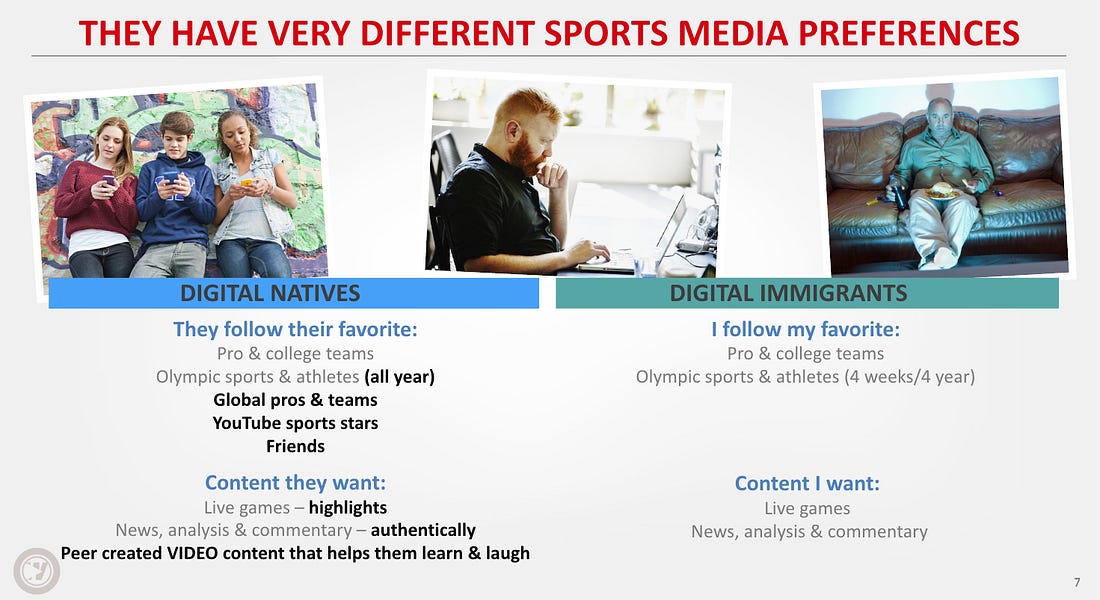
The knee jerk answer is “people, of course!” followed by traditional descriptors like heads of household, shopping parents, decision makers at companies, etc., the usual lists that every PR professional produces as part of a pitch. Here’s an example from a pitch deck from the agency I used to work at (the NDA expired years ago):
 |