|
|
|
Newsletter continues after sponsor message
|
|
|
BSIP/Universal Images Group/Getty Images |
|
Among women there’s a certain sense of inevitability around getting a urinary tract infection. Just had sex? Girl, don’t just lie there – get up and empty your bladder real quick so you don’t get a UTI. Had a lot of sex in a short period of time and it burns when you pee? Ah, classic UTI scenario!
While it is true that sexual activity raises your risk of getting a urinary tract infection, UTIs may not be as common as we’ve been led to believe, as Meghan Rabbitt reports. According to Maria Uloko, a clinical urologist and researcher, “millions of women are being treated for UTIs they may not actually have.”
Uloko and colleagues reviewed the medical records of over 250 women who had been diagnosed with recurrent urinary tract infections – at least two in a six-month period or three in a year. They found that just 15% of those women had clear indications of a bladder or urinary tract infection. The rest had signs of hormonally-driven inflammation. A quarter had pelvic floor dysfunction.
These conditions produce the same symptoms as UTIs — burning with urination, urgency, frequency, and/or lower abdominal pain — but require different treatment. Uloko says many patients she sees have been treated with repeated rounds of antibiotics, only to have the symptoms return within a few months. "Most of them don't actually have UTIs, even though that's been their diagnosis time and time again," she says.
So why do these women keep getting misdiagnosed? A urinary tract infection is caused by bacteria in the urethra that aren’t supposed to be there. When a patient presents with classic UTI symptoms, most clinicians do a quick urine test for signs of inflammation. They also test for bacteria – but that must be cultured and it takes a few days to get results.
"Because patients are suffering in real time, clinicians often start them on a broad-spectrum antibiotic right away if that urinalysis comes back positive and adjust the medication if needed once the culture comes back," says Uloko.
UTI-like symptoms can also be prompted by hormone changes due to breastfeeding, menopause, or hormonal medications like birth control, says Lindsey Burnett, a urogynecologist and co-author with Uloko on the study. A loss of hormones to the tissue of the vulva can cause inflammation and pain, and so can certain medications. In addition, a tight pelvic floor can disrupt bladder function.
If you have symptoms like an overactive bladder, recurrent UTIs and pelvic floor dysfunction, there are hormonal treatments that may help. Unfortunately many clinicians aren’t trained to accurately assess and diagnose these conditions, Uloko says. Consider seeing a specialist such as a urologist, urogynecologist, gynecologist, or Menopause Society-certified practitioner.
Read the full story for more about symptoms, diagnosis and potential treatments – and what questions to ask your doctor.
Plus: 'Say no to power peeing' and other good tips from a pelvic floor physical therapist |
|
Katherine Bruno/Upper Hudson Planned Parenthood |
|
Starletta Washington of Troy, N.Y., was stunned when she heard the city’s last remaining hospital planned to close its birthing center. Washington was born there and so were her children.
"Nobody else was going to be born in the city of Troy unless they were born on a city bus, in the back of a cab, or, disgustingly, on the side of the street?" Washington said. "Blew my mind."
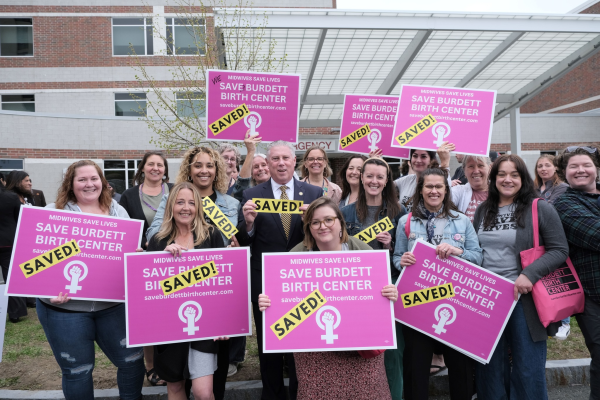
Not only is Samaritan Hospital’s birthing center the only one left in this old industrial city, it is beloved. Samaritan's Burdett Birth Center has become a model for patient-focused care, as Noam Levey reports for KFF Health News. Midwives and doulas work alongside OB-GYNs, and C-section rates and preterm births are lower than the state average.
In 2023, Trinity Health, which owns Samaritan Hospital, said Burdett was losing money and would close.
In the past 15 years, hospitals have closed hundreds of maternity units as cities and towns shrink and hospitals consolidate into larger systems. But with the prospect of having to drive up to half an hour to Albany to give birth, community members came together across divides to keep Burdett open.
Doulas, midwives, moms and others held rallies and passed out signs. Activists conducted a community survey that found 1 in 4 Troy residents didn't have access to a car and would have trouble getting to Albany. They tapped into frustration with Trinity Health, which operates 91 hospitals and brought in $25 billion in revenue in 2025.
"The whole hospital scene has changed," says Mayor Carmella Mantello, who herself gave birth at Burdett. "It was very personable. You had nurses and doctors who were able to give more care and spend more time with patients." Now, by contrast, many hospitals have what she described as a "more corporate type of atmosphere."
Mantello, who was then on the city council, is a Republican. The coalition fighting to keep the birthing center open included other Republican county and state elected officials, as well as a Democratic state assemblyman, Planned Parenthood, and the local Catholic diocese.
Trinity Health executives resisted, and even sued the state of New York for preventing the closure. But eventually $5 million in state funding was allocated, and Trinity reversed its decision to close the birthing center.
Lois Uttley, a researcher and activist who has worked with communities facing hospital consolidation, said Troy's success reflects a growing bipartisan suspicion of big corporate healthcare organizations. "The executives of these health systems will tell the community that joining a big health system will be good, that the quality of care will improve, that efficiencies will mean they can keep the costs low," Uttley said. "But what I have seen over the last 30 years of work is that those promises often are broken."
Read the full story or watch a video version here.
Also: Maternity care in rural areas is in crisis. Can more doulas help? |
|
We hope you enjoyed these stories. Find more of NPR's health journalism online.
All the best and happy Labor Day,
Andrea Muraskin and your NPR Health editors |
|
Listen to your local NPR station. |
|
Visit NPR.org to find your local station stream. |
|
|
| |
|
|
|
|
|
|
|
|
You received this message because you're subscribed to Health emails. This email was sent by National Public Radio, Inc., 1111 North Capitol Street NE, Washington, DC 20002
Unsubscribe | Privacy Policy |
 |
|
|
|
|
|
|
|