
|


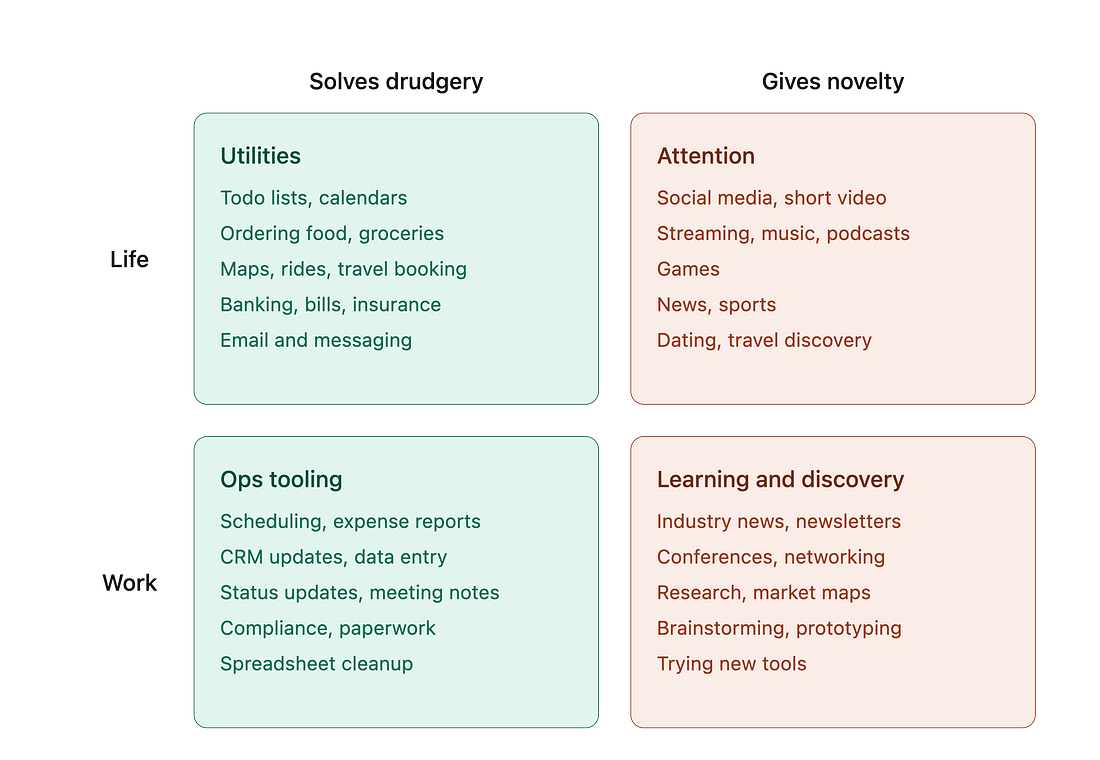 |
Quick observation on why AI has exploded at work, but has been slow to disrupt consumer apps:
At work, AI follows patterns and gets rid of drudgery (good!)
At home, AI follows patterns but it generates slop (bad!)
This is why AI has taken off at work, but not so much for consumer apps and experiences (social, entertainment, dating, etc).
Much of work is drudgery - filling out forms, following processes, writing updates, reviewing boilerplate code, etc. - and AI does a great job compressing this down the boring steps so that humans can focus on the high-leverage steps. The boring/routine work is not hard, but they often take a lot of steps and you have to stitch together a lot of data. You follow patterns. AI is good at following patterns too.
The other way to think of this is the line between verifiable/adversarial. AI is fantastic at automating tasks that have verifiable outcomes, which is why we’re seeing amazing strides from coding, mathematical proofs, and workplace productivity is an extension to that. Consumer products, on the other hand, thrive in the world of novelty - which I’ll argue is inherently adversarial.
Humans = Novelty-seeking monkeys
Consumer attention is hard to win over because people crave novelty, seek parasocial relationships, and are so cognizant of AI slop. A video of an attractive person talking loses its ability to generate parasocial relationships. In domains like social media, video, etc where authenticity is paramount, a distorted AI sign in the background can ruin the entire thing. Novelty is generated by surfing the cultural wave with something new and unique - AI slop often pattern matches to the past, after all, it’s the past that’s in the data set, and as a result, new/unique is hard
This is a form of “adversarial creativity” - and it exists in business as well. When you think about inherently adversarial activities in business - like sales and marketing, where novel messaging, competitive move+countermove dominate - AI has received the most scrutiny for generating slop. No one wants the same sounding AI generated cold emails. No one wants to use AI slop software. You have to go outside the model in order to really land a message.
Perhaps this is the ultimate human-in-the-loop problem, because to do something fresh and unique requires adversarial creativity. We already see indications - for the chronically online, you want feed your addition in real-time, which is why group chats and feeds dominate. While a meme or a tech demo might be amazing one week (remember when we were all making Studio Ghibli avatars a while back?) then the next week they become stale/uncool. Modern marketing has become dominated by social media, and and social media is characterized by speed. This is why it sucks to watch cable news or read newspapers these days. It just summarizes what you already read a few days (or weeks) ago online. Social media’s OODA loop iterates more quickly than the trad news OODA loop, and subsequently, swiping a feed has replaced reading the morning newspaper.
The coming product retention crisis
When you apply this thinking to tech products, it becomes natural to think that they may become an extension of “content” on the internet. Just as you might record a quick video, or type 200 characters into a textarea, perhaps you will also consider typing into a prompt that builds an app - then you just publish some screenshots/videos of it so that people will try. And just as you might make a memetic video or post about a world event, a funny Super Bowl moment, perhaps we will treat apps the same.
We don’t really talk about the “retention” of content because, of course, there isn’t any. You get a big spike, your 15 minutes of fame, and then you need to be thinking of your next poast. App poasting might be the same, where quantity beats quality, and you ride the spike and its more about the system you use to generate hits, and the brand and IP you create over the course of time. Who will be the “Mr Beast of apps?” That’s a fair question at the dawn of the AI age when an app might take about as much time to build as editing a Youtube video.
So this means average product retention will collapse, and the days of seeing >20% D30 will feel like a dream. Maybe it won’t be the right metric, and we’ll need to pick a new one. The question will be, how many apps hit how many eyeballs and how many apps? And if you are lucky, perhaps you’ll come up with a strategy to build YouTube and not just be a video creator, although both are lucrative activities.
The future of marketing (and by extension, a large swath of product) is zero-sum and PvP - the abundance of apps/videos/pods/creators/experiences will mean we have infinity times more supply than demand. To win consumer attention, you have to be slightly ahead of the OODA loop and do something newer and more novelty-creating than others. You have to distill the consumer zeitgeist, map it to your strategy, and move quickly. Not so fast to become random/alienating, but not too slow to become yesterday’s news - something in between. We’re already seeing an instantiation of this with the 24x7 always-on nature of product videos/launches — our feeds are saturated by AI startups launching and relaunching every day.
Or, the cost moves elsewhere. In the “there will only be four jobs” view of the world (h/t Yoni Rechtman) - pay attention to the last one:
product eng/vibe coder/PM/slop cannon: self explanatory. This is the high velocity, high tool use generalist. they are obviously not restricted to product and eng roles. Anyone can be commercial and product minded.
SREs/infra/security/systems: we’re going to be producing so much STUFF across every org that there’s going to need to be really really good people stitching it together, making it stable, secure, and robust.
Adults: sometimes you need a grown up in the room to just say “hey, come on.” They are effectively a much needed governor on an otherwise accelerating organization. You will find them across roles but there are obvious places like legal and finance where you’re NGMI without an adult in charge.
Hot people: You will find hot people in roles ranging from sales, to people, to CX. There will always be an important place for those who present an easy UX to the world and are pleasant to be around. Remember, there are many ways to be hot.
Part of having forward deployed hot people is that it’s costly to actually be there in-person. When everyone is focused on digital/scalable/quantity/ephemeral, it’ll be effective in some competitive contexts to do the expensive signal thing in order to prove to the customer you’re competing for that they’re special. So maybe it’ll be a barbell.
Can’t adversarial creativity simply be automated?
I dunno. It’s complicated. After all, novelty is adversarial against the dataset itself. What’s new/unique = whatever isn’t in the recent training data. So being fresh is literally an adversarial act against the model’s prior. And of course, it’s not verifiable. AI doesn’t work like this right now, but maybe it can generate ideas and someone with more prescience and cultural touch can edit.
But the other danger is in the downside case of automation. Parasocial trust takes a second to break. The moment that content or marketing or messaging feels like AI, or feels inauthentic, then the parasocial bond goes away. If you’re the cool AI CEO posting all the cool things you’re creating, and all of a sudden emdashes and “load bearing” and so on start appearing, the power of the approach wilts.
You can’t go direct by copy-pasting AI.
You're currently a free subscriber to @andrewchen. For the full experience,