
|
 |
A.I. Risk And The End Of The Neoliberal Style In Politics
You can’t make pragmatic compromises with predatory counterparties.
|

| |||||||||||||||


 |
Artificial intelligence is unpopular. Artificial intelligence is scaring people—because it’s scaring its own engineers; because its executives tell the world it might wipe out millions or billions of jobs. The public overwhelmingly supports aggressive A.I. regulation; it overwhelmingly opposes further investment in A.I. infrastructure.
Thus, if you want to get elected, and you’re right on the cusp, vocal advocacy for reining in A.I. would seem to be the most direct path over the top.
And yet…
Democratic consultants are privately encouraging their battleground candidates to avoid talking about artificial intelligence regulations out of fear that powerful tech groups will unleash a tidal wave of spending against them ahead of November.
That guidance came from strategists in three separate top-tier House races, according to people involved in those races, who were granted anonymity to discuss internal conversations. And it follows a surge in AI panic on Capitol Hill as industry leaders warn about existential threats posed by their rapidly developing technology.
Read the whole story, if you have a few minutes to spare. There will be a temptation to assume this is really all just complicity disguised as defensiveness. That leading Democrats want to slow and water down the anti-A.I. consensus because they hope to get back in the good graces of Big Tech and the industry’s richest investors. Some of that is absolutely in the mix. But this is really a story about political economy. About oligarchy. About the terminal failure of a Democratic Party model of politics that goes back decades.
Taking their motives at their word, I think these advisers are making an error, and their fear of this dirty money is misguided. But if they’re right (and, really, if they’re wrong and I’m right) they need to accept that the political style of neoliberalism can not function under these conditions.
These days the words neoliberal and neoliberalism get tossed around almost exclusively as insults. Progressive critics of the Democratic Party use the epithets as rough synonyms for pussy, sell out, corruption, and cryptofascism¹.
But neoliberalism is a real word, with a real meaning—multiple meanings in fact. One of those meanings is actually pretty apposite as a description of many mainstream Democrats.
And to the extent that Democrats are neoliberals, or practice a neoliberal style of politics, it’s time to move on. It’s probably been time to move on for a while. But now, for real.
In my mind there are three substantive definitions of neoliberalism, each of which should probably have its own unit of language.
There’s neoliberalism, an antiquated term for the economic component of classical liberalism, which imagines a synthesis of state and private economic actors. Regulated capitalism, plus a social safety net. In this sense, FDR was a “neoliberal” and Bernie Sanders is arguably a “neoliberal.” But nobody really has this definition in mind when they use the word.
There’s neoliberalism in the more right wing sense, which mounts economic arguments for getting the government out of the way of private interests, notionally to the end of supercharging “growth.” In this sense Ronald Reagan and Margaret Thatcher were neoliberals.
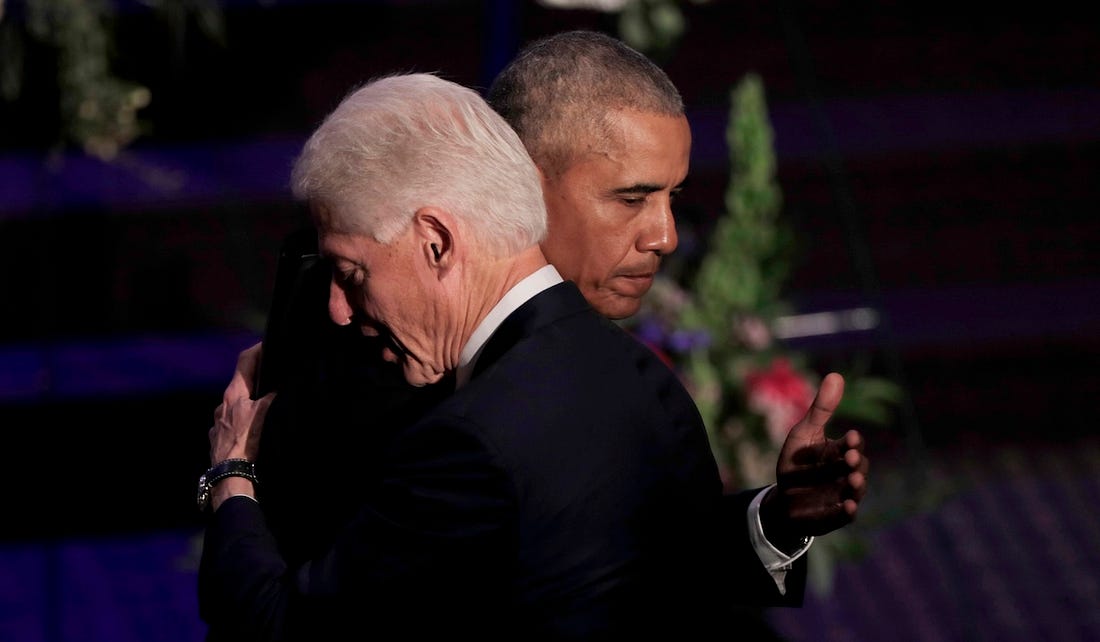
Finally, there’s the neoliberalism of modern-day Democrats, who reclaimed the term from the right. Here’s its manifesto, written 44 years ago. As a program, it was a creature of its time: high-inflation, ossified liberal institutions, poor Democratic electoral performance. It was a call for progressive-minded people to disenthrall from New Deal dogmas and embrace faith in technocracy, problem solving, and strange bedfellows. In this sense, Bill Clinton and Barack Obama are neoliberals.
These neoliberals should acknowledge that a key, political aspect of their worldview has failed.