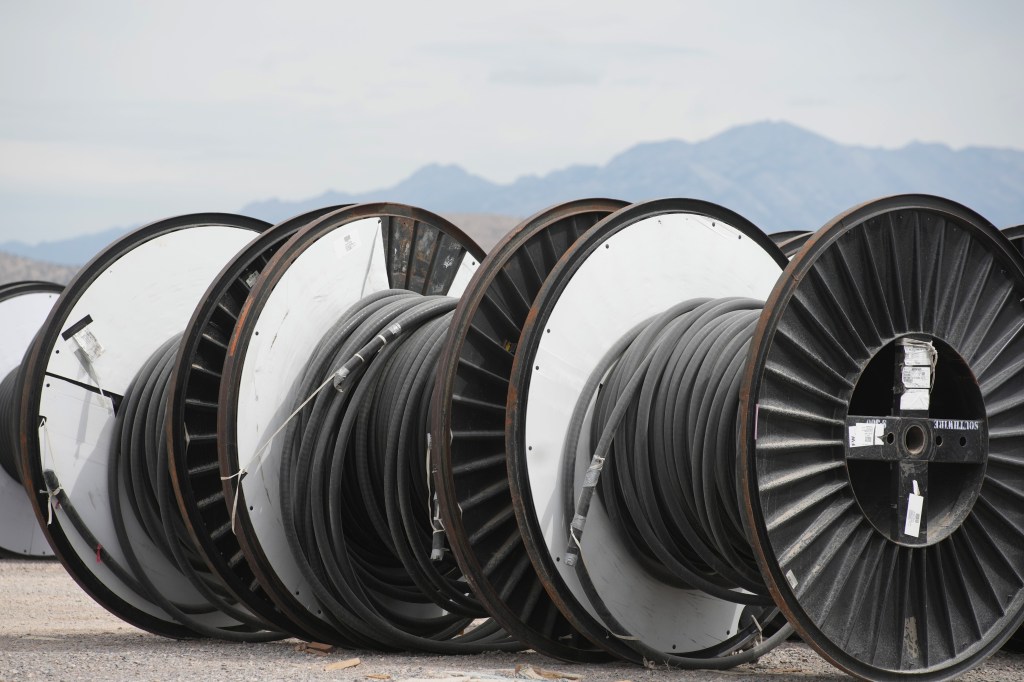
Large rolls of cable at an electrical substation that is under construction at the site of a new QTS Eagle Mountain data center in Eagle Mountain, Utah, on Aug. 28, 2026.George Frey/Bloomberg/Getty Images
U.S. spending on data centers and IT now exceeds housingTwo decades after the housing boom reshaped, then tanked, the U.S. economy, the AI boom is
similarly transforming the drivers of growth.
Hyperscalers have poured so much money into building as much AI infrastructure as possible—and as quickly as possible—that investment from a handful of companies is expected to reach $1 trillion a year soon.
Meanwhile, the housing market has been largely frozen since the COVID-era boom ended in 2022, when the Federal Reserve embarked on an aggressive rate-hiking campaign to rein in inflation.
“We’re seeing a pivotal shift in the U.S. economy: investment is shifting away from residential investment and towards computers,” Adam Shapiro, vice president at the San Francisco Fed, posted on LinkedIn recently.
He pointed out that inflation-adjusted spending on information processing equipment, which includes data centers and computer hardware, now exceeds residential investment.
According to data from the Bureau of Economic Analysis, real private residential fixed investment was $748 billion in the second quarter, down 18% from an early 2021 peak. During that same span, spending on information processing equipment has soared 51% to $752 billion.
“The AI investment boom is massive,” Shapiro added.
The onslaught of AI spending is expected to keep ramping up. S&P Global estimated last month that capital expenditures from Alphabet, Amazon, Microsoft, Meta, Oracle, and SpaceX will exceed $1.3 trillion in 2027, up from a projected $870 billion in 2026 and $470 billion in 2025.
The ratings firm added that the industry’s capex is growing faster than revenue, warning that the aggressive build-out could lead to overcapacity if future demand doesn’t pan out as expected.
S&P sees 2028 as an inflection point, with revenue accelerating and capex flattening. Until then, it added, operating cash flow from the six hyperscalers will collectively be negative in 2026 and 2027.
—Jason Ma