| | Global oil prices slide as hopes rise on Middle East peace talks, venture capitalists rush to clean ͏ ͏ ͏ ͏ ͏ ͏ |
| |  Abu Dhabi Abu Dhabi | New York | Pretoria |
 | | | Climate Week Edition |
| |
|
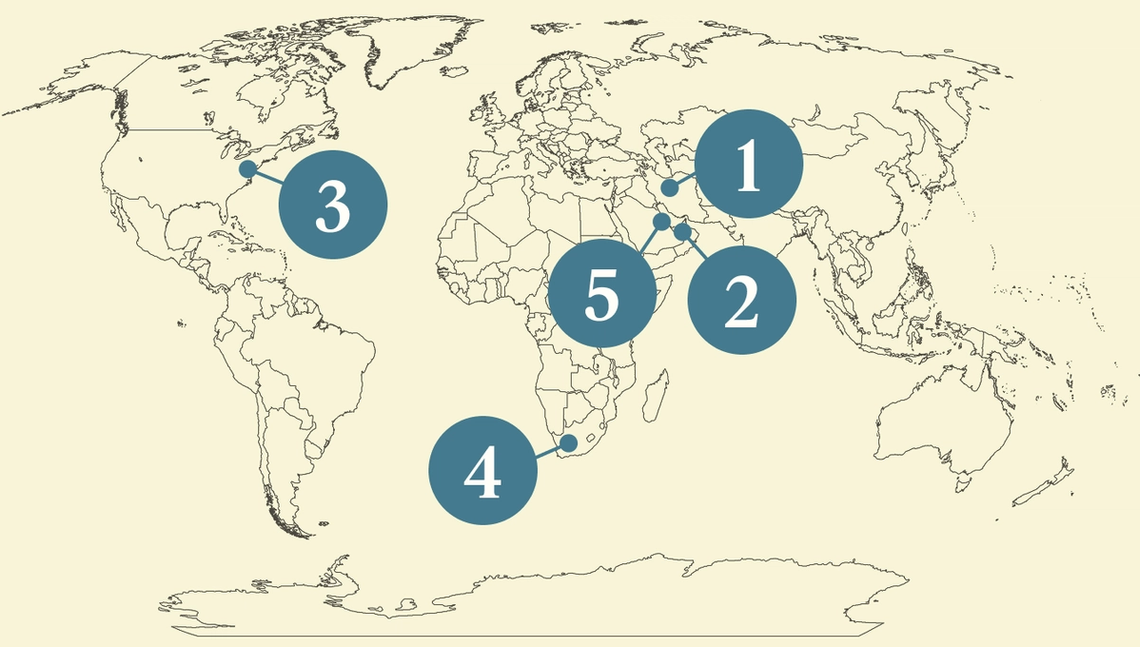 - Shock absorbers
- Investment barriers
- Climate tech ‘tourists’
- Going platinum
- No Hormuz substitute
 Courts hand Trump a setback on solar, and Chevron plans a global drilling push. |
|
 The energy transition won’t happen without governments and companies taking more risks. There should be more tailwinds than ever for clean energy, from the data center buildout to the scramble to replace oil and gas supplies from the Gulf. But at the UN General Assembly meeting in New York this week, climate is being nudged off the agenda by AI, and development banks are under pressure from the White House to scrap their climate finance goals. As the CEO of Masdar told me here yesterday, renewables are still held back in developing countries — the locus of most future energy demand growth — by a perception that they’re a risky investment. I’ll have interviews with a number of other leading energy executives and investors here this week, and one of the main things I’ll be looking for are examples of risks that paid off, and those that still look too scary to take. This is a moment of unprecedented turmoil and change in the energy market, but the rewards will be huge for those that succeed in navigating it. We’ll be landing in your inbox every day this week, so stay tuned. And if you’re in town, don’t forget to join our Thursday evening happy hour! → |
|
|
Oil prices slide on UN talks |
|
Bureaucratic barriers hamper renewables |
 Christophe Van Der Perre/Reuters Christophe Van Der Perre/ReutersBureaucratic barriers that impede the flow of capital — rather than problems with supply chains or local grid infrastructure — have become the biggest obstacle to building more renewable energy projects in developing countries, the CEO of Masdar told Semafor. Mohamed Jameel Al Ramahi, who leads the Abu Dhabi-based renewables developer, said it is “absolutely” on track to meet its goal of reaching 100 gigawatts of low-carbon generating capacity in its portfolio by 2030, up from about 65 now. Much of that growth will need to happen in developing countries, but many lack a regulatory structure for credible long-term offtake deals with developers, key requirements for banks to put up financing. Masdar is working with development banks to solve the problem. In the meantime, Al Ramahi said the company plans to expand its US portfolio, despite antipathy to renewables from the Trump administration: “In the US, renewables were built prior to the tax credits, and they will continue to be built and operated post tax credits.” |
|
Data centers drive cleantech VC surge |
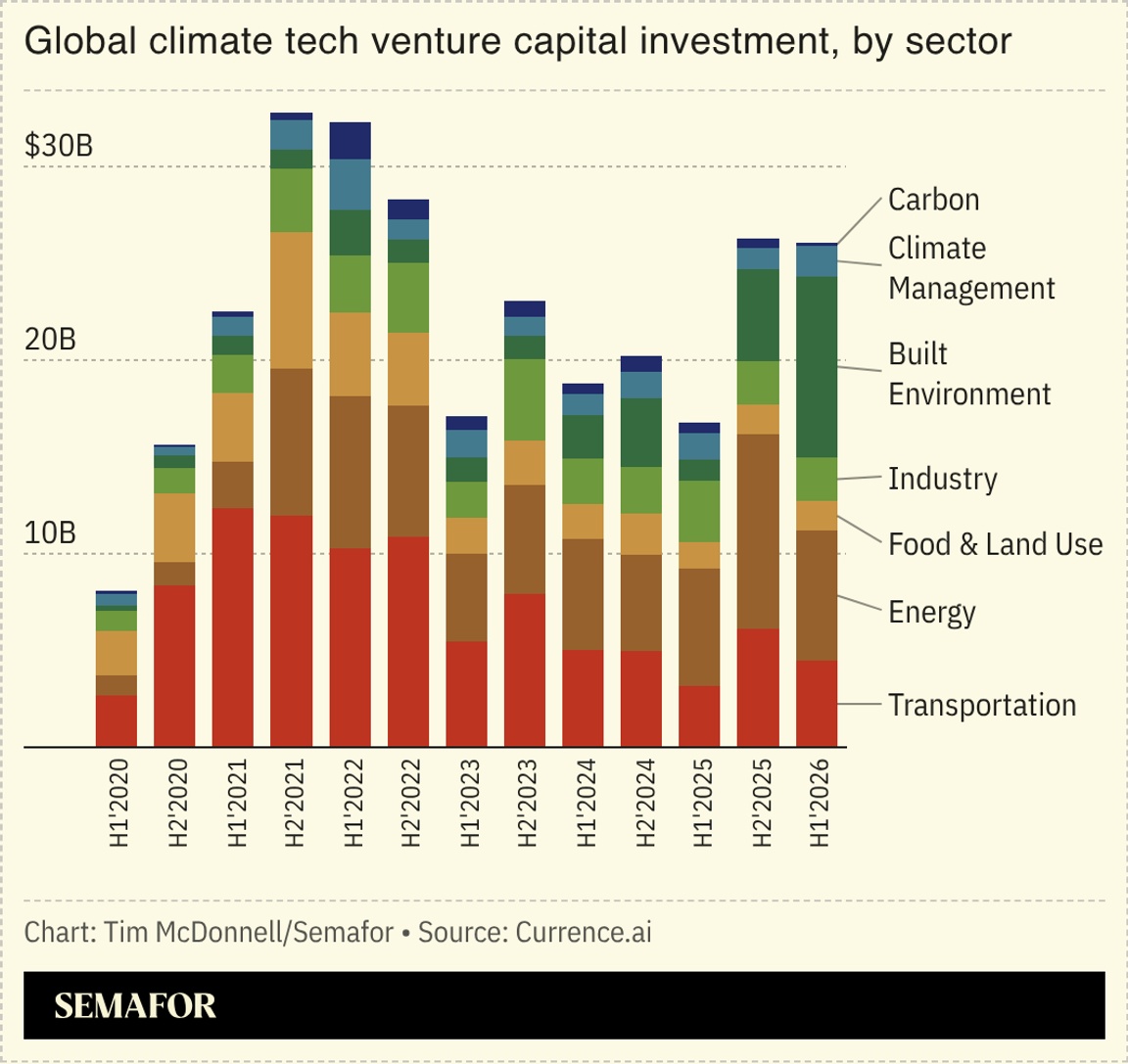 The data center buildout is driving a rush of venture capital investment in clean tech, breathing new life into startups that were at risk of being steamrolled by the Trump administration’s pullback on climate policy. Global climate-tech venture investment hit $26 billion in the first half of 2026, 55% above the previous year, according to climate tech finance tracker Currence.ai. Data centers and the products and services that help them operate are in particularly high demand, with startups in the sector seeing their fundraising and valuations jump. It’s an opportunity to push some new carbon-cutting tech across the “valley of death” between pilot and commercial scale, to the benefit of the global energy transition at large — but also links clean tech’s fortunes to a digital infrastructure buildout whose ultimate scale remains uncertain. “Venture capital sees the data center opportunity, and is focused on it,” Frank O’Sullivan, managing director for energy at VC firm S2G Investments, told Semafor. “There’s an opportunity over the next little while to see a lot more clean tech success stories emerge. The risk is that the driver of all of this — the data center bubble — might pop.” |
|
| | Semafor Next 3 Billion • Exclusive |  | |
S. Africa woos US, China with platinum |
| | Alexis Akwagyiram, Tiisetso Motsoeneng, and Sam Mkokeli |
| |
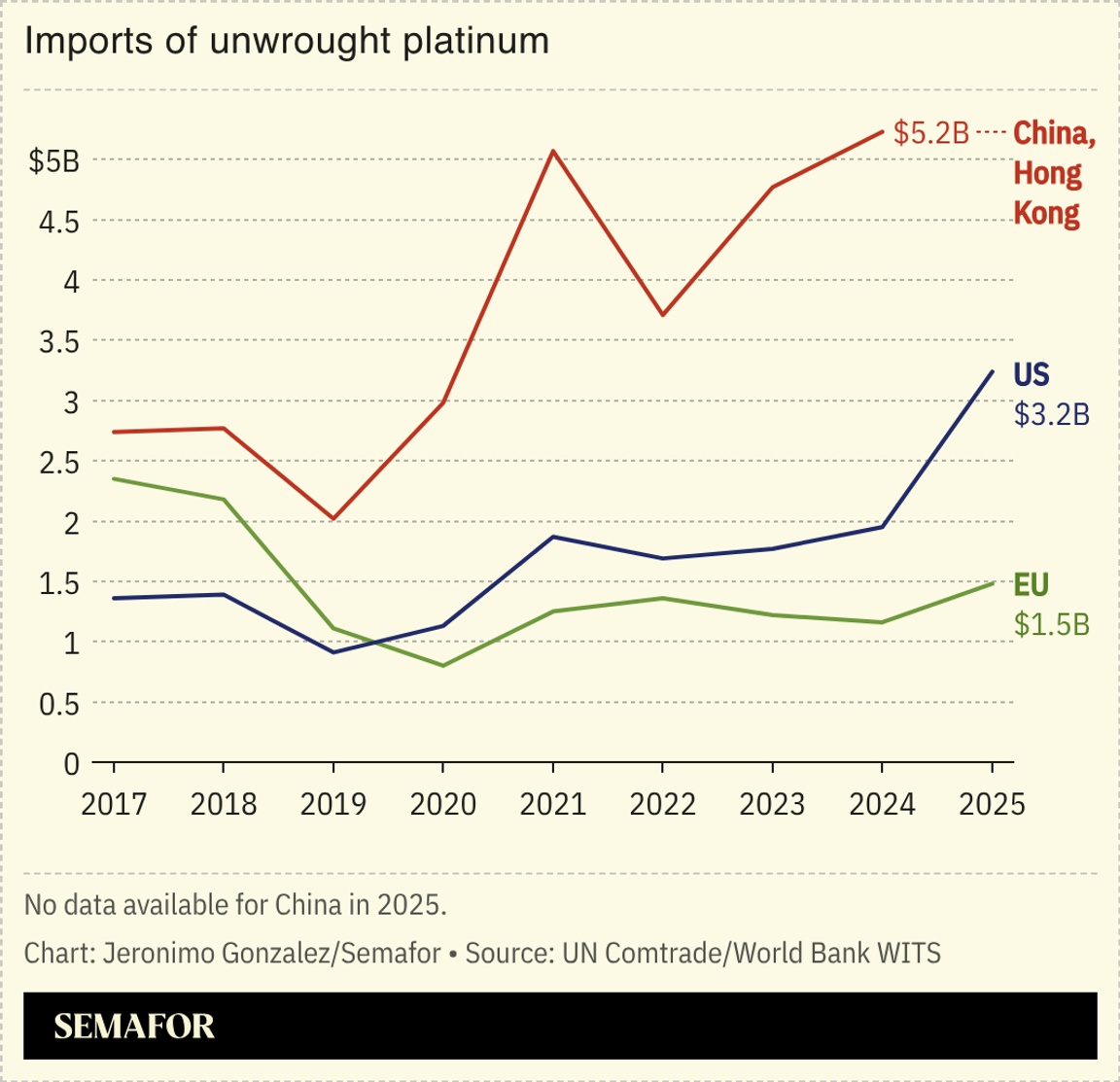 South Africa is leveraging its role as the world’s dominant supplier of platinum to simultaneously strengthen its relationships with Washington and Beijing, according to records reviewed by Semafor and interviews with executives and officials. Trade ministry documents show Pretoria has sought commercial deals with Washington to develop local processing of platinum — used in catalytic converters, defense equipment, and data center hardware — and to grow its own automotive industry. Deepening that relationship would give South Africa a bulwark against punitive US trade pressure following the Trump administration’s accusations of government-sponsored discrimination against Afrikaners. Meanwhile, market data shows China has stockpiled platinum, mostly from South Africa, to develop green hydrogen and to build state-run data centers. This dual approach reflects the way many other African countries are seeking to extract geopolitical and economic benefit from the scramble for minerals needed for the energy transition and AI. |
|
Strait of Hormuz not “obsolete” |
 Courtesy of Qatar Economic Forum, Powered by Bloomberg Courtesy of Qatar Economic Forum, Powered by BloombergThe Strait of Hormuz can’t be rendered “obsolete,” despite the Trump administration’s assertions, Qatar’s energy minister said. Rejecting US Treasury Secretary Scott Bessent’s view that it could become a “worthless piece of water” as alternatives emerge, Saad Sherida Al-Kaabi noted the route carries far more than oil, and that the other goods can’t be moved as efficiently by land or air. Doha has studied exporting gas via pipeline, but decided against it “based on commercial and technical criteria,” he said at the Qatar Economic Forum. The country plans to expand LNG capacity from 77 million tons per year to 142 million by 2030, and duplicating that infrastructure isn’t feasible. The expansion could be delayed if equipment can’t reach Qatar through Hormuz, Al-Kaabi said. The first new LNG plant is expected to start operations next year, and facilities damaged in Iranian strikes will take around three years to repair, he added. — Mohammed Sergie |
|
 - Australia’s prime minister opens New York Climate Week with a keynote address on why climate security is national security.
- Miami’s mayor Eileen Higgins and a senior BlackRock executive will discuss the future of capital flows in cities exposed to climate risks.
- The president of Ethiopia, the European Commission green transition chief, and California’s governor attend a high-level dialogue on green electrification.
|
|
 New Energy- British chemical and energy giant Ineos opened a carbon dioxide storage facility off Denmark, as the cutting-edge technology gains momentum in Europe.
- A US district court ruled that the Trump administration must reinstate a $7 billion grant program that funded solar panel installations for middle- and low-income families.
- France’s state-owned power group EDF said it plans to build 10 small modular nuclear reactors in the EU by 2035.
Fossil Fuels- A shortage of motor oil has pushed prices to new highs, with the cost of the car engine lubricant quadrupling in the US since February.
- China’s electricity gri
|
|
|


