Council on Foreign Relations

September 30, 2026

A Final U.S. Withdrawal in Iraq

By Ivana Saric
Digital Editor, Council on Foreign Relations

The United States withdrew from its last military base in Iraq today, twenty-three years after its 2003 invasion and at a time of shifting U.S. security priorities in the region. 


The withdrawal “marks a transition from a wartime coalition mission to an Iraqi-led security effort,” the Pentagon said in a statement.


For CFR’s Ed Husain, the exit is “the logical conclusion of a nation seeking to withdraw from a long war.”


It comes against the backdrop of the ongoing Iran war, which has put Iraq in the crossfire since breaking out in February: Iran-backed forces in Iraq have repeatedly targeted U.S. forces in Iraq, drawing U.S. reprisals on Iraqi territory.


Iraq’s government has celebrated the U.S. withdrawal as an affirmation of its sovereignty. The Trump administration now counts on it to disarm Iran-backed militias in its territory, while Iran and its allies have welcomed news of the withdrawal.


The pullout marks a shift in where the United States bases its counterterrorism efforts. The coalition dedicated to combating the self-declared Islamic State will move its headquarters to Jordan and U.S. forces will continue counterterrorism efforts in Syria, U.S. Central Command said. 


Nonetheless, the move raised concern among some Council experts who spoke to the Daily Brief, with CFR’s Bruce Hoffman suggesting that it risked creating a “vacuum” like the one that occurred after the initial U.S. withdrawal in 2011. U.S. troops deployed to Iraq again in 2014 after the self-declared Islamic State seized a large portion of Iraqi and Syrian territory.


Husain said that the U.S. pullout could “leave Iran strategically stronger and Iraq weaker.” Hoffman concurred, saying the U.S. exit might “embolden Iran” and undermine the security of the United States’ Kurdish allies in the north of Iraq.


CFR’s Farah Pandith said it could risk giving bad actors a compelling pitch to potential recruits. “The narrative that America has given up on the region, has no interest in its prosperity or future, is dangerous,” she said. “It leaves an opening for the narrative they want to blossom in the minds of future and current recruits.” 


The Daily Brief will bring you the latest from the region as it comes.

Press Reply—We Read Every Email

We love hearing your questions and feedback. Let us know at dailybrief@cfr.org.


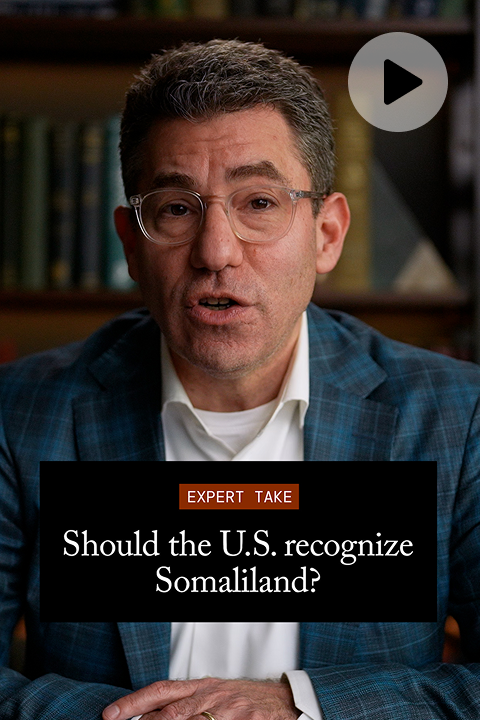
Video: Should the United States Recognize Somaliland?

Somaliland declared independence from Somalia in 1991 but has struggled to gain global recognition. That may be changing. President Abdirahman Mohamed Abdullahi recently met with U.S. officials and policymakers in New York and Washington to make the case for U.S. recognition, CFR’s Steven Cook explained in a new YouTube Short.


Somaliland is located in a strategic position, across the Gulf of Aden from Yemen, where the Houthi rebels now control the Bab el-Mandeb Strait. “American interests could be served as a result of recognizing Somaliland’s independence,” Cook said. Yet overall, the international community is still strongly opposed to recognizing Somaliland.

Watch the video
 
Video: CFR Expert Steven Cook on Somaliland Recognition Efforts
 

CFR Spotlight: Culture Under Fire

The Mariupol Drama Theater was destroyed in the third week of the war. It was rebuilt and reopened with a Soviet-era performance.

Yesterday’s Daily Brief told you about Russia’s attack on the National Academy of Sciences in Kyiv. It’s part of a pattern: as Russian bombardments of Ukraine have increased over the past few months, experts say Moscow has targeted cultural sites with no military value.


Former CFR writer Mariel Ferragamo examined the attacks on Ukraine’s cultural sites in a visual story published today. The campaign is still strategic, Ukrainians and outside experts told her. “Without a culture, you can’t have a nation,” said Małgorzata Ławrowska-von Thadden, a Ukrainian museum expert.

Read more on CFR.org
 

Regional Roundup

Every day, the Daily Brief brings you a curated list of the top stories from around the world.

Africa

  • South Africa Summons U.S. Ambassador. The government summoned Brent Bozell for the third time since he assumed the post in February over “undiplomatic conduct,” an unnamed official said. Relations between Pretoria and Washington are currently strained.
  • Burundi to Accept Third-Country Deportees. The East African nation said it had agreed to accept deportees from the United States without ties to Burundi. Details remained sparse.

Americas

  • United Nations Extends Haiti Force for Six Months. The UN Security Council voted to extend its Gang Suppression Force’s mandate until March 2027. The force has struggled as violence continues in the country, while operating at about one-third of its planned size. Thousands more troops could arrive in upcoming months. 
  • Federal Trade Commission Reportedly Opens Investigation Into U.S. AI Companies. The probe will look into whether Anthropic, OpenAI, and other technology giants broke federal laws or harmed consumers.

Asia Pacific

  • AP: Afghanistan Claims It Killed Dozens of ‘Insurgents’ Near Pakistan Border. The defense ministry claimed government forces killed and captured dozens of people crossing from Pakistan, including members of the self-declared Islamic State, the news agency reported. Pakistan did not immediately comment but has denied similar claims in the past.
  • Journalist Arrested in Hong Kong Over Alleged Sedition. The arrested journalist was identified by the South China Morning Post and local news outlets as Tang Ho-wing, the founder of an online media outlet. The arrest raised concerns about press freedom under recent national security laws.

Europe

  • UK Says ‘Strong Indication’ Iran Played Role in Foiled Air Base Plot. British Prime Minister Andy Burnham said today the United Kingdom had “strong indications” that Iran was involved in an alleged plot to attack a U.S.-run air base in England this weekend. An investigation is ongoing.
  • UK and France Set to Abandon Migration Deal. A deal allowing the UK to send some migrants who crossed the English Channel back to France in exchange for accepting an equivalent number of asylum seekers will expire tomorrow. Negotiations to extend it stalled over France’s desire for a Europe-wide deal.

Middle East

  • FlyDubai Plane Makes Emergency Landing After Pilot Stabbing. A flight headed from Dubai to Tel Aviv landed in Saudi Arabia after one pilot tried to stab the other mid-flight. The plane plunged several thousand feet as passengers and crew sought to subdue the attacker and stabilize the aircraft.
  • Iran Says It Has Received Latest U.S. Counterproposal. Iranian Foreign Minister Abbas Araghchi presented the U.S. response to Tehran’s recent proposal to end the war during a cabinet meeting today, a government spokesperson told state media. Details about the response were not immediately reported.
 

Regional Roundup

Host: Ivana Saric
Editor: Xian Chiang Waren
Email Operations: Eric Rojas
Editorial Director, News: Phil McCausland
Editor-at-Large: Robert McMahon
Chief Digital Content Officer: Millie Tran


Council on Foreign Relations

58 East 68th Street, New York, NY 10065

1777 F Street, NW, Washington, DC 20006

Shop the CFR Store

Facebook | X | Instagram | LinkedIn | YouTube

 Manage Your Email Preferences | View in Browser