|
|
|
|
Good morning. It’s not usually a good sign when bonds are in the headlines. But despite the risks, a contrarian take has emerged. Maybe now is actually the time to invest. We explore the idea in today’s edition, but first: |
|
|
|
|
|
|
|
|
|
|
|
|
|
|
|
|
|
|
|
|
|
|
Tariffs: According to trade experts and an analysis by The Globe and Mail, Ottawa’s remissions system could blunt the impact for importers caught up in the tariff trade war. |
|
|
|
|
|
|
|
|
|
|
|
|
|
|
|
|
|
|
|
|
|
When bonds are in the headlines, it’s rarely a good sign. But a contrarian take is that it's the right time to get into bonds. Reuters
|
|
|
|
|
|
|
|
|
|
|
An argument for getting into bonds |
|
|
|
|
What if you were offered an investment that yielded annual returns of 5.3 per cent over the next decade? It could be worth a look, right? |
|
|
|
|
Well, it’s your lucky day. Not only is that investment widely available, but it comes from the deepest and most liquid market of them all: U.S. Treasuries. |
|
|
|
|
Financial markets have been gripped by the daily movements of bonds for weeks, and usually with a heavy dose of concern. On Tuesday, for example, the 30-year U.S. Treasury yield rose to above 5.6 per cent, its highest level since 2002. (Standard disclaimer: Bond yields move inversely to prices.) |
|
|
|
|
|
|
|
|
By now, the reasons for the bond selloff are well known, from profligate government spending (especially in the United States) to competition from the massive financing needs of artificial intelligence companies to the persistence of inflation, which has forced many central banks to raise interest rates, with others soon to follow. |
|
|
|
|
It’s a standard rule in financial media that, when bonds are in the headlines, it’s rarely a good sign. But even as investors fret about the outlook, a contrarian take has emerged: Maybe it’s the right time
to get into bonds. |
|
|
|
|
“Investors buying fixed income today earn high levels of income, providing a substantial cushion against future yield increases,” Roger Hallam, global head of rates at investment giant Vanguard, said in a research note. (Remember that a yield increase means a price decline, so a bond’s coupon payments are providing a cushion against that decrease in price.) |
|
|
|
|
Some analysts and commentators have recently pointed to bonds with shorter maturities, which offer a sizable yield that isn’t much lower than longer-dated bonds. The two-year U.S. Treasury yield, for instance, was recently near 5 per cent, versus around 5.3 per cent for the 10-year Treasury. |
|
|
|
|
Hypothetically, if you invested $10,000 in a two-year bond at 5 per cent and held it to maturity, you’d wind up with $11,000 (comprising your initial $10,000 and $1,000 in interest). If inflation averaged 3 per cent over that time, you’d enjoy a 2-per-cent real return. That doesn’t sound like much, given the outsized gains on equity markets in recent years. But that could prove a nice hedge if something does go awry in the stock market. |
|
|
|
|
Of course, risks abound. Bond prices could continue tumbling. For many investors, their exposure to bonds is through ETFs, which have been duds. Through Tuesday’s close, the iShares 20+ Year Treasury Bond ETF has tumbled 7.4 per cent this year with distributions included, while the BMO Aggregate Bond Index ETF is down 0.8 per cent. |
|
|
|
|
The Iran war is seemingly not close to a resolution, adding pressure to U.S. government finances – not to mention energy prices. Too-hot inflation could very well chip away at fixed-income returns. |
|
|
|
|
Still, for the buy-and-hold investor, there is something tempting about the yields on offer, which in some cases, haven’t been seen in decades. |
|
|
|
|
While returns this year have been crummy, “I would argue that looking forward, the case for owning fixed income has become more compelling,” Hallam said. |
|
|
|
|
|
|
|
|
|
|
|
|
|
|
|
|
|
|
|
|
|
|
|
|
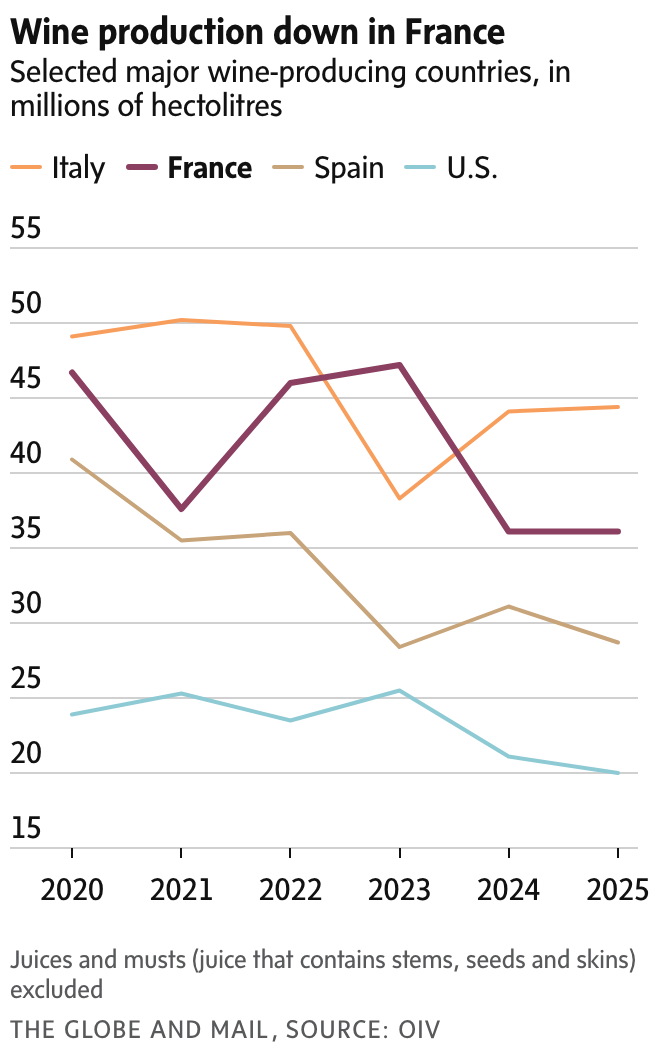
France’s wine growers are bracing for disaster from climate change and dwindling demand. Agriculture officials expect this year’s grape harvest to be one of the lowest in 30 years and the country’s overall wine production is forecast to be 60 per cent lower than its peak in 1979. Paul Waldie reports from Bordeaux. |
|
|
|
|
|
|
|
|
|
|
|
|
|
|
|
|
 |
If you do not include Indigenous people from the beginning, in all projects, you may run into trouble later. — Mark Podlasly, CEO of the First Nations Major Project Coalition |
|
|
|
|
|
|