| | In tonight’s edition: a barrage of scoops from the oldest and newest parts of this industry.͏ ͏ ͏ ͏ ͏ ͏ |
| |  New York New York |  San Francisco San Francisco | Washington |
 | Media |  |
| |
|
 - Cash for AI coverage
- The Atlantic’s podcast pickle
- Democracy Docket’s spread
- Mixed Signals
- Ellison’s next task
- Trusting Republicans
|
|
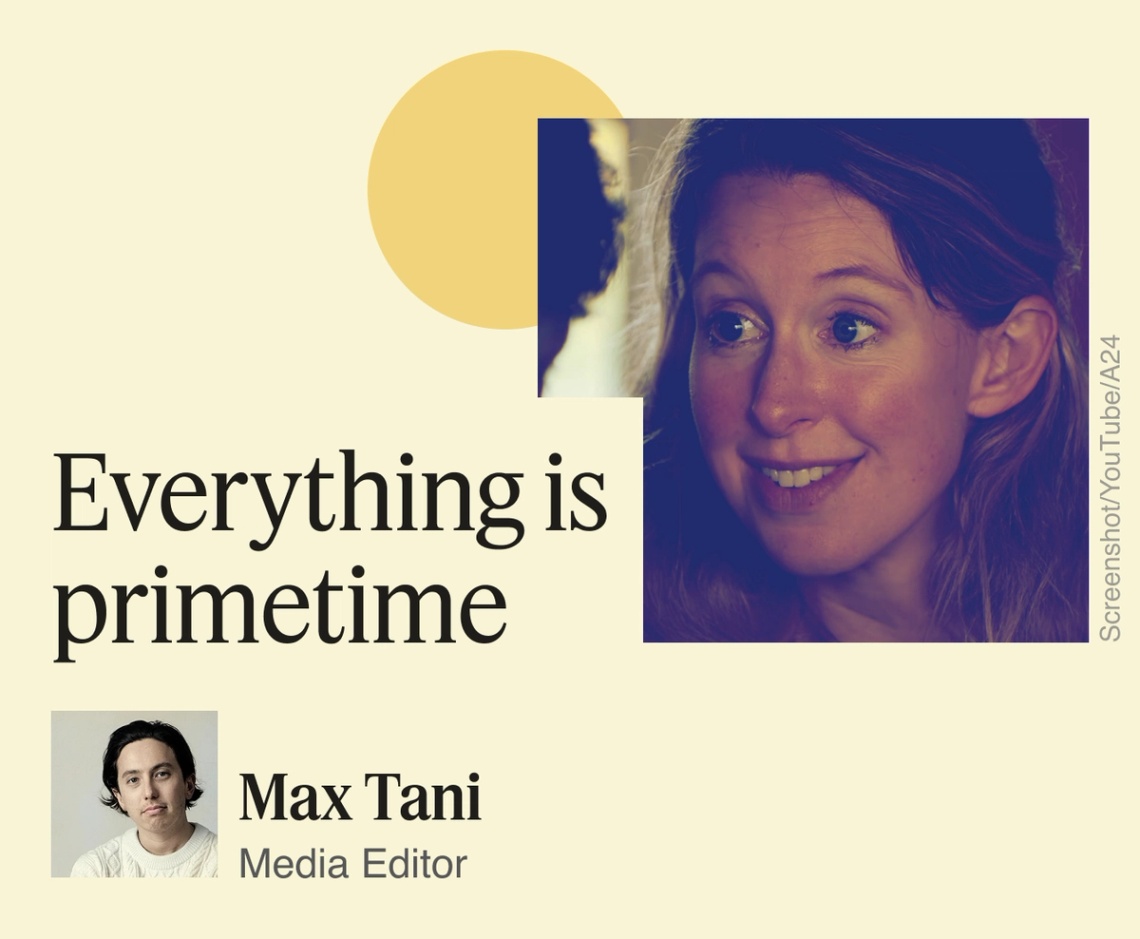 As the American right likes to say: Maybe you don’t hate the media enough. That’s how some people may feel after watching two major new films from buzzy 30-year-old director Lance Oppenheim. The first is Primetime, a dramatized account of the rise and fall of To Catch A Predator and its host, Chris Hansen, whom the film portrays as an exploitative villain for the ruthless lengths he goes to entrap, expose, and humiliate alleged creeps and predators for television ratings. The other is You Can See Everything, the new documentary from Oppenheim and Nathan Fielder, which chronicles Theranos founder Elizabeth Holmes’ final days before prison. The film offers a glimpse at how hard it can be to grasp a subject — even with remarkable access. Fielder serves as the movie’s anti-Hansen, attempting to understand Holmes and her mindset through a journalistic, at times removed approach. But he grows increasingly frustrated as he attempts to parse her cryptic comments and studied and bizarre mannerisms. At the film’s packed New York City debut last week, Fielder acknowledged his own bewilderment at the project and its subject. The movie also explores the complications of onscreen dramatizations themselves with a remarkable riff on the Hulu scripted series about Holmes, but I won’t spoil the bit. As journalism has come under political attack over the last decade, Hollywood has rushed to our defense with films like 2016’s Spotlight and 2022’s She Said, paeans to heroic reporters. This year Oppenheim, a former New York Times documentarian himself, is here to remind America of the media’s dark side. Also today: a barrage of scoops from the oldest and newest parts of this industry. |
|
Nonprofit to offer big grants for AI coverage |
 Screenshot/Tarbell Center for AI Journalism; Screenshot/Machine Gods Screenshot/Tarbell Center for AI Journalism; Screenshot/Machine GodsThe Tarbell Center for AI Journalism, a nonprofit close to the AI safety movement, plans to announce that it is launching a $10 million fund for grants to newsrooms and other ambitious AI reporting projects. The first recipient is Machine Gods, NPR’s new video podcast from former Hard Fork hosts Kevin Roose and Casey Newton, which is receiving a $480,000 grant from the organization. Tarbell is also separately backing NPR’s “Power and Influence” desk, giving the public media outlet $250,000 to help expand its coverage of how AI intersects with politics, money, and power. “We think that having resources at newsrooms is an important part of ensuring strong coverage,” Executive Director Cillian Crosson told Semafor. The organization, which is backed by groups including the deep-pocketed nonprofit Coefficient Giving, said it plans to fund investigative teams, AI verticals at national outlets, and other large-scale initiatives in new and legacy media. In particular, the organization is focused on expanding reporting on frontier companies and on the ways that AI companies and aligned political action groups are influencing American politics and tech regulations. Grants will range between $50,000 and $500,000, but Tarbell said it could make multimillion-dollar grants for the right projects. |
|
Tensions inside The Atlantic |
 Screenshot/YouTube/Nicholas Thompson Screenshot/YouTube/Nicholas ThompsonAtlantic CEO Nicholas Thompson was talking about the media business on Vox’s Channels podcast last month when host Peter Kafka asked him: How was the magazine’s editor-in-chief, Jeffrey Goldberg, feeling about the growing success of Thompson’s personal podcast? “We make a lot of money on the stuff I do,” he said. “Jeff likes when we make money.” Thompson’s podcast, The Most Interesting Thing in AI, has been a particular source of friction between Thompson and Goldberg, four people familiar with the situation told Semafor. The show is made by the magazine’s business side, and features interviews with technologists and business leaders, interspersed with sponsored content. But the magazine’s journalists have complained that it is not subject to The Atlantic’s editorial rules, input, or oversight, even though a casual listener could easily take it for an Atlantic editorial product. Other staffers say the CEO’s bookings of blockbuster podcasts guests like OpenAI CEO Sam Altman are, intentionally or not, undercutting the newsroom’s own efforts. |
|
 Marc Elias has argued dozens of cases around mail-in balloting and election access across the country and in front of the Supreme Court over the last decade. But he’s found surprising success with his side hustle: overseeing the Trump-skeptical legal news site Democracy Docket. What began as a listserv meant to help Democrats understand complex redistricting cases has grown into a serious media operation. Last month, Democracy Docket surpassed 500,000 free email subscribers, the company first told Semafor, including 70,000 subscribers paying $10 a month or $120 per year. The company also has a YouTube channel with more than 800,000 subscribers, a following that has grown significantly in Donald Trump’s second term. “In this era where so many political disputes, so many public controversies, really wind up in court, and oftentimes the court arguments frame the public debate — I think lawyers have an obligation to speak directly and plainly in language that everyone, non-lawyers and lawyers alike, can understand,” Elias said. |
|
An actor explains the microdrama boom |
 The actor Kasey Esser recently found himself editing a script on the fly: His on-screen wife had a fever, and he was supposed to touch his forehead to hers to take her temperature — because the Chinese screenwriter hadn’t realized Americans take their sick loved ones’ temperatures with the backs of their hands. Esser is a big star in the growing world of microdramas — vertical video serials driven by old-fashioned cliffhanger plots that are a huge business in Asia and growing fast in the US. They got 6.5 billion views on YouTube in the first half of 2026, up more than 50% from the previous year, Puck’s Matt Belloni recently reported. They also represent an unusually direct cultural import from China, whose entertainment industries — unlike the rest of China’s export-driven economy — have long punched below their weight. We talked to Esser about what it’s like inside this fascinating new hybrid media machine on the latest Mixed Signals. |
|
 Caroline Brehman/Reuters Caroline Brehman/ReutersDavid Ellison has his prize. Now he has to figure out what to do with it. The combined Warner Bros.-Paramount entity — rechristened Skydance — has to sort through personnel issues, uneasy talent, and a mountain of debt. On the personnel front, as Semafor scooped earlier this week, Ellison was able to poach Mattel CEO Ynon Kreiz to serve as his co-CEO. Kreiz will report directly to the board and will be able to go to them if he and Ellison disagree, theoretically giving him more equal footing. (He’ll also notch north of $40 million for his troubles.) Ellison will also hold onto Casey Bloys, the executive behind HBO’s programming. Bloys reportedly made it clear that he wasn’t interested in sharing the job with anyone else, something that may have precipitated Paramount programming boss Cindy Holland’s decision to leave. If Ellison’s personnel picture looks rosy, his financial picture looks decidedly not. Despite robust demand for his investment-grade and junk debt, Paramount’s $55 billion debt offering — the largest ever — opened with a thud, as traders, saddled with more Skydance debt than they knew what to do with, frenetically sold it off. That led to some early jitters and some extremely unhappy phone calls from investors, and prompted both Skydance’s CFO and one of its top bankers to calm the waters a little bit. — Rohan Goswami |
|
Media’s image recovers with the right |
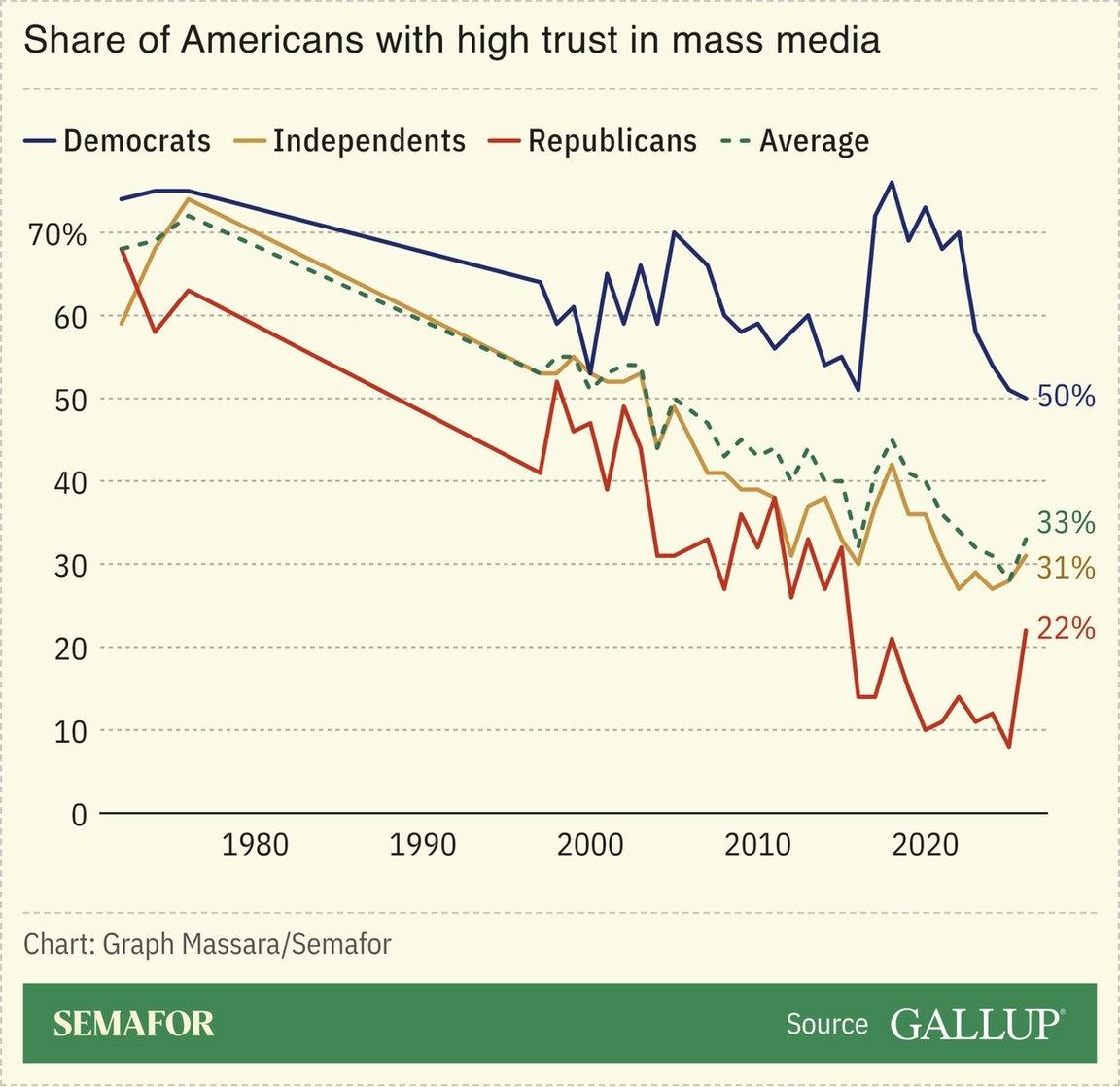 Republicans’ trust in news media has improved since last year’s all-time record low, according to Gallup polling. A still-demoralizing 33% of Americans say they have at least a “fair” amount of trust in the media, up from 28% in 2025. But Republicans’ confidence shot up from 8% to 22% in the same timeframe — a period during which the mainstream news media felt political, social, and corporate pressure to move to the right, as the Trump administration restocked the press pool with right-leaning outlets and retaliated against critical reporting. Nine in 10 Republicans now also say the US has “a lot” of press freedom, while 57% of Democrats and 68% of independents say the same. — Graph Massara |
|
 Media is being reshaped by two powerful forces: the rise of the creator economy and the rapid evolution of AI. Once disruptive forces, both are now central to how media is created, distributed, and consumed. On Thursday, November 5, Semafor Co-Founder & Editor-in-Chief Ben Smith and Media Editor Max Tani will host The New Media & Marketing Playbook, convening leaders including Ben Davis, Senior Partner & Co-Head of Digital, WME, and Melissa Hobley, Chief Marketing Officer, Tinder, to explore how creators and AI are converging and what it means for the future of media and marketing. NYC | November 5 | Request Invite |
|
NPR: The families of a photographer and a Ukrainian translator killed while traveling with a Fox News war correspondent blame the network for their deaths, David Folkenflik reports. |
|
|


