





Let’s get into it. Happy Monday.
|

Join Will Sommer and Sam Stein for MAGA Mondays today at 10:00 a.m. EDT on Substack and YouTube.
 |
Grief and Fear in Two Ohios
by Andrew Egger
Springfield, Ohio—
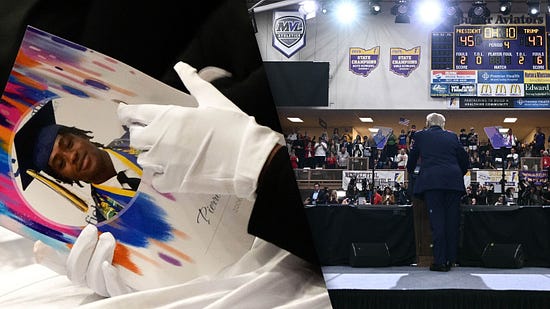
They buried Pierre Damas Bel on Saturday. That night, Donald Trump came to town to take a victory lap on the policies that killed him.
It’s been a bit more than a month since Bel, a 20-year-old Haitian who had come to the United States legally as a high schooler in 2024, threw himself under a truck on the interstate—a death of despair following the revocation of his legal status by the Trump administration this summer. Among the hundreds gathered to mourn Saturday at Springfield’s St. John Missionary Baptist Church, the grief was still raw and immediate.
The banners on the church walls proclaimed messages of scriptural comfort: “Jehovah Shammah: The Lord is always present. Jehovah Rophe: The Lord heals.” As family members audibly wailed and sobbed, the ministers asked God in English and Haitian Creole for consolation amid heartbreak.
“You are near the brokenhearted. We pray that you would draw near us today,” prayed Pastor Ernie Brown of St. John. “When questions have no answers, give them strength to trust you with what we cannot understand.”
Many unanswerable questions hung over Bel’s funeral. Here are two. How could a country extend such a shining future to a young man like him—only to shatter that future, and him, by suddenly ripping it away? And how could the president who made it happen show his face that same day, just miles down the road, not only to defend that change, but to bask in it?
Hours later, 25 miles away in the Dayton suburb of Vandalia, Trump spiked the football. “This is in honor of Springfield, Ohio,” he said, “a quaint little town of 32,000 people where they took in 35,000 people and put them into Springfield, and it didn’t work out too well. And they’re being removed.”
If there was ever a kid America’s immigration system was for, it was Pierre Damas Bel. America, to him, wasn’t just a safe haven from his broken homeland of Haiti. It was a place where he seemed destined to flourish.
Speakers recalled how Bel had distinguished himself in school, in athletics, socially, in junior ROTC, and at work. He had been bound for local Wittenberg University to play soccer on a scholarship; he intended to study neuroscience and hoped one day to open a hospital back in Haiti.
Bel couldn’t have known it, but his dream had started to die the same year he arrived—the year Republicans selected Springfield’s Haitians as their national scapegoat for Joe Biden’s immigration excesses, the year they became the targets of a million racist political lies: “They’re eating the dogs,” Trump blustered from a debate stage. “They’re eating the cats.”
This summer, the hammer dropped. The Supreme Court ruled that it couldn’t really know that Trump’s attempt to evict the Haitians was motivated by racism, so who were the justices to put up a fuss? Just like that, the way was clear for Trump to transform America’s Haitian TPS recipients from a law-abiding, integrating community into illegal immigrants—no longer able to work, get driver’s licenses, or otherwise participate in society; systematically shackled with ankle monitors, under immediate threat of getting dragged into an ICE van and deported.
Maybe the most remarkable and heartrending thing about Bel’s story was this: He kept his faith in America almost to the end. Unable to play soccer at Wittenberg because of his ankle monitor, he instead enrolled at a nearby state school, Wright State.
According to his family, the last humiliation came at Wright State’s ROTC program. Because he was not an American citizen, Bel was ineligible to become an ROTC cadet; he was participating in the program as an elective.
Perhaps, at first, he saw this as a distinction without a difference. But then came the news that he, alone among his classmates, could not receive a ROTC uniform. He had embraced America; there was no mistaking the signs that America was not embracing him back.
He wanted to wear the cloth of the country. The country put an ankle monitor on him instead. Days later, he threw himself under a truck.
None of this had had to happen. “Our dear friend and brother may have died by suicide,” said Guerline Jozef, executive director of the Haitian Bridge Alliance, at the funeral. “But he was killed by the system.”
How are the local Republicans feeling about all this? In theory, these are the beneficiaries of Trump’