
|


 |
This edition is sponsored by Christianity Today’s Week of Giving.
When I was a kid, my parents used to read the Bible to me every night before I went to bed. My favorite passage was Psalm 23; I can still recite it from memory today after hearing it so many times. Today’s set of reviews by theologian Andrew Wilson features a deep dive into Psalm 23—drawing out new insights from this familiar passage—as well as a classic by Augustine and a book on the relationship between AI, technology, and vocation.
Happy Reading,
Taylor Berglund
Senior Features Editor, Christianity Today
A portion of this newsletter appeared as a column at Christianity Today. Join CT for full access to all our journalism.
This email may contain affiliate links that help support CT at no additional cost to you.

Sponsored Content
Seventy years ago, in October 1956, the first issue of Christianity Today was mailed, and since then the ministry has helped people make sense of a changing world through a biblical lens. Wars have come and gone. Nations have risen and fallen. Culture has changed. But Jesus Christ is the same yesterday and today and forever.
Has CT helped you find clarity when the world felt confusing, challenged you to think more deeply about your faith, or reminded you that Christ is still at work in his Church? If so, will you show your support during CT’s annual Week of Giving to ensure this trusted Christian voice remains here for the next generation?
This week only, every gift will be matched up to $350,000, doubling your impact and helping the next generation have this trusted Christian voice to follow Christ faithfully. Give a special gift.
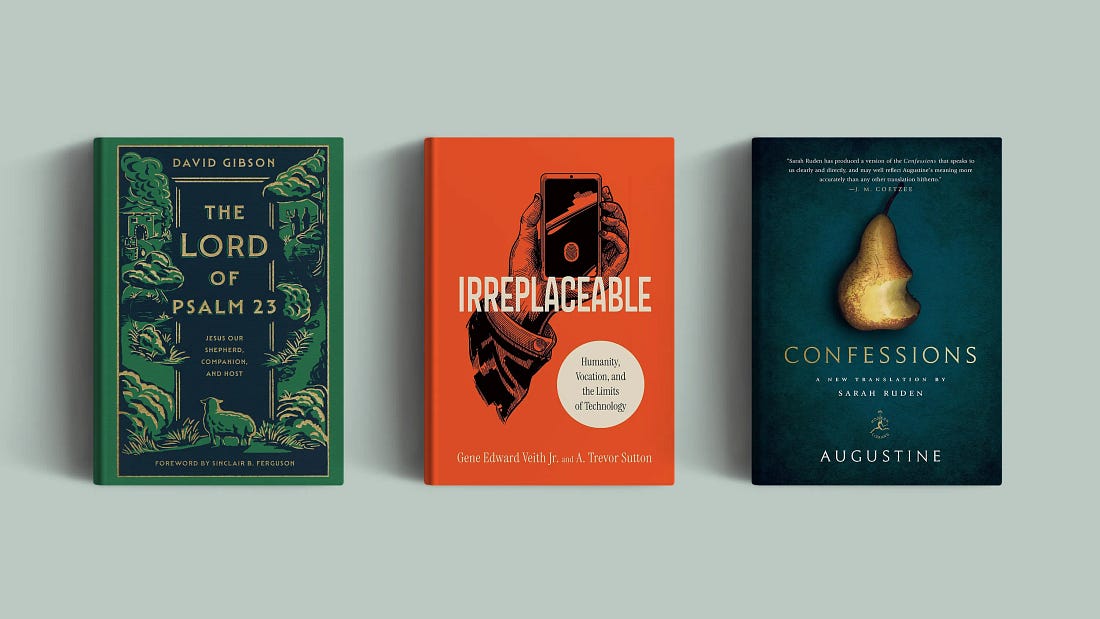 |
Three Books on Theology
Gene Edward Veith Jr. and A. Trevor Sutton, Irreplaceable: Humanity, Vocation, and the Limits of Technology (Baker Books, 2026)
Christians are writing a lot of books about technology at the moment. You can see why. Even before the extraordinary potential of AI became apparent with the launch of ChatGPT four years ago, a wide range of evangelical thinkers and authors—many of whose children who had never known a world without the iPhone—were writing books about how phones, screens and social media were undermining basic Christian goods and what we should all be doing about it. With the rollout of AI, which amplifies many of these concerns and generates plenty of new ones, that trend looks set to continue.
For the most part, that is a good thing. The interaction between our technology, our work, and our anthropology looks to be one of the defining questions of the 21st century. But the challenge for authors is how to approach the subject in a fresh and illuminating way. Without a distinctive angle, the risk (which Gene Veith and Trevor Sutton occasionally run into in Irreplaceable) is putting the same few ingredients into the blender—the creation mandate, social imaginaries, power, embodiment, Jacques Ellul, Marshall McLuhan, and Neil Postman—and producing a very familiar smoothie.