Plus: When abortion and surrogacy law collide |

US Edition - Today's top story: Nobel laureate Karl Deisseroth on how light is changing what we know about the brain

October 9, 2026

US Edition

The Conversation
 

Top headlines

Editor’s note

Nobel week is a science editor’s boon and bane.

On one hand, it might be the only time when every mainstream news outlet and their mother find themselves talking about esoteric topics like asymmetric organic synthesis. On the other hand, for anyone not on Central European Time – i.e. me, and the newly minted Nobel lareates in the U.S. – it means a lot of squinting at a glowing screen before dawn, frantically sending emails to find experts who can turn mind-blowingly elegant yet complicated science into articles that nonscientists can understand and marvel at, too.

Thankfully, we found some intrepid scientists who were up for that task.

  • For Monday’s physiology or medicine prize, we interviewed one of the winners: Karl Deisseroth of Stanford University, who shares his journey to pioneering the field of optogenetics – using light to control the activity of neurons. For more context, we reached out to neuroscientist Kimberly D'Ardenne of Arizona State University to help situate optogenetics in the long train of technological advances that have helped researchers better understand the brain.

  • For Tuesday’s physics prize, we tapped physicist Doug Cowen of Penn State to explain what the tiny particles whizzing through you, me and the cosmos – that is, neutrinos – even are, and why researchers had to build a Nobel-winning facility in the South Pole ice to study them. We also asked astrophysicist Tyce DeYoung of Michigan State University to describe what it’s like to work at the IceCube observatory.

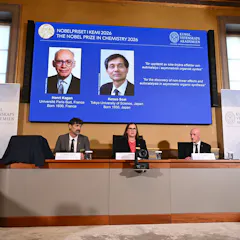
  • And, finally, for Wednesday’s chemistry prize, which honors the researchers who figured out how to selectively create one of the two mirror images that some molecules can exist as, chemists Cedric Schaack and Mallory Green of Wake Forest University go over why this discovery makes the “difference between therapeutic breakthroughs and medical tragedies.” We also asked biochemist Sajish Mathew of University of Maryland Eastern Shore how these Nobel-winning chemical reactions have played in his own work on why a compound in grapes has had inconsistent results in treating Alzheimer’s disease.

As for me and my colleagues over at the science desk? We’ll be taking a Nobel-caliber nap … until next year!


 

Vivian Lam

Associate Health and Biomedicine Editor

 
Images of smartphone on screen with text doomscrolling's worst nightmare, with a cream background

Lead story

Karl Deisseroth after winning the 2026 Nobel Prize for Medicine or Physiology. Associated Press/Alamy

Nobel laureate Karl Deisseroth on how light is changing what we know about the brain

Gemma Ware, The Conversation

From algae to a Nobel prize: listen to The Conversation Weekly podcast to hear Karl Deisseroth explain his brain science breakthrough.


Environment + Energy

Data centers make heat all year long – here’s how the ground can hold onto it until winter

Moones Alamooti, University of North Dakota

Rocks deep underground can be used to hold heat until it’s needed.

How Hurricane Isaias broke through to become the first Atlantic hurricane in an eerily quiet 2026 season

Christopher Davis, UMass Amherst

An atmospheric scientist explains what’s been going on in the atmosphere, and how El Niño and the jet stream both play important roles.

Health + Medicine

Sexual assault survivors’ stories may shift over time – a psychologist explains why it doesn’t mean they’re lying

Michele Patterson Ford, Dickinson College

The brain’s acute response to the trauma of sexual assault can block a person’s ability to accurately assess what they experienced.

International

Iraqi Kurds sees opportunities – and risks – in the withdrawal of US troops

Firmesk Rahim, UMass Boston

The region may become less of a target for groups seeking to pressure the United States. But the Kurds also have less security support now, should they need it.

What we talk about when we talk about US strategic ‘credibility’ – from Vietnam to Iran

Christopher Nichols, The Ohio State University; Kaveri Sarkar, The Ohio State University

‘Credibility is on the line’ has long been a refrain guiding U.S. foreign policy.

Science + Technology

A molecule’s ‘handedness’ can determine whether it’s an effective drug – 4 examples of pharmaceuticals where chirality matters

Cedric Schaack, Wake Forest University; Mallory Green, Wake Forest University

The 2026 Nobel Prize in chemistry gave a hand to handed molecules – and the processes chemists use to create them.

Education

Students from military families are often misunderstood in US public schools – a retired military officer and behavioral health expert explains what schools can do

Nikki R Wooten, University of South Carolina

Students from military families have specific experiences and needs that require support from their schools.

Why faculty diversity at universities still lags far behind the changing demographics of college students

Rodney Coates, Miami University

College faculties have become more diverse since the 1970s, but college faculty of color still often find that they feel marginalized among their peers.

Economy + Business

The oil market that sets today’s gas prices was invented in western Pennsylvania

Brian C. Black, Penn State

A historian traces how Oil City brokers, then John D. Rockefeller, then futures exchanges decided what the world pays for crude – and why no one entity does today.

Politics + Society

When abortion and surrogacy law collide, contracts can’t answer the hardest questions

Sonia Suter, George Washington University; Naomi Cahn, University of Virginia

A custody battle over a newborn with a heart condition raised a question courts have rarely faced: Can anyone be forced to end a pregnancy?

Trending on site

The Conversation's News Quiz

Francis Halzen, who has been awarded the 2026 Nobel Prize in physics, did much of his amazing neutrino research at a South Pole observatory that shares a name with what famous hip-hop artist?

Big Boi
Ice Cube
Coolio