Dear Colleague,
Two findings can make a case feel settled—until the patient’s story raises another question.
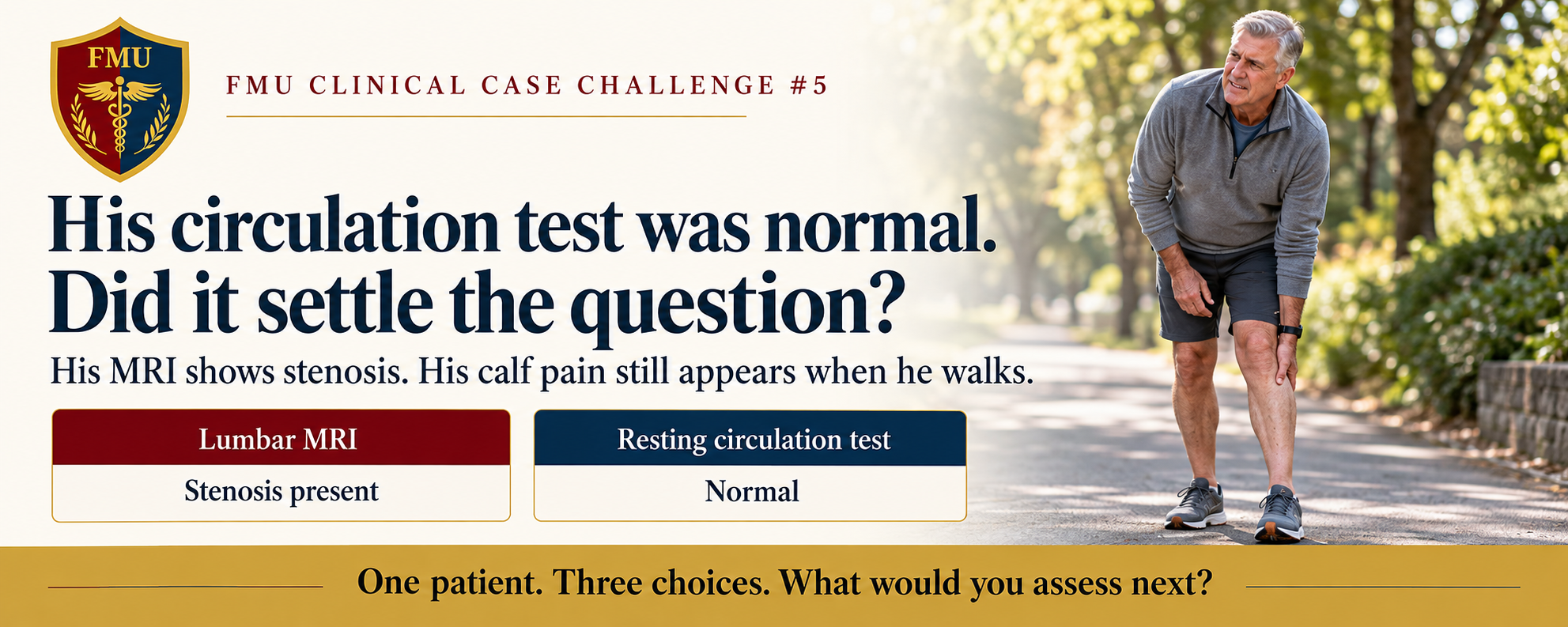
Challenge #5: His MRI shows stenosis. His resting circulation test is normal. How do you explain why his walking limitation persists?”
A 63-year-old man seeks help for low-back stiffness and right calf pain when
walking.
His lumbar MRI shows moderate central canal stenosis at L4–L5.
After several visits, his back stiffness improves—but his calf pain still limits him to approximately two blocks.
He tells you:
“My back feels better, but I still can’t walk any farther.”
As you review his symptoms, several details stand
out:
- The calf pain begins at a fairly consistent walking distance, sooner when walking uphill.
- It resolves within about three minutes of stopping—even when he remains standing upright.
- Sitting or bending forward does not provide noticeably faster
relief.
- Lower-extremity strength, sensation, and reflexes are intact.
He has hypertension and a 30-pack-year smoking history. He reports no sudden deterioration, pain at rest, or foot wounds.
His feet are
warm, and pedal pulses are palpable.
A recent resting ankle-brachial index (ABI) was reported as normal:
Right: 1.08 | Left: 1.10
No exercise ABI testing was performed.
He asks:
“My circulation test was normal. Doesn’t that mean the calf pain must be coming from my back?”
What is the most appropriate next step?
A. Accept the normal resting ABI and MRI findings as sufficient support for a spinal explanation, and continue spinal rehabilitation without further vascular assessment.
B. Coordinate exercise treadmill ABI testing to
evaluate a possible exertional vascular limitation, while continuing to assess the lumbar contribution.
C. Repeat the resting ABI first, because a vascular cause of walking pain should produce an abnormal result at rest.
Choose your answer before opening the
explanation—and identify the case details that support your choice. What does the normal test tell you, and what remains unanswered?”
SEE THE ANSWER & WHY IT FITS THIS
CASE →
Listen to Dr. Grisanti’s brief introduction and explore your free lesson →
Have a colleague who evaluates walking-related leg pain? Forward this challenge and compare your reasoning.
A Free Lesson—Plus Two FMU Resources to
Explore
On the answer page, access a free vascular examination sample lesson from FMU’s comprehensive Physical Exam Certification™ training, directly related to this
case.
You can also explore the dedicated pages for our Physical Exam Certification™ and Clinical Implementation System™ to see how FMU connects clinical assessment with patient planning and follow-up.
Warmly,
Ron Grisanti, D.C.
Founder, Functional Medicine University
P.S. Before letting a test result settle the story, ask: “Did the assessment match the
circumstances that bring on the symptoms?”
P.P.S. Explore FMU’s professional recognition and educational credentials, review the curriculum, and meet the instructors: Explore FMU.