Quality Payment Program Small Practices Newsletter: October 2026
Quality Payment Program Small Practices Newsletter: October 2026
The Quality Payment Program (QPP) Small Practices Newsletter is a monthly resource that provides small practices (15 or fewer clinicians) with program updates, upcoming QPP milestones, and resources to support their continued participation and success in QPP, including the Merit-based Incentive Payment System (MIPS). The newsletter is disseminated on the second Tuesday of each month.
Please share this newsletter with your fellow clinicians and practice staff and encourage them to signup to receive this monthly resource.
At-a-Glance: Required and Recommended Activities for Successful Participation in QPP
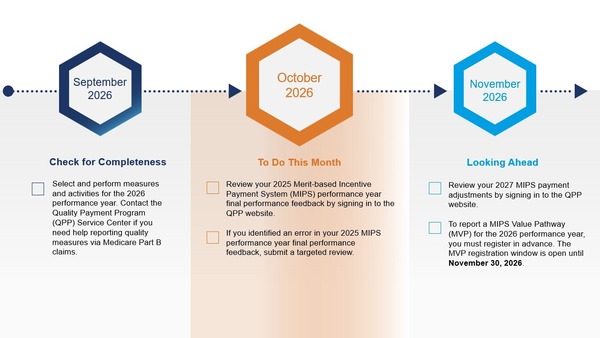
Each month, we share required and recommended activities for small practices to support their successful participation in QPP. The activities follow a rolling quarter approach, letting you see activities for the previous month, the current month, and the following month.
The Centers for Medicare & Medicaid Services (CMS) is committed to providing support to small practices. Visit (and bookmark) the Small Practices webpage of the QPP website for information tailored to small practices about relevant program updates, upcoming milestones, and resources to support your successful participation in QPP.
For support collecting and submitting program data, you may choose to work with a third party intermediary.Qualified Clinical Data Registries (QCDRs) and Qualified Registries are the only third party intermediaries approved by CMS to submit data on behalf of clinicians and practices.
CMS approved third party intermediaries are one option for collecting and submitting your data, but you don’t have to use a third party to submit your data. For more information about working with a QCDR or Qualified Registry, refer to the 2026 MIPS Guide to Using a QCDR or Qualified Registry (PDF).
Finding a QCDR or Qualified Registry
To find a list of QCDRs and Qualified Registries that are approved by CMS to submit data, visit the QPP Resource Library, type “qualified posting” in the search bar for the most up-to-date qualified posting list of QCDRs and Qualified Registries (as the qualified status may change) for the current performance year.
The QCDRs and Qualified Registries included in these postings are the only third party intermediaries that are approved by CMS to submit data on behalf of MIPS eligible clinicians and groups.
If you receive an unsolicited offer from a consultant offering assistance with data submission for the 2026 performance year, refer to the 2026 QCDR Qualified Posting (XLXS)and the 2026 Qualified Registry Qualified Posting (XLXS) to confirm whether the organization has been approved by CMS to submit data on behalf of clinicians.
Data Submission
If you decide to work with a QCDR or Qualified Registry, they can submit your data for you; however, you’re responsible for validating the data submitted on your behalf by the QCDR or Qualified Registry before it is submitted.
Third party intermediaries can upload a file (QRDA III or QPP JSON) or use the QPP Submission Application Programming Interface (API).
They can’t manually enter data.
Important Note: As stated above, even if a QCDR or Qualified Registry submits data on your behalf, you’re responsible for the data submitted. We strongly recommend that you sign into the QPP website during the submission period to ensure your data is true, accurate, and complete.
You can’t correct or resubmit data after the data submission period closes.
CMS has released MIPS performance feedback and final scores for the 2025 performance year.
Your 2025 final score determines the payment adjustment you’ll receive in 2027.
2027 MIPS payment adjustments will be available in November 2026.
How Do I Access Feedback?
Sign in to the QPP website using your Health Care Quality Information Systems (HCQIS) Access Roles and Profile (HARP) system credentials; these are the same credentials that allowed you to submit your 2025 MIPS data.
Click “View Feedback” on the home page and select your organization (Practice, Alternative Payment Model (APM) Entity, Virtual Group). Practice representatives can access individual group feedback. Third party representatives can’t access final feedback or payment adjustment information.
If you don’t have a HARP account or QPP role, please refer to the Register for a HARP Account and Connect to an Organization documents in the QPP Access User Guide (ZIP) and start the process now.
Individual clinicians, groups, subgroups, virtual groups, APM Entities (including Shared Savings Program Accountable Care Organizations [ACOs]), designated support staff, and authorized third party intermediaries may request that CMS review their MIPS final scores through a process called “targeted review.”
When to Request a Targeted Review
The targeted review period will be open for approximately 60 days. Targeted review opens with the release of final scores and will close 30 days after the release of MIPS payment adjustments. We’ll announce the release of MIPS payment adjustments through the QPP listserv in approximately one month.
If you believe there’s an error in the calculation of your MIPS final score, you can request a targeted review now.
For example:
Data was submitted under the wrong Taxpayer Identification Number (TIN) or National Provider Identifier (NPI).
You have Qualifying APM Participant (QP) status and shouldn’t receive a MIPS payment adjustment.
Performance categories weren’t automatically reweighted even though you qualify for reweighting due to extreme and uncontrollable circumstances.
Note: This isn’t a comprehensive list of circumstances. If you have questions about whether your circumstances warrant a targeted review, please contact the QPP Service Center by phone at 1‑866‑288‑8292 (TRS: 711) or by email at QPP@cms.hhs.gov.
How to Request a Targeted Review
To access your MIPS final score and performance feedback and request a targeted review:
Sign in using your HARP credentials (ACO-MS credentials for Shared Savings Program ACOs); these are the same credentials that allowed you to submit your 2025 MIPS data.
Click “Targeted Review” on the left-hand navigation pane.
CMS generally requires documentation to support a targeted review request, which varies by circumstance. A CMS representative will contact you about providing any specific documentation required. If the targeted review request is approved and results in a scoring change, we’ll update your final score and/or associated payment adjustment (if applicable), as soon as technically feasible. Please note that targeted review decisions are final and aren’t eligible for further review.
Review these targeted review resources:
2025 Targeted Review User Guide (PDF) – This guide outlines the process for requesting a targeted review and examples for when you would or wouldn’t request a targeted review.
CMS has added CY 2024 QPP performance information in the Provider Data Catalog (PDC) and on clinician and group profile pages ofthe Medicare.gov compare tool. CMS is required to report the final scores and performances of MIPSeligible clinicians under each MIPS performance category, and both the names of Advanced Alternative Payment Models (APMs)and of eligible clinicians in Advanced APMs. Performance information for clinicians and groups is displayed using measure-level star ratings, percent performance scores, and check marks.
The following documents, available on the Public Reporting: Doctors and Clinicians Initiative webpage and on the QPP Resource Library webpage, include details about the CY 2024 QPP performance information recently added to the PDC and to clinician and group profile pages on the Medicare.gov compare tool:
If you have any questions about public reporting of clinicians and groups in the PDC and on the Medicare.gov compare tool, contact the QPP Service Center by emailing QPP@cms.hhs.gov, submitting a QPP Service Center ticket, or calling 1-866‑288‑8292 (Monday – Friday, 8 a.m. – 8 p.m. ET).
People who are deaf or hard of hearing can call 711 to connect with a Telecommunications Relay Services (TRS) Communications Assistant.