The Myth of Killer Robots |
By Ivana Saric
Digital Editor, Council on Foreign Relations |
Once the stuff of sci-fi legend, interest in—and concern about—so-called killer robots is growing as artificial intelligence (AI) advances. The problem is, there’s no real consensus on what qualifies as an autonomous weapon, but Washington and the public see the need for policies that address these systems.
CFR’s Michael Horowitz and Georgetown’s Lauren Kahn aimed to cut through the confusion with a new visual analysis. They argue that autonomy is a spectrum, not a binary, that reflects how much discretion the machines have in selecting and engaging their targets. “The question isn’t, ‘Is it autonomous?’ but rather, ‘How autonomous is it?’” they write.
Horowitz told the Daily Brief that he and Kahn wanted to write the piece to help dispel misconceptions that permeate the debate around autonomous weapons systems.
“There’s real concern about the integration of AI into weapon systems that often gets conflated with questions about AI decision support systems like Maven Smart System, and which doesn’t recognize the substantial degrees of autonomy that already exist in many modern weapon systems,” Horowitz said.
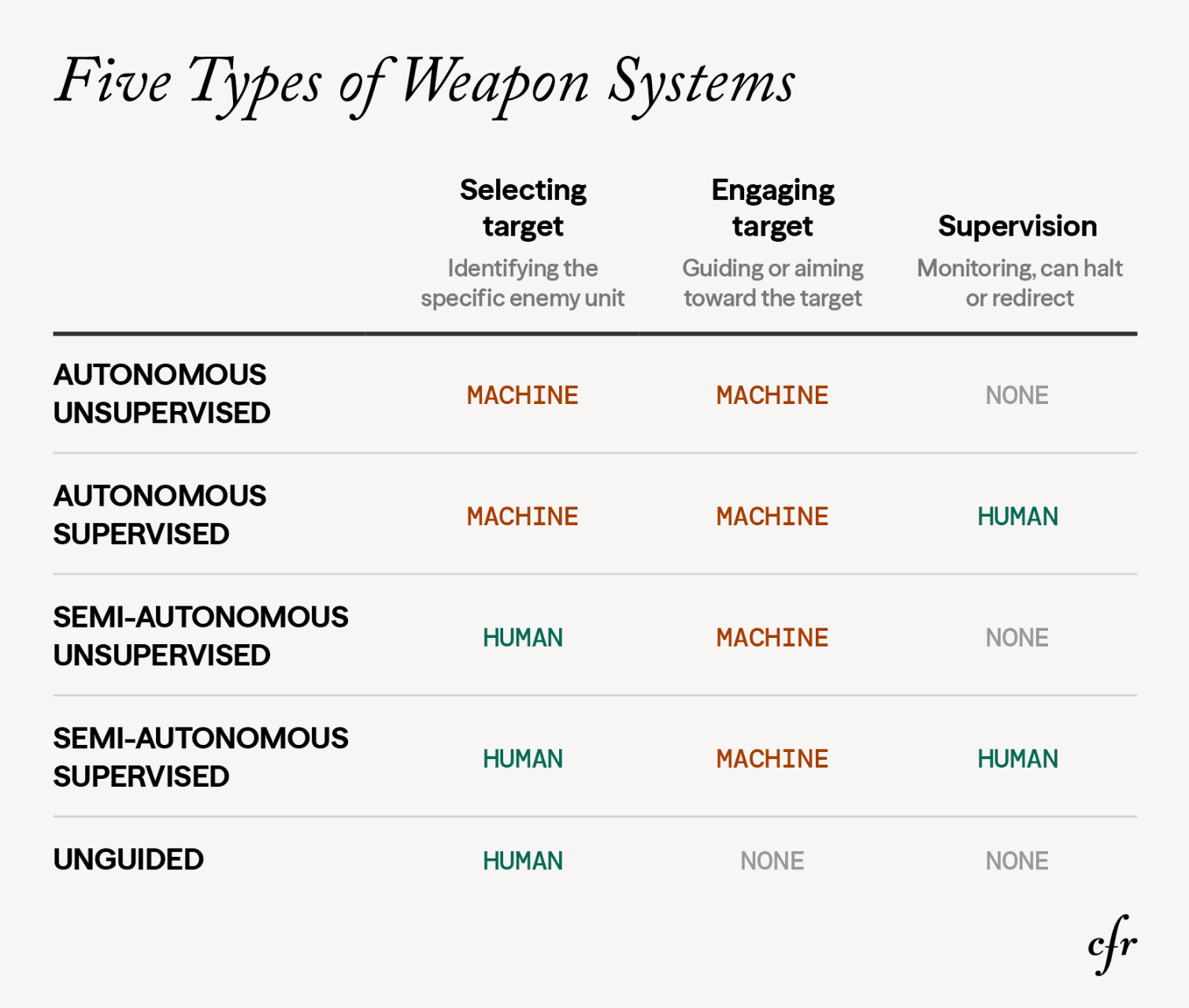
With that in mind, they laid out a guide to classify autonomous weapon systems based on the role machines play. It contains three key questions: is the machine selecting the target, is it guiding or aiming the weapon at the target, and can a human monitor and intervene? It is worth keeping in mind that these systems are only used after humans have determined that the use of force is legal, Kahn and Horowitz write.
These criteria help classify three basic types of weapon systems—unguided, semi-autonomous, and autonomous—based on whether a human or machine selects and engages a target. Semi-autonomous and autonomous weapons can be further categorized as supervised or unsupervised, based on the level of human oversight, leading to five types of systems overall. |
Horowitz said he hopes this framework will “help policy makers domestically and internationally moving forward.” Read the full analysis on CFR.org. That’s all for today. We’ll be back Monday. |
|
|
|
Heading into the weekend, the Daily Brief team is sharing a few CFR.org long reads for you to enjoy: |
|
|
|
Every day, the Daily Brief brings you a curated list of the top stories from around the world. |
-
Ethiopia Names Caretaker Government in Tigray. A six-month interim government has been established in the northern region of Tigray after recent fighting between Ethiopian forces and a rebel coalition, the office of Prime Minister Abiy Ahmed said today. The caretaker administration intends to stabilize the region to prepare for elections.
- Reuters: United States to Fund Maternal and Newborn Health Donations. The news agency reported today that the United States had agreed to a one-year deal to help fund maternal and newborn healthcare in some of the world’s poorest countries, citing a State Department source and UNICEF.
|
-
AP: Chile’s President Makes First State Visit to Bolivia in Decades. Chilean President José Antonio Kast today marked the first state visit by a Chilean leader to neighboring Bolivia in more than seventy years. Kast is scheduled to discuss issues including trade and security with Bolivian President Rodrigo Paz, as both right-leaning leaders work to build relations as the continent undergoes a political shift.
-
Brazilian President’s Reelection Campaign Wins Court Challenge Against Meta. A complaint filed by the campaign of President Luiz Inácio Lula da Silva accuses the U.S. social media company of giving challenger Senator Flávio Bolsonaro favorable treatment on its platforms, which include Instagram and Facebook. A judge ruled yesterday that Meta must take action to ensure equal treatment of the presidential candidates. Meta did not immediately comment.
|
-
China Considers New Tech Export Restrictions. Beijing unveiled a proposal today that would ban or restrict the exports of vital technologies, citing national security. The bans and restrictions would affect forty technologies related to artificial intelligence, solar energy, biotech, and more.
-
‘Cockroach’ Movement Founder Detained in India. Abhijeet Dipke was taken into custody by police ahead of a planned demonstration in Delhi today. A founder of the Cockroach Janta Party, he is the third leader of the group to be detained in recent days as anti-government protests continue in India; Saurav Das and Ashutosh Ranka were sent to jail for five days earlier this week.
|
-
U.S. Senators Call for Investigation into Ukraine’s Starlink Disruption. In a letter to the Pentagon, a bipartisan group of senators called for an “immediate investigation” into this week’s disruption of Ukraine’s satellite communications system, which is used by Ukraine’s military. It was restricted apparently without warning this week; Reuters reported yesterday that the order to limit the system may have come from within the White House, citing unnamed officials.
|
-
West Bank Settlers Attack Palestinians, Washington Post Journalist. Dozens of Israeli settlers reportedly attacked and wounded villagers today during the olive harvest, an economic lifeline for people in the West Bank territory. The Palestinian Red Crescent Society reported twenty people wounded across multiple incidents. Heidi Levine, a Washington Post photojournalist wearing a vest that said she was a member of the press, was also injured, the newspaper said in a statement.
-
Houthis Strike Yemen’s Government Headquarters. Five people were killed and sixteen others were wounded yesterday in a Houthi attack on the presidential palace in Aden, which serves as the seat of Yemen’s internationally recognized government. The Iran-backed rebel group claimed it was targeting a Saudi military operations center allegedly in the compound.
|
|
|
|
Correction: The Wednesday, October 14, 2026, edition of the Daily Brief incorrectly stated that a person shot by police in Mauritius had died. The person was wounded, not killed. We regret the error. For corrections and other feedback, write to us at dailybrief@cfr.org. |
|
|
|
Host: Ivana Saric
Editor: Xian Chiang Waren
Email Operations: Eric Rojas
Editorial Director, News: Phil McCausland
Editor-at-Large: Robert McMahon
Chief Digital Content Officer: Millie Tran |
|
|
|
58 East 68th Street, New York, NY 10065 |
1777 F Street, NW, Washington, DC 20006 |
|
|
|
|